
Furnace Installation and Replacement in Northampton, MA
Walk through a Victorian on Elm Street or a center-hall colonial off Bridge Road and you will usually find the same thing in the basement: an aging oil or propane furnace tied into a duct system that was added decades after the house was built, often undersized for the rooms it feeds. Northampton has gas service in parts of the center, but plenty of the surrounding neighborhoods still run on delivered fuel, and that single fact changes how a furnace replacement should be priced and specified here compared to a town with gas on every street.
- Powers Air HVAC, based in Granby, MA
Furnace Installation and Replacement in Northampton
We replace failing furnaces and install new ones for Northampton homeowners who have already decided that a furnace, not a heat pump, is the right call for this heating season. That is a legitimate decision. Not every house, budget, or timeline lines up with converting to electric heat right now, and a furnace that is sized correctly and installed cleanly will run for years without drama. We are not going to talk you out of a furnace replacement if that is what the house and the budget call for. We will size it properly, tell you honestly what it costs, and tell you where a heat pump might make more sense down the road if you want to hear it.
Drew handles these jobs directly rather than handing them to a crew you have never met. If you call about a furnace quote, you are talking to the person who will be doing the load calculation and, in most cases, the install.
What Northampton homes are working with
Northampton’s housing stock skews old. A lot of the center and the neighborhoods around Elm, Market, and Prospect were built before 1940, which means balloon framing, retrofitted ductwork squeezed into spaces it was never designed for, and basements with plenty of other equipment competing for room. Some of that ductwork was sized for an oil furnace with a big blower and will choke a modern high-efficiency unit if nobody checks the static pressure before swapping equipment. A furnace that looks like a straightforward replacement on paper can turn into a ductwork problem once you actually measure airflow.
Fuel source is the other variable that matters more here than almost anywhere else in our service area. Northampton has gas mains through parts of downtown and the denser residential streets near it, but a meaningful share of houses, especially as you move toward the hilltowns or into the larger lots on the edges of town, run on delivered oil or propane. If you are on gas, a furnace replacement is usually the cheapest heating option on the table and the economics of switching to a heat pump are a closer call. If you are on oil or propane, the math shifts, because you are comparing the furnace’s running cost against electricity rather than against cheap pipeline gas, and that comparison looks different than it does in a gas town. We will walk through both numbers with you rather than assume which one applies to your house.
How we size and specify the system
Every furnace quote we write starts with a load calculation, a Manual J, not a rule of thumb based on square footage or what was in the house before. Insulation, window count and condition, ceiling height, air leakage, and how the ductwork is actually laid out all affect how much heat a house needs on the coldest night of the year. Two houses the same size on the same street can have genuinely different loads.
Oversizing is the most common mistake in this industry, and it is almost always the easier sale, because a bigger furnace sounds safer. In practice an oversized furnace short-cycles, meaning it fires, blasts heat, and shuts off before it has run long enough to heat evenly or dehumidify the air it just pushed around. That means more temperature swing in the house, more wear on the blower and igniter from constant starting and stopping, and a shorter equipment life despite the bigger price tag. If someone hands you a furnace quote with a tonnage or BTU figure and no load calculation behind it, that is a warning sign, not a value.
A real quote tells you the calculated heat load, the specific unit and AFUE rating being proposed, what happens to your existing ductwork, where the venting goes, and what the whole job costs installed. Anything less than that is a guess with a number attached to it.
What the work involves
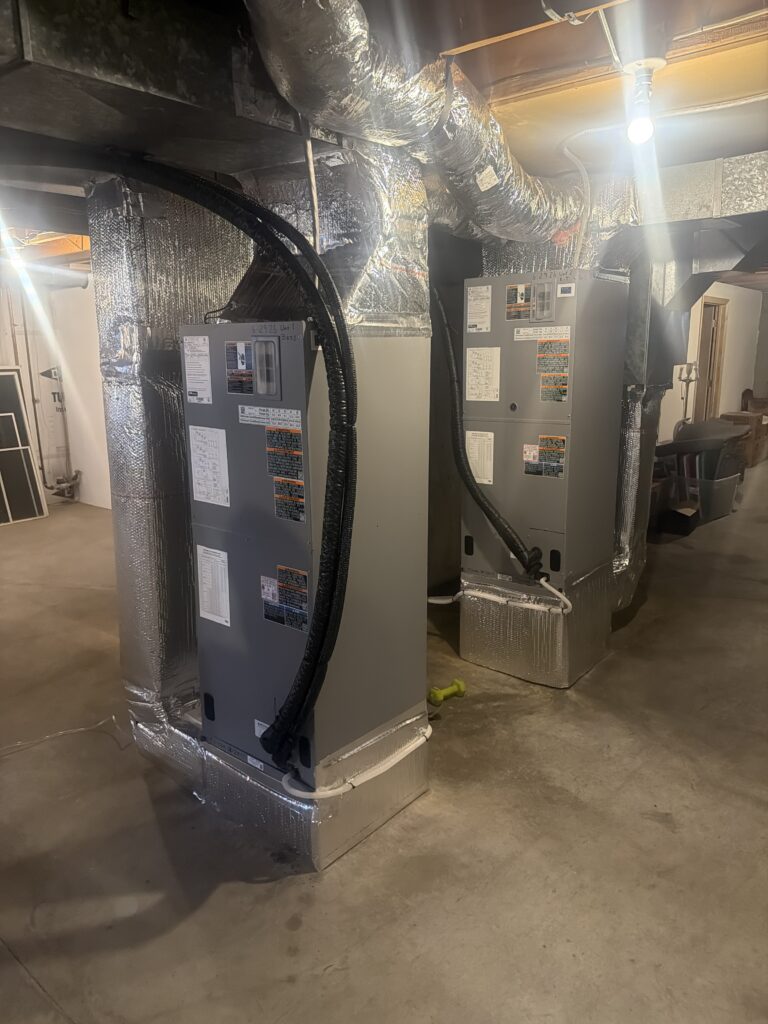
A furnace replacement starts with removing the old unit and assessing what you actually have for ductwork, venting, and fuel supply. In Northampton’s older housing, the ducts often need some modification, resizing a trunk line or adding a return, to get proper airflow to a new high-efficiency unit rather than just bolting the new furnace onto whatever was already there. Venting is its own decision: a high-efficiency condensing furnace vents through PVC rather than a chimney, which changes where it can be placed and how condensate drains away from the unit.
We also check the electrical circuit serving the furnace and the gas or oil line sizing before anything goes in, because an install that skips that step tends to surface problems later rather than on day one. Once the new unit is set, we commission it: verify static pressure, check temperature rise against the manufacturer’s spec, confirm safe combustion and venting, and walk you through the thermostat and filter setup before we leave.
- Removing and disposing of the old furnace, along with any associated oil tank or gas line modifications
- Sizing and, where needed, modifying supply and return ductwork so static pressure matches the new equipment
- Installing proper combustion air and venting: direct vent PVC for a high-efficiency condensing furnace, or a lined chimney for a conventional one
- Setting up condensate drainage for high-efficiency furnaces, which produce acidic condensate that needs to go somewhere specific, not just the nearest floor drain
- Pulling permits and scheduling the required inspections
- Commissioning the system: verifying gas pressure or oil nozzle sizing, airflow, and temperature rise against manufacturer specs before we call the job done
What it costs
Furnace installation in Northampton typically runs between {PRICE_LOW} and {PRICE_HIGH} installed, and where a given job lands in that range depends on a handful of concrete factors: the AFUE efficiency tier you choose, whether the existing ductwork needs modification or just a connection, how far the new venting has to run, whether your electrical panel has room for the furnace’s circuit without upgrades, and how accessible the install location is. A straightforward swap in an accessible basement with ductwork already in reasonable shape sits at the lower end. A job that involves resizing ducts, rerouting vent pipe, or addressing an electrical panel that is already full costs more, and we will tell you which of those applies to your house before you commit to anything.
- Whether it's a straight swap or a fuel conversion, oil to gas, oil to propane, or adding a heat pump into the mix as primary or backup heat
- Ductwork condition, and whether the existing supply and return can handle the new unit or need rework
- Venting type, direct vent versus relining an existing chimney
- Electrical service, since some high-efficiency furnaces and any accompanying heat pump equipment need panel capacity that older services don't have
- Access: basement height, oil tank removal, and how far the equipment has to travel from the truck
If you are weighing a furnace against a heat pump before you decide, it is worth having that conversation now rather than after the new furnace is installed. We will give you a straight answer on which one makes more financial and practical sense for your specific house.
Permits and Inspection
Furnace replacements in Northampton require a permit and inspection, and that applies whether the job touches gas piping, oil lines, or just venting and ductwork. We pull the permit, schedule the inspection, and handle the paperwork as part of the job rather than leaving it for you to chase down. A contractor who quotes a furnace replacement without permit costs built in is quoting a lower number by skipping a step the city requires, and that gap tends to show up later when you try to sell the house or file an insurance claim.
Rebates and incentives
Mass Save offers incentives that can apply to heating equipment upgrades, and the specifics of what qualifies and what the current incentive amounts are change often enough that we would rather point you to the source than quote you a number that might be out of date by the time you read this. You can review current program details directly at masssave.com, and our Mass Save rebate page covers how the process generally works for heating equipment. If you are deciding between a furnace and a heat pump, that is also the conversation where incentive eligibility tends to matter most, and we are glad to help you work out what applies to your specific house before you commit either way.
Get a Quote
If your furnace is on its way out or you are planning a replacement before next winter, call {PHONE} and talk directly with Drew about what your house needs. You will get a load calculation, a real recommendation, and a quote that spells out exactly what is included, not a generic estimate from someone who has not seen your basement.
frequently asked questions
Is a furnace still a good option if I eventually want to add a heat pump?
Yes. A lot of Northampton homeowners install a furnace now and add a ductless heat pump or central heat pump system later as a supplemental or primary heat source, using the furnace as backup for the coldest stretches. We can design the furnace install with that future step in mind if you tell us up front that it is part of the plan.
Do I need a new furnace just because mine is old, or can it be repaired?
Not always. If a furnace is in reasonable shape mechanically, a repair can buy you several more seasons for a lot less money than a replacement. We will tell you honestly when a repair makes sense and when you are better off putting that money toward a new unit instead.
How long does a furnace installation take?
A straightforward swap usually takes one day. Jobs that involve ductwork modifications, venting changes, or electrical panel work can take longer, and we will give you a realistic timeline once we have seen the site, not before.
Will my existing ductwork work with a new high-efficiency furnace?
Sometimes, but not always. A lot of Northampton's older ductwork was sized for equipment with different airflow characteristics than today's high-efficiency furnaces. We check static pressure before recommending a unit so you are not left with a furnace that the ducts cannot actually move air for.
Does Powers Air handle the permit and inspection?
Yes. Furnace installations require a permit and inspection in Northampton, and we handle both as part of the job rather than leaving them for the homeowner to arrange.