
Air Conditioning Repair in Holyoke, MA
Holyoke’s housing stock is overwhelmingly nineteenth and early twentieth century – triple-deckers, mill-worker rowhouses, and brick multifamilies built around steam or hot water radiators, not ductwork. When one of those buildings has central air at all, it’s usually a retrofit that was done imperfectly, and when it has a window unit or a single ductless head that’s quit in July, the call is never a maintenance call. It’s an emergency call.
- Powers Air HVAC, based in Granby, MA
If your system has stopped cooling, or it’s running constantly and the house still isn’t comfortable, call {PHONE}. Drew answers, and he’s usually the one who comes out, not a dispatcher reading off a script.
- No cold air, or air that is barely cooler than the room
- Ice forming on the outdoor unit or the line set
- Short cycling, where the system turns on and off every few minutes instead of running a full cycle
- A breaker that trips repeatedly when the AC starts
- Water pooling near an indoor unit, or a stain on the ceiling below one
- A system that has gotten noticeably louder, especially on startup
What Holyoke homes are working with
Most of the housing Powers Air gets called to in Holyoke falls into two categories. The first is the classic triple-decker or two-family mill house – balloon-framed, built before 1930, heated by a steam or hot water boiler with cast iron radiators in every room and absolutely no duct chases anywhere in the structure. If there’s cooling in a building like this, it’s almost always either window units, a single ductless mini-split head someone installed years ago to cool a bedroom, or nothing at all. The second category is the smaller stock of mid-century single-family homes on the outskirts of the city, some of which do have forced hot air and existing ductwork, usually undersized for anything beyond the furnace it was built for.
Gas service is spotty depending on the street, and a fair number of Holyoke homes still run on oil or propane for heat, which changes the math on cooling retrofits because a ductless or ducted heat pump system can offset some of that delivered-fuel heating cost in addition to handling summer cooling. Ownership matters too – Holyoke has a high rental and owner-occupied-multifamily ratio, and a landlord fixing an AC problem in a tenant unit has different priorities than a homeowner upgrading their own place. Either way, the diagnosis starts the same: what’s actually there, what it’s doing, and whether it’s worth repairing or replacing.
How we size and specify the system
Before Drew tells you whether to repair or replace, he looks at the whole house, not just the failed component. That means a load calculation, not a guess based on square footage. A Manual J load calculation accounts for insulation, window area, orientation, and the specific layout of the rooms you’re trying to cool, and it’s the only honest basis for recommending equipment capacity.
Oversizing is the single most common mistake in this market, and it’s usually sold as a feature. A bigger unit sounds safer, but an oversized system short-cycles – it blasts cold air, satisfies the thermostat, and shuts off before it’s actually removed the humidity from the room. You end up with a cold, clammy house and a compressor that’s cycling on and off far more than it should, which shortens its life. A correctly sized system runs longer, steadier cycles and actually controls humidity, which is most of what makes a house feel comfortable in a Holyoke summer.
Any quote you get should show the load calculation, the specific equipment model and its capacity, and what that capacity is based on. If a quote is just a price and a brand name with no calculation behind it, that’s the sign to get a second opinion.
- The load calculation behind the recommendation, not just a model number
- Equipment capacity at your actual design temperature, not just at the 47°F rating
- What the electrical service needs to support it, and whether the panel has room
- Line set length and routing, and what that does to performance
- What backup or auxiliary heat looks like, if the system also handles heating
Repairs in older multifamily buildings carry their own complications – tight basement access, knob-and-tube wiring nearby that needs to be respected, and in some cases electrical panels that are already maxed out before you add a condenser or an air handler. Drew flags those issues up front instead of discovering them mid-job.
What the work involves
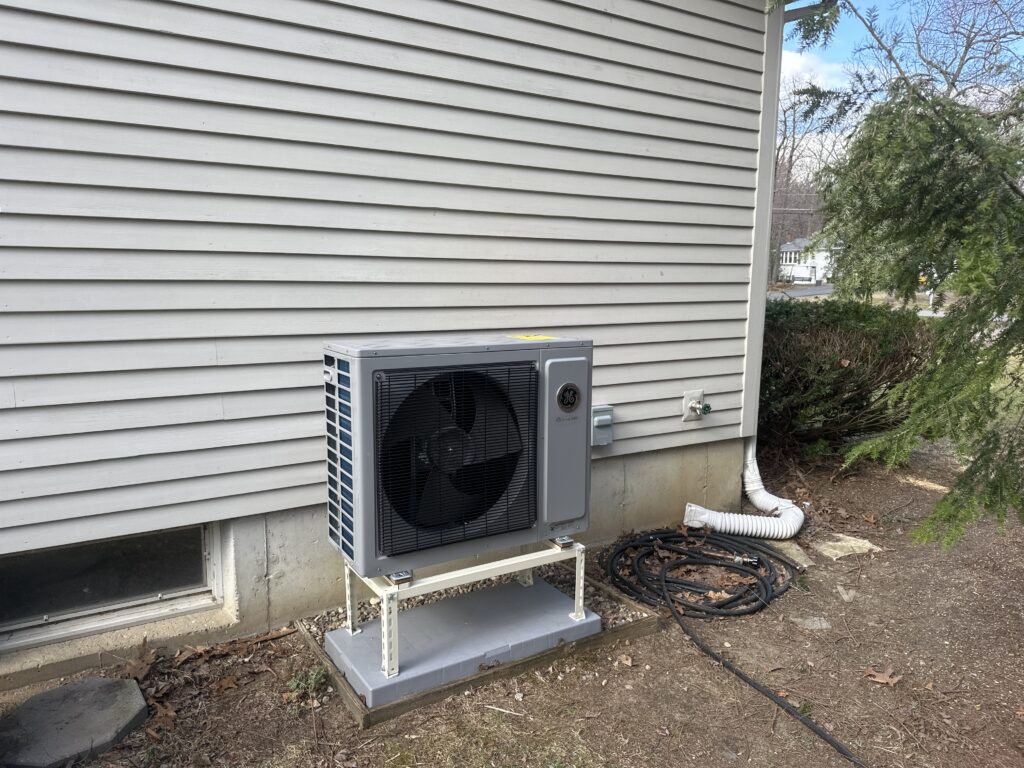
A repair call starts with diagnosis: checking refrigerant charge, electrical components, the condenser fan motor, and airflow across the coil, because a system that’s “not cooling” can fail for half a dozen different reasons and guessing wastes your money. If the fix is a capacitor, contactor, or a refrigerant leak that can be located and sealed, that’s usually a same-visit repair. If the compressor itself has failed on an older system, or the unit is using a refrigerant that’s being phased out, replacement is often the more honest recommendation than pouring money into a unit near the end of its life.
For homes without ductwork – which describes a large share of the triple-deckers and mill houses in this city – a failed window unit or a single struggling mini-split head is often the moment to look at a proper multi-zone ductless system instead of patching the old setup. That’s a different conversation than a straight repair, and Drew will tell you honestly which one you’re actually facing before any work starts.
- Checking refrigerant charge and finding the source of a leak, rather than just topping it off
- Testing the capacitor, contactor, and other electrical components that fail from heat and age
- Inspecting the condenser coil and airflow, since a restricted coil is one of the most common reasons a system runs constantly without cooling
- Checking the condensate line and pan, since a clogged line is a common cause of water damage around indoor units
- Reviewing thermostat wiring and settings, which is sometimes the actual issue behind what looks like an equipment failure
Every repair and installation Drew does that touches electrical service capacity is permitted and inspected. If a panel needs work to safely support new cooling equipment, that’s licensed electrical work performed in-house, not handed off to a sub and hoped for the best.
What it costs
Straightforward repairs – a capacitor, a contactor, a refrigerant top-off with leak repair – typically run in the {PRICE_LOW} to {PRICE_HIGH} range, though the final number depends on what’s actually wrong, how accessible the equipment is, and whether parts are readily available for the unit’s age and refrigerant type. Replacement costs move with the number of zones you need, whether you’re installing ducted or ductless equipment, how long the refrigerant line set run is, and whether the existing electrical service can support the new equipment or needs upgrading first. Access matters too – a condenser on a third-floor triple-decker roof or a tight urban side yard takes more labor than a suburban slab. Drew gives you a real number after he’s seen the job, not a phone estimate that changes once he’s on site.
- Number of zones or indoor units involved
- Whether the issue is electrical, mechanical, or refrigerant-related
- Access to the outdoor unit and any indoor equipment
- Age and condition of the system, including whether parts are still available
- Whether the underlying issue points to an electrical service or panel limitation
Rebates and incentives
Holyoke is served by Holyoke Gas and Electric, a municipal utility, which means the incentive landscape here is not identical to the Mass Save programs that apply in towns served by investor-owned utilities. There are still programs worth understanding, and the rules and amounts change, so the right move is to check current offerings directly rather than rely on anything printed on a flyer. Powers Air doesn’t issue rebates – the utility and state-sponsored programs do – but we can walk through what applies to your specific building and equipment choice. Start at masssave.com [EXTERNAL LINK: official Mass Save program site for current rebate terms] for the general statewide picture, and see our Mass Save heat pump rebates page for more on how these programs typically work.
Get a Quote
If your AC has quit in Holyoke, call {PHONE}. Drew will walk you through what’s likely wrong over the phone, get a technician out, and give you a straight answer about repair versus replacement before any work begins. No dispatcher, no sales pitch, no call center reading from a script.
frequently asked questions
Can my AC actually be repaired if my house has no ductwork?
Yes, but what you're repairing in that case is usually a window unit or a ductless mini-split head rather than central air. If the existing equipment is old or undersized, a repair call is often the right moment to look at a proper multi-zone ductless system instead.
How fast can you get to a no-cooling call in Holyoke?
Call {PHONE} and Drew will tell you honestly where you fall in the queue. Summer breakdowns are the highest-priority calls we take.
Does Holyoke Gas and Electric offer the same rebates as Mass Save?
Not necessarily. HG&E is a municipal utility and its incentive programs are separate from the investor-owned utility programs that fund most Mass Save rebates. Check current HG&E and state offerings directly for your specific situation.
Is it worth repairing an old AC unit or should I replace it?
It depends on the age of the unit, the refrigerant it uses, and what's actually failed. If it's a compressor failure on an older unit using a phased-out refrigerant, replacement is usually the more honest answer. Drew will tell you which situation you're in before recommending anything.
Do you work on AC in triple-deckers and multifamily buildings?
Regularly. A large share of our Holyoke calls are exactly this building type, and the access and electrical considerations are different from a single-family home, which is part of the diagnosis.