EV Charger Installation
- Powers Air HVAC, 2 Cedar St, Framingham MA 01702
What EV Charger Installation Involves
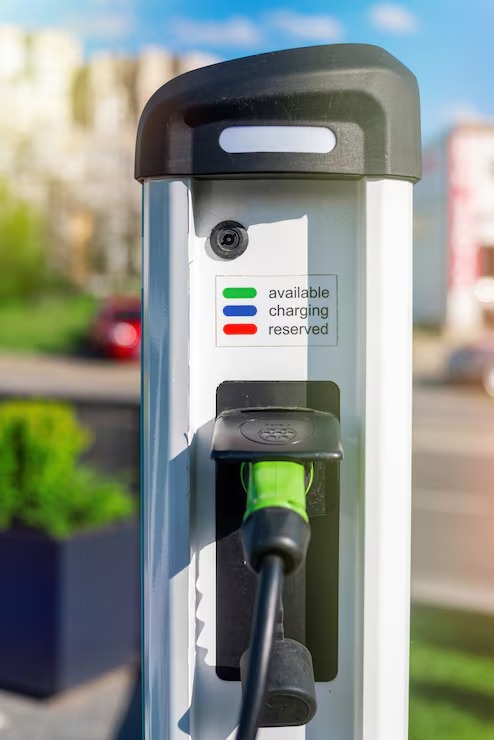
- The circuit. A dedicated 240 volt, 40 to 60 amp circuit run from your electrical panel to the charging location, sized to the charger and the car, not just to whatever breaker happens to be open.
- The charger. Hardwired to the wall, or plugged into a NEMA 14-50 outlet so you can swap chargers later without touching the wiring again.
- The panel. Whether your existing panel has the physical space and the spare capacity to add that circuit safely, or whether it doesn't.
When It Is the Right Answer and When It Is Not
This is the part most companies skip, and it’s the part that actually matters.
It’s the right answer when:
- You have off-street parking. A driveway, a carport, a garage. Level 2 charging only makes sense where the car sits in one place long enough, close enough to the house, for a fixed circuit to reach it.
- You plan to own the car for years, not months. The circuit and the charger are a fixed cost that pays off in convenience over time, not a one-off expense you want to avoid thinking about.
- Your panel has room, or can be given room, to add a 40 to 60 amp circuit without pushing your total load past what the panel is rated for.
- You park on the street. There's no safe or code-compliant way to run a permanent circuit across a sidewalk or a public way, and we'll tell you that instead of pretending otherwise.
- Your panel is already fully loaded. A 100 amp panel carrying electric heat, an electric water heater, and a range often has nothing left to give a charger without something else changing first. In that case the honest next step is a look at the panel itself, not the charger.
- You're leasing the house or expect to move within a year or two. A hardwired charger and a new circuit are a real improvement to the property, but they're not something you take with you.
- A slower charging speed genuinely covers your driving pattern. If you drive under 30 miles a day and you're not in a hurry, the outlet that came with the car may be all you need, and we'd rather say so than sell you a circuit you don't need.
How We Size and Specify
Every EV charger installation starts with the same two questions: what does the car actually draw, and what does the panel actually have left to give it.
Most home EV chargers are rated at 32, 40, or 48 amps of continuous draw. Under electrical code, a continuous load has to be sized at 125 percent of that draw when you pick the breaker and the wire, which is why a 40 amp charger needs a 50 amp circuit, not a 40 amp one. This is where a lot of DIY installs and cut-rate quotes get it wrong, either underrating the wire gauge for the run length or putting a 50 amp charger on a breaker that was never meant to carry it continuously for hours at a stretch.
On the panel side, we do a load calculation, not a guess. That means adding up what the house is already asking the panel to carry (heat, water heater, range, dryer, any existing large appliances) and comparing it against the panel’s actual rated capacity, not just counting open breaker slots. A panel can look like it has room and not have room, because the number that matters is amps available, not spaces available.
The other variable is distance. A charger fifteen feet from the panel is a different job than a charger sixty feet away in a detached garage, both in wire cost and in voltage drop over the run, and we account for that in the quote rather than finding out about it partway through the job.
Equipment and What Actually Differs Between Systems
- Hardwired versus plug-in. A hardwired charger is wired directly into the circuit with no outlet in between. A plug-in charger connects to a NEMA 14-50 outlet, the same style used for a range or a large welder. Plug-in gives you the option to unplug and replace the charger later without an electrician. Hardwired is slightly more permanent and, for some models, is what the manufacturer requires to unlock the full rated charging speed.
- Amperage rating. This is the single biggest factor in charging speed, more than brand. A 32 amp unit and a 48 amp unit on the same car can mean a meaningfully different number of miles added per hour.
- Smart features. Wifi connectivity, app-based scheduling, and load-sharing between two chargers on one property are genuinely useful for some households and irrelevant for others. They add cost and they don't change whether the underlying circuit is sized correctly, which is the part that actually matters for safety and longevity.
- Outdoor rating. If the charger is going on an exterior wall or in a detached, unheated garage, it needs a NEMA rating built for that exposure. This is an easy detail to miss on a generic quote.
What the Work Looks Like Start to Finish
- Walkthrough. We look at the panel, the proposed charger location, and the distance between them, and talk through your car's charging spec and how you actually drive.
- Load calculation. We confirm, on paper, that the panel can support the new circuit alongside everything else already on it.
- Quote. You get a specific number for the circuit run, the charger and its installation, and the permit, before any work starts.
- Permit. We pull the electrical permit with your town before the work begins. This is not optional and it's not a formality we skip to save time.
- Installation. The circuit is run from the panel to the charger location and the charger is installed, hardwired or on a NEMA 14-50 outlet as specified.
- Inspection. The town's electrical inspector signs off on the finished work. This is what makes the installation legitimate for insurance, for resale, and for your own safety, and it's the step that a cash-quote electrician skipping the permit never gets to.
What it costs
Every EV charger job has three real cost drivers: the length and difficulty of the circuit run from the panel to the charger, whether the panel has room or needs work first to make room, and which charger you choose. A fifteen-foot run to a garage right next to the panel is a different price than sixty feet through a finished basement ceiling to a detached structure, and a job that surfaces panel capacity problems is a different scope than one that doesn’t.
We quote a specific number after the walkthrough, not a range pulled from a website. If the panel needs attention before the charger can go in, that gets scoped and priced as its own line so you’re deciding on real numbers, not a guess that changes once we’ve opened the panel.
Rebates and Incentives
Permits and Inspection