
Furnace Installation and Replacement in Springfield, MA
Springfield has blocks of triple-deckers built before 1930 sitting a few streets from ranch houses from the 1960s and newer colonials pushed out toward the hill neighborhoods, and the furnace in the basement of each one is usually a different age and a different fuel than the one next door. A fair amount of the city has gas service on the street, which changes the furnace conversation in a way it doesn’t for towns further out on oil or propane, but plenty of Springfield housing stock still runs on an oil-fired system installed decades ago that’s simply outlived its welcome.
- Powers Air HVAC, based in Granby, MA
Furnace Installation and Replacement in Springfield
We run furnace installs and replacements into Springfield regularly. It’s about 13 miles from our Granby base, close enough that it’s a normal service call, not a special trip. The city is the largest market in this part of the valley by a wide margin, and that size cuts both ways: more housing variety to size correctly, and more competition between contractors quoting the job. We’d rather you understand what you’re being quoted than just take the lowest number.
A furnace replacement in Springfield isn’t a single product. It’s matching a specific appliance to a specific house, and that house could be a 1,100 square foot unit in a triple-decker on the back half of a forced-air retrofit, or a 2,400 square foot single-family with original ductwork from the 1950s that’s never been resized for a modern high-efficiency furnace. We treat those as different jobs because they are.
What Springfield homes are working with
Springfield’s housing stock splits a few ways that matter for furnace work. The older neighborhoods, Forest Park, the McKnight district, parts of the North End, carry a lot of multifamily and triple-decker construction from the early 1900s, much of it converted from steam or hot water heat to forced air at some point, with ductwork that was sized for a furnace that’s long gone. The newer single-family sections out toward Sixteen Acres and East Forest Park tend to have more consistent duct sizing but are now hitting the 20 to 30 year mark on original equipment. And because Springfield has natural gas infrastructure through much of the city, unlike a lot of the smaller towns we cover that are stuck on delivered oil or propane, gas furnace replacement is a realistic option here in a way it simply isn’t everywhere in this territory.
The other split that matters is ownership. Springfield has a higher share of rental and multifamily property than most towns in our service area, which means a lot of our furnace calls here come from landlords weighing reliability and operating cost against a tenant’s comfort complaints, not just a homeowner picking equipment for their own house. That changes the conversation. A landlord often wants the most dependable, least callback-prone equipment at a reasonable price point, not necessarily the highest-efficiency unit on the market, and we’ll say so plainly instead of upselling past what the job needs.
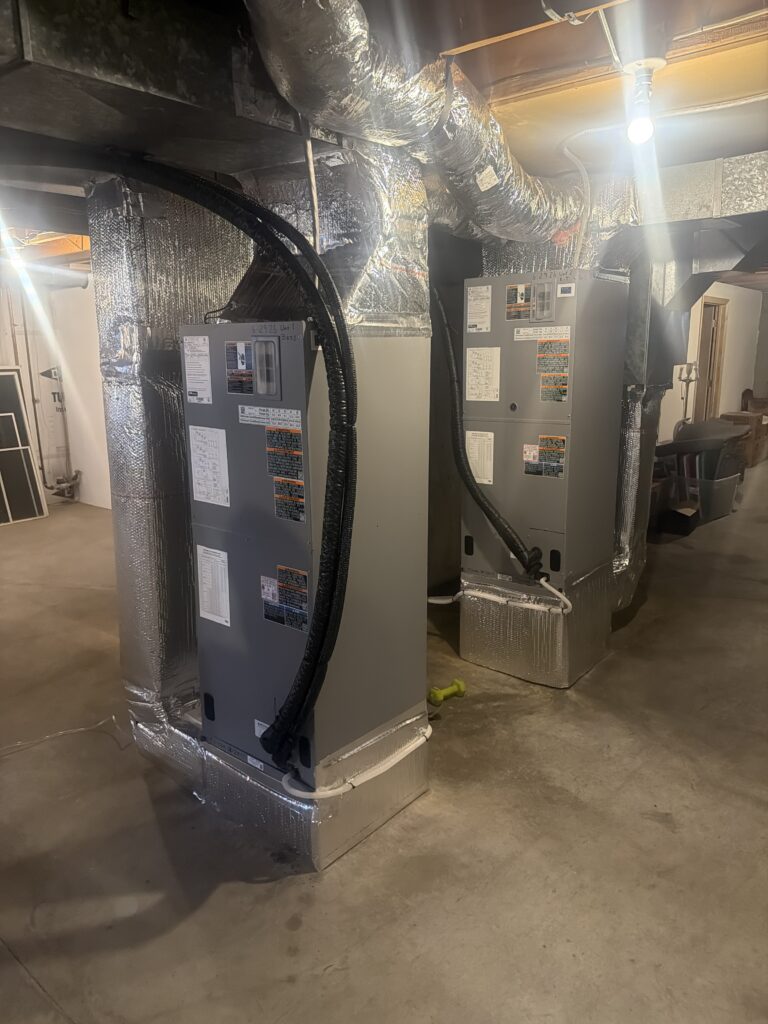
How we size and specify the system
Every furnace replacement we quote starts with a load calculation, a Manual J, not a guess based on square footage or what the old unit happened to be rated for. The old furnace in a lot of these Springfield basements was oversized to begin with, which was common practice decades ago and is exactly the wrong instinct. An oversized furnace short-cycles, meaning it blasts heat, satisfies the thermostat fast, and shuts off before it’s actually distributed evenly or dehumidified the air, which leaves rooms uneven and the equipment wearing out its components faster from constant on-off cycling.
The load calculation accounts for the house’s actual envelope, insulation levels, window area, air sealing, and orientation, and from there we size the furnace to match the real heat loss, check whether the existing ductwork can actually move that air without excessive static pressure, and specify venting and combustion air correctly for the unit and fuel type. If a contractor hands you a number without having done any of that, or without having been in your basement and attic, that’s a quote built on a guess, and it’s worth asking what it’s actually based on before you sign anything.
A real quote should spell out the furnace model and efficiency rating, the ductwork changes if any are needed, venting work, electrical and gas connections, and what’s included for startup and commissioning. If a bid doesn’t show you that level of detail, ask why.
What the work involves
A furnace replacement typically runs one to two days depending on whether the ductwork needs modification. The old unit gets disconnected and removed, which includes the gas or oil line, electrical, venting, and whatever duct connections were in place. We inspect the existing ductwork at this point for leakage, undersized trunk lines, and static pressure issues, since a new high-efficiency furnace moving air through old, leaky, or poorly sized ducts won’t perform the way the rating suggests it should.
From there it’s setting the new furnace, connecting gas or oil supply and electrical, running new venting if the old chimney-vented unit is being replaced with a direct-vent high-efficiency model, which is common on these jobs, and tying in the control wiring and thermostat. Condensate drainage needs to be addressed on high-efficiency condensing furnaces since they produce acidic condensate that has to be routed to a drain, not just the old gravity vent that worked for a standard-efficiency unit. We finish with startup, combustion analysis, and a walkthrough of what the thermostat and any new controls actually do.
- Removing and disposing of the old furnace, along with any associated oil tank or gas line modifications
- Sizing and, where needed, modifying supply and return ductwork so static pressure matches the new equipment
- Installing proper combustion air and venting: direct vent PVC for a high-efficiency condensing furnace, or a lined chimney for a conventional one
- Setting up condensate drainage for high-efficiency furnaces, which produce acidic condensate that needs to go somewhere specific, not just the nearest floor drain
- Pulling permits and scheduling the required inspections
- Commissioning the system: verifying gas pressure or oil nozzle sizing, airflow, and temperature rise against manufacturer specs before we call the job done
What it costs
Furnace installation in Springfield generally runs {PRICE_LOW} to {PRICE_HIGH}, and the spread is wide because the variables are real. A straightforward like-for-like replacement with existing ductwork in good shape and gas service already at the house sits at the lower end. The cost moves up with ductwork modifications, switching fuel types, venting changes for a high-efficiency condensing furnace that needs new PVC venting instead of the old metal chimney connection, electrical work if the furnace’s blower motor and controls need a dedicated circuit the panel doesn’t currently support, and access difficulty in tighter triple-decker basements or multi-unit mechanical rooms. We’ll give you the actual number for your house after the load calculation and a look at the mechanical room, not before.
- Whether it's a straight swap or a fuel conversion, oil to gas, oil to propane, or adding a heat pump into the mix as primary or backup heat
- Ductwork condition, and whether the existing supply and return can handle the new unit or need rework
- Venting type, direct vent versus relining an existing chimney
- Electrical service, since some high-efficiency furnaces and any accompanying heat pump equipment need panel capacity that older services don't have
- Access: basement height, oil tank removal, and how far the equipment has to travel from the truck
Rebates and incentives
Mass Save exists as a program and it’s worth understanding before you commit to equipment, but the rules and incentive amounts change and we’re not going to quote you a figure that might be outdated by the time you read this. What we can do is look at your specific house and furnace situation and help you work out what actually applies, including whether a furnace replacement on its own qualifies for anything or whether incentives in this territory are weighted more toward heat pump and weatherization work. Check masssave.com directly for current program details, [EXTERNAL LINK: Mass Save program page, the authoritative current source for incentive rules and amounts], and see our Mass Save heat pump rebates page for how the program generally works in this region.
Permits and Inspection
If you’re on the fence between a straight furnace replacement and looking at a heat pump instead, that’s a conversation worth having before you buy, not after. Springfield’s gas infrastructure makes a gas furnace a legitimate option in a way it isn’t in the towns around us that are stuck on oil, so the decision here is less obvious than it is elsewhere in our territory, and it’s worth fifteen minutes to talk through before committing.
Permits and Inspection
Furnace replacement in Springfield requires a mechanical permit and inspection, and if the job involves gas line work, a gas permit as well. This isn’t paperwork for its own sake. Permitted work gets inspected by the city for proper venting, combustion air, and gas or electrical connections, which is exactly the stuff that goes wrong on a rushed or under-the-table install and shows up later as a carbon monoxide risk or a failed inspection when you try to sell the house. We pull the permits and schedule the inspections as part of the job, not as an upsell.
Get a Quote
If your furnace is on its last run or you’re just tired of guessing whether this is the winter it finally gives out, call {PHONE}. You’ll talk to Drew, not a scheduler reading from a script, and we’ll walk through your house, your ductwork, and what actually makes sense before anyone talks price.
frequently asked questions
Is it better to replace my furnace with the same fuel type or switch?
It depends on what's already at the house. If you've got gas service and working ductwork, sticking with gas is often the simplest and least disruptive option. If you're on oil and the tank or line is also due for attention, that's a good moment to at least look at the alternatives side by side before committing to another oil furnace.
How long does a furnace installation take in Springfield?
A straightforward replacement is usually a one-day job. If the ductwork needs modification, venting has to be changed from chimney to direct-vent PVC, or there's electrical work involved, it can run into a second day.
Do I need a permit to replace a furnace in Springfield?
Yes. Furnace replacement requires a mechanical permit, and gas line work requires a gas permit, both inspected by the city. This protects you, not just the contractor, and any reputable installer should be pulling these as a matter of course.
My ductwork is old. Does that matter for a new furnace?
It can matter a lot. A new high-efficiency furnace pushing air through undersized, leaky, or poorly laid out ductwork won't perform at its rated efficiency and may run louder or less evenly than the unit it's replacing. We check static pressure and duct condition before finalizing a furnace recommendation, not after it's installed.
Can I just get the biggest furnace available to be safe?
No, and this is one of the most common mistakes in furnace replacement. An oversized furnace short-cycles, wears out faster, and leaves the house less evenly heated than a correctly sized one. The load calculation exists specifically to avoid this.