
Furnace Repair and Heating Service
- Powers Air HVAC, based in Granby, MA
What Furnace Repair and Heating Service Involves
Furnace repair covers oil, propane, and, in the pockets of this territory that have it, natural gas furnaces, along with the ductwork, venting, and electrical components that keep the system running. The symptoms homeowners describe overlap a lot from one call to the next, but what’s actually wrong underneath usually doesn’t, which is why a real diagnosis matters more than a guess over the phone.
Most calls come down to one of a handful of things: a failed igniter or pilot assembly, a dirty or malfunctioning flame sensor, a clogged filter choking airflow, a bad blower motor or capacitor, a control board or thermostat wiring issue, a cracked heat exchanger, or a burner that’s fouled and not combusting cleanly. The job is figuring out which one you actually have before anything gets replaced.
- No heat at all, or heat that starts and then shuts off within a minute or two
- Short cycling, meaning the furnace turns on and off repeatedly instead of running a full heating cycle
- A furnace that runs constantly but never brings the house up to temperature
- Strange smells, especially anything like burning dust at startup that doesn't clear, or any smell of fuel
- Banging, rattling, or a loud boom on startup, which can point to a delayed ignition problem worth taking seriously
- A yellow or flickering burner flame instead of a steady blue one
- A carbon monoxide alarm going off, which is not a wait-and-see situation under any circumstances
Diagnosis means a combustion analysis, a meter on the electrical components, and an actual inspection of the heat exchanger and venting, not a part swapped on a hunch. If an igniter is bad, we replace the igniter. If the heat exchanger is cracked, we tell you that plainly, because that’s a safety issue and a different conversation than a repair.
When It Is the Right Answer and When It Is Not
This is the part most contractors skip, and it’s the part that matters most in the middle of winter when a bigger bill feels like the last thing you want to hear. Repair is the right call for a lot of the furnace calls we get. It is not the right call for all of them, and pretending otherwise just delays a bigger decision and a colder week.
Repair usually makes sense when:
- The failure is isolated to one component, such as an igniter, flame sensor, capacitor, or control board
- The heat exchanger and venting are sound and passed inspection
- The cost of the fix is a small fraction of what a new furnace would run
- The furnace is reasonably young and this is its first real issue
Replacement usually makes more sense when:
- The heat exchanger has cracked or corroded, which is a safety issue that can't be patched around
- This is the third or fourth repair call in a couple of heating seasons on the same unit
- The furnace is well past fifteen years old and running at low efficiency on oil or propane you're paying to have delivered
- The repair cost is approaching what a meaningful chunk of a new system would cost
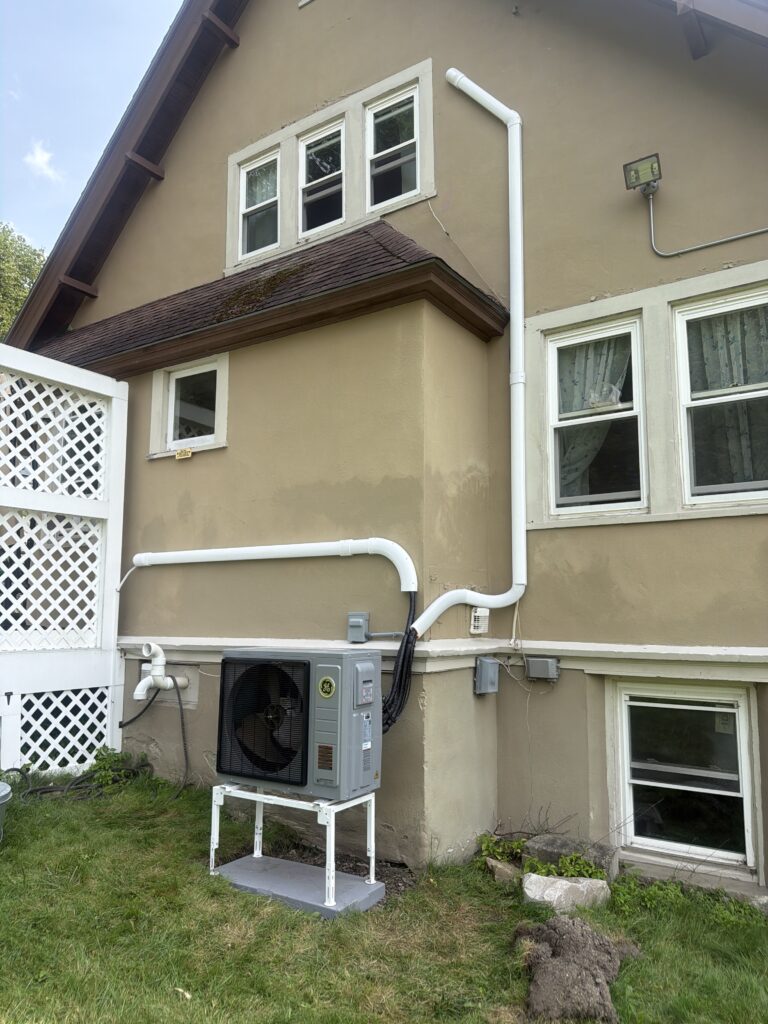
- The house has no ductwork at all, in which case the real question isn't repairing a furnace, it's whether ductless makes more sense for how the house is actually built
Two local facts shape that decision more than almost anything else. First, much of this territory has no natural gas distribution, so heating runs on delivered oil or propane. That changes the math on repair versus replacement here in a way that doesn’t apply in a gas town, since a higher-efficiency replacement can meaningfully cut delivered fuel costs over time. Second, a lot of the older housing stock, especially in the mill cities and older town centers, was built with steam or hot water radiators and never had ductwork installed at all. If that’s your house, furnace repair or replacement isn’t really the conversation. Ductless is.
We’ll tell you honestly which category you’re in. Sometimes that means a part and a service call and you’re warm again by evening. Sometimes it means a longer conversation about what actually makes sense for the house, and we’ll point you to that conversation rather than patching something that’s better off replaced.
How We Size and Specify
If a repair call turns into a replacement conversation, sizing is where a lot of installs go wrong, and it’s usually the installer’s fault, not the equipment’s. A furnace sized off the square footage of the house, without a real Manual J load calculation, tends to come out oversized. An oversized furnace heats the air fast, satisfies the thermostat, and shuts off, then repeats that cycle every few minutes instead of running a longer, steadier one. That short cycling wears parts out faster and leaves rooms at the far end of the ductwork colder than the ones near the furnace, even though the unit is technically bigger.
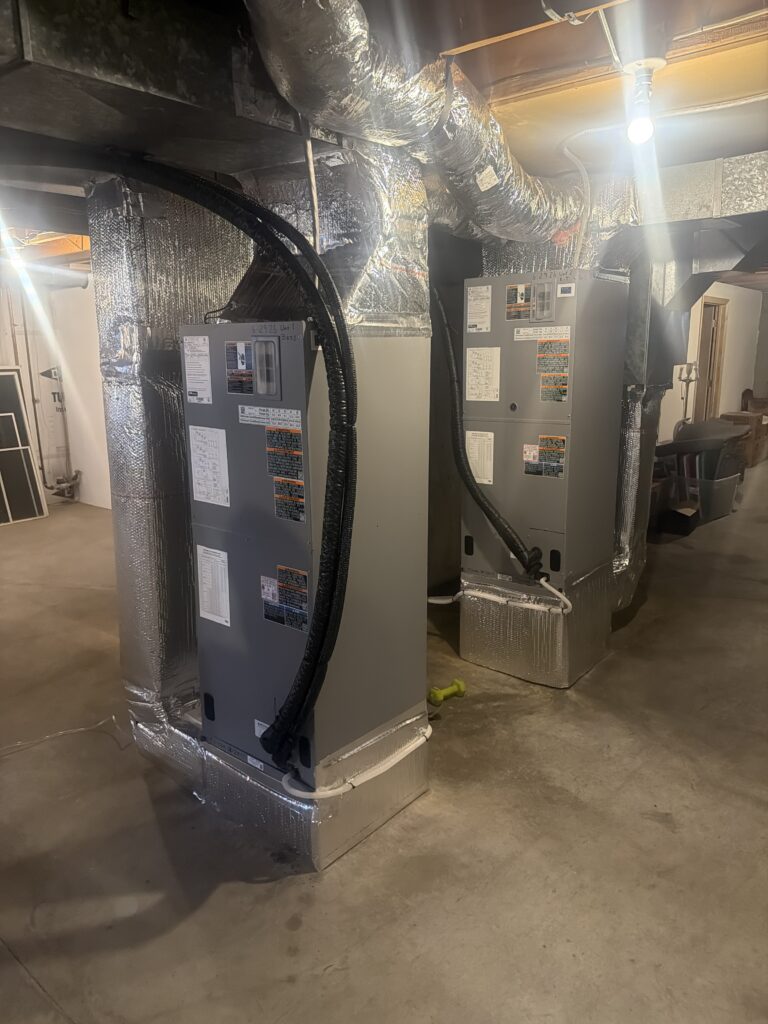
A proper load calculation accounts for square footage, insulation levels, window count and orientation, ceiling height, and how the house actually holds or loses heat, not just its footprint. It also means checking the AFUE rating, since that number tells you what share of the fuel you’re burning actually turns into heat in the house rather than going out the flue, and deciding between single-stage, two-stage, or modulating equipment based on how the house is used, not just the lowest quote. And if the new furnace is tying back into existing ductwork, we check static pressure in that ductwork before assuming it can handle it. Ducts sized for an old, failing furnace can choke a new one, and that shows up as noise, weak airflow in certain rooms, and equipment that never lives up to its rating.
Equipment and What Actually Differs Between Systems
- Oil furnaces run on a delivered tank and typically vent through a masonry or metal chimney, with standard equipment landing in the mid-80s percent AFUE range
- Propane furnaces can be power-vented with no chimney required, and high-efficiency condensing models reach into the mid-90s percent AFUE range, which matters more the longer you're staying on delivered fuel
- Natural gas furnaces exist where distribution reaches, but most of this territory simply doesn't have a gas main, which shapes almost every heating decision we make with a homeowner here
- Single-stage furnaces are either fully on or fully off. Two-stage and modulating furnaces run at partial output most of the time, which holds temperature steadier and runs quieter
- A cracked heat exchanger on any fuel type is a safety issue, not a maintenance item, and it's the one failure that always points toward replacement rather than repair
- If a repair or replacement uncovers an electrical issue, an undersized circuit, a failing disconnect, or a panel already at capacity, that's work Powers Air performs in house under, not something handed off and left for someone else to schedule
What the Work Looks Like Start to Finish
You call, and we ask what the furnace is doing, when it started, and what fuel it runs on, which helps us show up with the right parts on the truck more often than not.
Onsite, we diagnose with a combustion analyzer and an electrical meter rather than swapping parts to see what sticks. We’ll walk you through what we found before doing anything else, in plain language, including what it will take to fix it and what your options are if it’s not a straightforward repair.
If the part is on the truck, most repairs finish in that same visit. If it needs to be ordered, we’ll tell you honestly how long that takes and get it scheduled, and we’ll talk through temporary heat options if the house needs it in the meantime. Fuel piping work that requires a licensed gas or oil fitter is coordinated through our trusted subcontractor network. Once the repair is done, we run a full heating cycle and check combustion and safety controls before we consider the job finished, and we clean up after ourselves.
What it costs
- The age of the furnace and how available parts are for that specific model
- Whether it's a single, isolated failure or a symptom pointing toward a bigger problem, like a cracked heat exchanger
- Whether the fix requires fuel piping work through a licensed subcontractor or is purely mechanical and electrical
- The condition of the ductwork and venting feeding the system
- Whether the brand and model are common in this area or a boutique line with a longer wait on parts
Rebates and Incentives
Where We Work
Get a Quote
If your furnace has stopped working right, or it’s on its way out and you’re weighing repair against replacement, call 413-339-3194. You’ll talk to Drew directly about what’s going on, not a call center reading from a script, and you’ll get a straight answer about whether it’s a quick fix, a bigger issue, or worth talking through replacement options.