
Heat Pump Installation in Northampton, MA
A lot of Northampton’s housing stock predates central heating as we think of it now, which means a boiler, a tank of oil or propane somewhere in the basement, and a house full of radiators with no ducts behind the walls to run air through even if you wanted to. That combination is exactly why Northampton has become the center of the heat pump conversation in this part of the state, and exactly why it is also the most competitive town in our service area for it.
- Powers Air HVAC, based in Granby, MA
Heat Pump Installation in Northampton
We get more questions about cold-climate performance from Northampton than anywhere else we work, and that is a good thing, because it means people here are reading past the marketing. The honest answer is that modern cold-climate heat pumps are rated and tested to keep producing meaningful heat well below zero degrees, with documented performance data down to -13°F and beyond on the equipment we spec most often. The old reputation heat pumps have – that they quit when you need them most – comes from a generation of equipment that is fifteen or twenty years out of date. Current cold-climate units hold a far larger share of their rated capacity at low temperatures, and the compressor technology that makes that possible (variable-speed, inverter-driven) is standard on the systems we install, not an upgrade tier.
What we won’t do is tell you a heat pump makes your existing heating system obsolete on day one. For a lot of Northampton houses, the right first conversation is about how a heat pump and the existing oil or propane boiler work together, not which one wins.
What Northampton Homes Are Working With
Northampton’s center is dense with Victorian, Colonial Revival, and early twentieth-century construction, a lot of it two- and three-family, a lot of it owner-occupied but plenty rented out too. These houses were built for steam or hot water radiators fed by a boiler, and there is usually no ductwork anywhere in the structure. That single fact is why ductless mini-split systems come up constantly in Northampton: they deliver heating and cooling without opening a single wall or ceiling for ducts, running instead on a small refrigerant line set from an outdoor condenser to one or more indoor heads.
There’s no natural gas main reaching a meaningful share of this territory, which means the baseline heating cost you’re comparing a heat pump against is delivered oil or propane, not cheap piped gas. That changes the math substantially in a heat pump’s favor compared to a gas-heated town, because you’re not competing against the cheapest fuel option, you’re competing against two of the more expensive ones. We also see a real range in house size here, from compact in-town Victorians on small lots to larger properties further out toward the hilltowns, and the right system looks different for each.
How We Size and Specify the System
Every recommendation starts with a Manual J load calculation, which accounts for your home’s square footage, insulation levels, window area and orientation, air leakage, and the local design temperature for Northampton. That number, not a rule of thumb per square foot, tells us how much heating and cooling capacity the house actually needs room by room.
Oversizing is the single most common mistake in this trade, and it happens because bigger sounds safer. It isn’t. An oversized heat pump short-cycles, turning on and off rather than running long, steady, low-speed cycles the way these systems are designed to operate. That means worse dehumidification in summer, uneven temperatures in winter, more wear on the compressor, and a system that is less comfortable than a correctly sized one despite costing more. If a bid lands on your counter with a price and a model number but no load calculation behind it, that’s the warning sign, not the good deal.
A proper quote tells you the calculated load, the equipment’s rated capacity at your design temperature, the HSPF2 and SEER2 ratings, how backup or auxiliary heat is handled on the coldest days, and where the line sets and condensate drains will run.
What the Work Involves
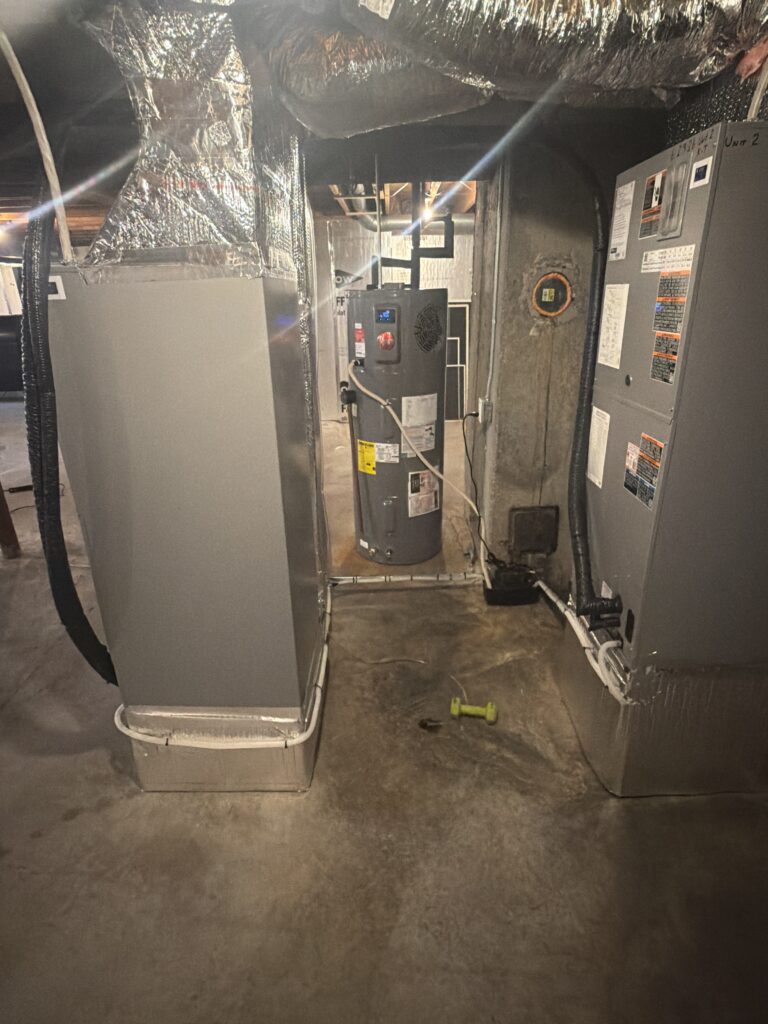
For a ductless install, that means mounting one or more indoor heads where they’ll actually heat and cool the rooms you live in, running refrigerant line sets to an outdoor condenser sited with enough clearance for airflow and snow, and setting up condensate drainage that won’t freeze or back up in a Northampton winter. Refrigerant line length and elevation change both have real limits, and they affect how we place the outdoor unit and route the lines through walls or soffits with minimal visible impact.
For homes doing a ducted air-source or central heat pump retrofit instead, we’re evaluating the existing ductwork’s static pressure and sizing, since undersized or leaky ducts will choke even a well-matched system. On either path we’re also looking at your electrical panel. Heat pump equipment and, increasingly, EV chargers draw real amperage, and a panel at or near capacity sometimes needs attention before new equipment goes in. We handle panel upgrades and change-outs ourselves, as licensed electrical work, not as a referral to someone else’s subcontractor.
- A load calculation and walkthrough to confirm zone locations
- Mounting the outdoor condenser and indoor units
- Running refrigerant line sets within the manufacturer's length and elevation limits
- Setting up a proper condensate drain
- Dedicated electrical circuits, including a check on panel capacity
- Commissioning the system and a walkthrough of the controls
Drew does this work himself or oversees it directly, with plumbing handled by a trusted subcontractor when a job calls for it. You’re not getting handed off between a salesperson, a scheduler, and an installation crew who’ve never spoken to each other about your house.
What It Costs
A straightforward single-zone ductless install in Northampton typically runs between {PRICE_LOW} and {PRICE_HIGH}, and multi-zone or whole-house systems climb from there. What moves the number: how many zones and indoor heads you need, whether you’re using wall-mounted, ceiling cassette, or ducted indoor units, how far the line sets have to run and whether that routing is simple or requires extra labor, whether your electrical panel has capacity or needs upgrading first, and how accessible the installation points are in an older house with plaster walls and tight mechanical spaces. We won’t give you a number until we’ve calculated the load and seen the house, because anyone quoting a flat price over the phone for Northampton’s housing stock is guessing.
Permits and Inspection
Heat pump installations in Northampton require permitting and inspection, and so does any electrical panel work tied into the project. That’s not paperwork for its own sake. A permitted, inspected install confirms the equipment is sized and connected correctly and protects you if there’s ever an insurance or resale question down the line. If a quote is noticeably cheaper because the permit step is being skipped, that’s usually where the savings is coming from.
Rebates and Incentives
Mass Save exists as a utility-sponsored program for Massachusetts homeowners, and it’s genuinely worth understanding before you finalize a heat pump project in Northampton, since incentive structures and eligibility rules change and depend on specifics like your current heating fuel and the equipment specified. We’re not going to quote you a rebate amount here because the program changes and we’d rather tell you accurately than tell you first. What we can do is walk through your specific situation and help you understand what to check into. Start with [EXTERNAL LINK: masssave.com, the official Mass Save program site, for current rebate details and eligibility] and our own overview at /mass-save-heat-pump-rebates for a general rundown of how the program works.
Get a Quote
If you’re weighing a heat pump against another oil delivery or a propane fill-up this winter, or you’re trying to figure out what a ductless system would even look like in a house with radiators and no ducts, we’ll come look at the house, run the numbers, and tell you straight what we’d do if it were ours. Call {PHONE} to set up a visit.
frequently asked questions
Do heat pumps actually work in a Northampton winter?
Yes, provided the equipment is a modern cold-climate model and it's sized correctly for the house. Cold-climate heat pumps are rated and tested to produce meaningful heat well below zero, and the variable-speed compressors in current equipment hold a much larger share of rated capacity at low temperatures than the heat pumps of ten or twenty years ago. The reputation problem comes from outdated equipment, not current technology.
Do I need to get rid of my boiler if I install a heat pump?
Not necessarily. Plenty of Northampton homeowners run a heat pump as the primary system for most of the year and keep an existing oil or propane boiler as backup for the coldest stretches, which is often the most practical approach in a steam or hot-water radiator house.
Can a heat pump work in a house with no ductwork?
Yes, that's exactly what ductless mini-split systems are designed for. Indoor heads mount directly in the rooms you're heating and cooling, connected to an outdoor unit by a refrigerant line set, with no ductwork required anywhere in the house.
How do I know if a quote is legitimate?
A proper quote is built on a Manual J load calculation specific to your house, not a flat rate per square foot. It should show the calculated load, the equipment's rated capacity at Northampton's design temperature, efficiency ratings, and how backup heat is handled. If none of that is in writing, ask for it before you sign anything.
Does Northampton have natural gas service?
Coverage is limited and much of the surrounding territory runs on delivered oil or propane. That matters for heat pump economics, since you're comparing the cost of operating a heat pump against two of the more expensive heating fuels rather than cheap piped gas.