
Air Conditioning Repair in South Hadley, MA
A lot of South Hadley’s housing was built before central air was ever part of the plan, which means what’s cooling your home right now is either a retrofit system fighting ductwork it wasn’t designed for, or a mini-split someone installed later because there was no duct run to tie into in the first place. Either way, when it quits in late July, you don’t want a theory about why. You want it fixed.
- Powers Air HVAC, based in Granby, MA
Drew Powers answers the phone and does the diagnosis himself, or he’s the one standing in your basement explaining what the gauges are showing. There’s no dispatcher reading from a script and no upsell conversation with someone who’s never seen your equipment. That’s the whole operation, and on a 95-degree day it’s the difference between a real fix and a guess.
- No cold air, or air that is barely cooler than the room
- Ice forming on the outdoor unit or the line set
- Short cycling, where the system turns on and off every few minutes instead of running a full cycle
- A breaker that trips repeatedly when the AC starts
- Water pooling near an indoor unit, or a stain on the ceiling below one
- A system that has gotten noticeably louder, especially on startup
What South Hadley homes are working with
South Hadley splits pretty cleanly into two building eras, and it matters for repair work. Close to the village center and around Mount Holyoke College, you’ve got older homes, some of them converted to rentals or faculty housing, with steam or hot water heat and no original ductwork at all. If there’s central air in one of these houses, it was added later, usually with a high-velocity small-duct system or a ducted mini-split threaded through closets and chases. Those systems have different failure points than a standard split system – smaller refrigerant lines, different blower characteristics, and air handlers that are often undersized for the load if whoever installed them didn’t run the numbers first.
Out past the center, in the post-war development and newer construction, you’re more likely to see a conventional forced-air furnace with a bolted-on AC coil and an outdoor condenser that’s reaching the end of its service life if the house is 15 to 20 years old. A good number of South Hadley properties are also landlord-owned, especially anything within walking distance of campus, and landlords tend to want the cheapest functional repair rather than the ideal one. That’s a legitimate call to make, but it should be an informed one – we’ll tell you honestly when a patch job makes sense and when you’re pouring money into a system on its last season. And like most of this part of the Pioneer Valley, gas service is spotty outside the main corridors, so a lot of these homes are on oil or propane for heat, which changes the math when a tenant or owner starts asking about replacing the whole system instead of just repairing it.
How we size and specify the system
Repair calls often turn into a sizing conversation, because the reason a unit is short-cycling or running constantly without actually cooling the house isn’t always a failed part – sometimes it’s a system that was oversized or undersized from day one. Before we recommend replacing anything, we run a Manual J load calculation based on your actual house: square footage, insulation, window orientation, how many people live there, what’s upstairs versus down. Guessing at tonnage based on the old unit’s nameplate is how you end up with a system that short-cycles, struggles with humidity, and wears out its compressor early.
Oversizing is the most common mistake we see undone in this town, especially in homes that got a quick quote without anyone measuring anything. A system that’s too big cools the air fast and shuts off before it’s pulled the moisture out, so the house feels clammy even at the thermostat setpoint. It also cycles harder, which shortens equipment life. If someone hands you a number with no load calculation behind it, that’s worth asking about directly – a real quote shows the math, not just a model number and a price.
- The load calculation behind the recommendation, not just a model number
- Equipment capacity at your actual design temperature, not just at the 47°F rating
- What the electrical service needs to support it, and whether the panel has room
- Line set length and routing, and what that does to performance
- What backup or auxiliary heat looks like, if the system also handles heating
Most repair calls start the same way: you tell us what you’re seeing – warm air, ice on the lines, a unit that won’t start, water where it shouldn’t be – and we go from there with the right diagnostic path instead of a parts-swap guess.
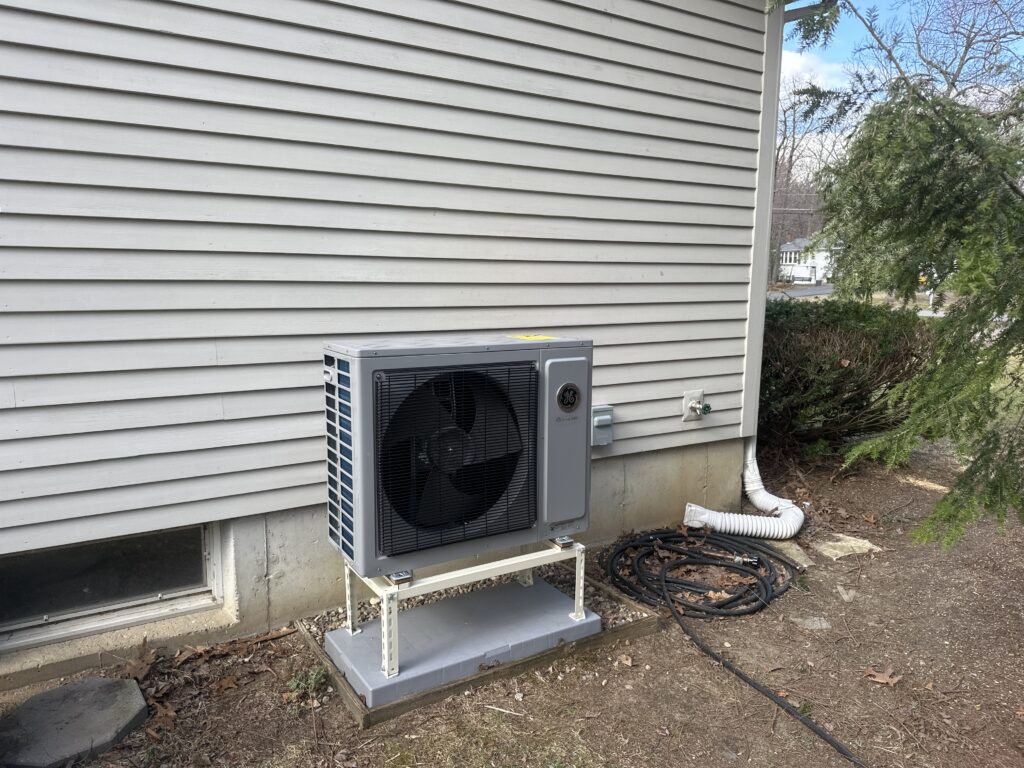
What the work involves
Diagnosis starts with the basics done right: checking refrigerant charge and pressures, inspecting the condenser coil and compressor, testing capacitors and contactors, and tracing the condensate path, which clogs more often in this area’s older homes where drain lines weren’t sloped properly to begin with. If it’s a ducted system, we also check static pressure, because undersized or leaky ductwork can mimic a refrigerant problem and send someone chasing the wrong fix.
For mini-splits, which are common in South Hadley’s older, duct-free homes, we check the indoor and outdoor unit communication, inspect the line set connections for slow leaks, and verify the condensate pump if there is one, since those fail quietly and show up as water stains before anyone notices the cooling loss. Once we know what’s actually wrong, we tell you the repair cost and, if the unit is older or the repair is a stopgap on a system near the end of its life, we tell you that too, with real numbers either way.
- Checking refrigerant charge and finding the source of a leak, rather than just topping it off
- Testing the capacitor, contactor, and other electrical components that fail from heat and age
- Inspecting the condenser coil and airflow, since a restricted coil is one of the most common reasons a system runs constantly without cooling
- Checking the condensate line and pan, since a clogged line is a common cause of water damage around indoor units
- Reviewing thermostat wiring and settings, which is sometimes the actual issue behind what looks like an equipment failure
We carry common parts on the truck for standard split systems and most major mini-split lines, so a lot of repairs get done in one visit. When a part has to be ordered, we tell you the timeline up front instead of leaving you guessing through a heat wave.
What it costs
Repair costs in South Hadley generally run between {PRICE_LOW} and {PRICE_HIGH}, and the spread comes down to what’s actually failed and how accessible the equipment is. A capacitor or contactor swap is on the low end. A refrigerant leak that requires finding the leak, repairing a line, and recharging the system costs more, and a compressor failure – especially on an older unit where the part is hard to source – can tip toward replacement being the smarter move. Line set length, whether the condenser sits somewhere easy to reach or is wedged behind a deck, and whether a ducted system’s issue turns out to be an undersized or leaky duct run rather than the equipment itself, all factor into the final number. We quote the repair after diagnosis, not before, and we’ll always tell you if replacement is the better use of your money.
- Number of zones or indoor units involved
- Whether the issue is electrical, mechanical, or refrigerant-related
- Access to the outdoor unit and any indoor equipment
- Age and condition of the system, including whether parts are still available
- Whether the underlying issue points to an electrical service or panel limitation
Rebates and incentives
If your South Hadley repair call turns into a replacement conversation, Mass Save is worth understanding before you decide anything. The program offers incentives tied to efficiency ratings for qualifying equipment, and the specifics change based on your current heating fuel, your home’s size, and what you’re installing. We’re not going to quote you a dollar figure because it depends on your situation and the program’s current rules, but we can walk through what might apply to your house specifically. You can review program details directly at masssave.com [EXTERNAL LINK: Mass Save program overview for homeowners evaluating efficiency incentives], and our own page on Mass Save heat pump rebates breaks down how the program generally works.
Get a quote
If your AC is down in South Hadley right now, call {PHONE} and you’ll get Drew, not a call center. We’ll talk through what’s happening, get a repair scheduled, and if replacement makes more sense for your house, we’ll tell you that honestly with the numbers to back it up.
frequently asked questions
My AC is blowing air but it's not cold. What's wrong?
This usually points to a refrigerant charge issue, a failing compressor, or in ducted systems, airflow problems from a dirty filter or blocked return. We check all three on a diagnostic visit rather than guessing based on symptoms alone.
Is it worth repairing an old AC unit or should I replace it?
If the unit is past 12 to 15 years old and the repair involves the compressor or a major leak, replacement is often the better value, especially given how heat pump technology has improved. We'll give you honest numbers for both paths before you decide.
Do you work on ductless mini-splits as well as central AC?
Yes. A lot of South Hadley's older homes near the village center and the college run on ductless systems since they never had ductwork installed, and we diagnose and repair both system types.
How fast can you get to a no-cool call in South Hadley?
We prioritize no-cool calls during hot weather and do our best to get there same day or next day depending on when you call. Reach out at {PHONE} and we'll give you a realistic window.
Can a landlord schedule a repair for a rental property?
Yes, we work with South Hadley landlords regularly given how much rental and faculty housing is in this town. We'll talk through the most cost-effective repair path for a rental versus what we'd recommend for an owner-occupied home, since the priorities are often different.