
Central Air Conditioning Installation in Granby, MA
Granby is still mostly open land and farmhouses, with newer single-family homes scattered along West State Street and the roads branching off it toward the reservoir. A lot of that housing already has ductwork in place from an oil furnace or an older central air system that’s reached the end of its life, which puts central AC squarely back on the table as the right call rather than the default one.
- Powers Air HVAC, based in Granby, MA
Central Air Conditioning Installation in Granby
If your house already has a trunk-and-branch duct system feeding registers in every room, replacing or adding central air conditioning usually makes more sense than cutting in a ductless system around it. You’ve already paid for the distribution. The job becomes matching an outdoor condenser and indoor coil to that existing ductwork, correctly, instead of designing a whole new delivery method.
That’s the case we look at honestly on every Granby estimate. Some houses are ductless candidates because they were never built with ducts. Others already have the infrastructure, and in those cases the better answer is a properly sized central system, not a sales pitch toward whatever product happens to carry a bigger margin that month.
- Ductwork already exists and is in decent condition
- A furnace or air handler is already in place and just needs a matching outdoor condenser
- One thermostat and one system serving the whole house is genuinely simpler than several ductless zones
- Whole-house humidity control matters as much as temperature does
What Granby homes are working with
Granby doesn’t have natural gas distribution running through it the way some of the closer-in Pioneer Valley towns do. Most houses here run on delivered oil or propane for heat, which is the single fact that changes the math on every HVAC decision in this town. A homeowner paying for oil deliveries or propane tank fills has a much stronger economic argument for a heat pump than someone on cheap piped gas — but that’s a separate conversation. For central air conditioning specifically, what matters is that these oil and propane systems are almost always paired with a forced-air furnace and a full duct system already, which is exactly the setup central AC is built to use.
The housing stock splits a couple of ways. There’s a cluster of older farmhouses, some dating back well before the town’s post-war growth, that were retrofitted with ductwork decades ago when oil furnaces replaced coal or wood heat. Then there’s newer single-family construction on larger lots, often an acre or more out past the center, built from the 1960s through today with central forced-air from the start. Both groups tend to be owner-occupied, long-term residents rather than rental turnover, which means the AC system installed now is usually expected to run for fifteen to twenty years without drama. Lot size out here also means outdoor condenser placement is rarely a tight squeeze the way it can be on a quarter-acre village lot — that’s one less constraint on the install.
How we size and specify the system
Every central air quote we write starts with a load calculation, not a guess based on square footage. A Manual J calculation accounts for your insulation, window count and orientation, ceiling height, air leakage, and the duct system itself — not just how big the house is. Two houses of identical size in Granby can need meaningfully different tonnage depending on whether they’ve been re-insulated, what the windows are, and how the ductwork was laid out originally.
Oversizing is the most common mistake in this industry, and it’s almost always sold as a feature. A bigger unit sounds safer. In practice an oversized air conditioner cools the air fast, satisfies the thermostat, and shuts off before it’s run long enough to pull humidity out of the house. You end up with a home that feels cold and clammy at the same time, short-cycling equipment that wears out its compressor faster, and higher electric bills for worse comfort. Right-sized equipment runs longer, steadier cycles and actually controls humidity the way it’s designed to.
A legitimate quote tells you the calculated load, the equipment’s rated capacity at that load, the SEER2 rating, and what’s being done with the existing ductwork — whether it’s being reused as-is, resized, or sealed. If a bid shows up with just a price and a unit model number and nothing behind it, that’s worth a second opinion before you sign anything.
- Short cycles: it cools the air fast and shuts off before it's run long enough to pull humidity out, so the house ends up cold and clammy at the same time
- Wears out faster, because more starts and stops means more stress on the compressor
- Costs more to buy and more to run than a correctly sized system would
What the duct system has to handle
Central air conditioning only performs as well as the ducts moving the air. Static pressure — the resistance the blower has to push against — gets overlooked constantly on replacement jobs where the new equipment just gets bolted onto whatever ductwork is already there. If the existing ducts are undersized, leaky, or were sized for a smaller furnace blower originally, a new high-efficiency condenser can be sized perfectly and still deliver weak airflow and warm rooms upstairs.
Line set and condensate realities
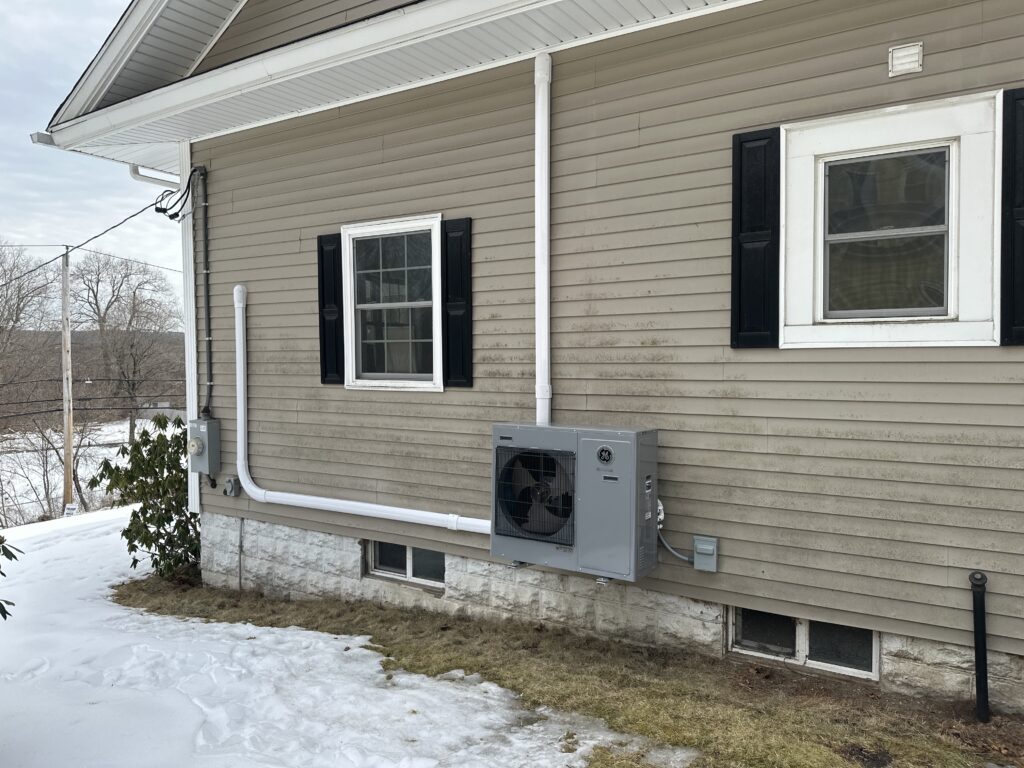
The refrigerant line set connecting the outdoor condenser to the indoor coil has real length and height limits before performance and efficiency start dropping off, and on a lot like many in Granby, where the condenser pad might sit well away from the house, that run length gets checked before anything gets quoted. Condensate drainage also needs a clear, code-compliant path away from the coil, particularly in basements without a floor drain nearby.
- The load calculation itself, not just a tonnage number pulled from it
- The SEER2 rating of the equipment proposed and what that means for the summer electric bill
- Ductwork condition, and whether sealing or modification is part of the job
- Electrical circuit requirements for the outdoor condenser
- What's covered under manufacturer parts warranty versus labor warranty
Electrical capacity for the new equipment
Central air equipment draws real current, and older Granby farmhouses sometimes still have 100-amp service or a panel already near capacity with well pumps, workshops, or other 240-volt loads. We check panel capacity as part of the quote, not after the equipment shows up. If a panel upgrade or change-out turns out to be part of the picture, that’s electrical work we perform directly as a licensed electrical contractor, under permit and inspection, not something we hand off to someone else to coordinate.
What the work involves
A typical central air conditioning installation in Granby covers setting the outdoor condenser on a level pad with proper clearance, installing or verifying the indoor coil at the furnace or air handler, running and insulating the refrigerant line set, wiring a dedicated disconnect and circuit sized to the equipment’s requirements, and connecting condensate drainage with a secondary safety pan where it’s needed. On replacement jobs we also inspect the existing ductwork for leaks, crushed sections, and undersized runs, because new equipment on bad ductwork just repeats the old problems with a higher electric bill. Everything gets charged to the manufacturer’s specification and checked for proper airflow and subcooling before we call the job done, and all electrical and refrigerant work is performed and inspected under the applicable permits.
- A straight conversation about whether central air is still worth the disruption, or whether ductless is the better fit for that unit
- New duct runs through closets, dropped ceilings, or chases, placed to do the least damage to finished space
- Coordination on panel capacity if the building's electrical service can't support another circuit
Ducted or ductless: the honest comparison for this house
If your Granby home already has forced-air ductwork in reasonable shape, central air conditioning is usually the more cost-effective and lower-disruption path — you’re using infrastructure that’s already there. If you’re dealing with a farmhouse addition, a converted attic, or any room without a duct run reaching it, a ductless head in just that space often solves the problem without tearing open walls or extending ductwork into a room it was never designed to serve. Plenty of houses end up with both: central air for the main structure, a ductless unit for the one room that’s always been the exception.
What it costs
Central air conditioning installation in Granby generally runs between {PRICE_LOW} and {PRICE_HIGH}, and where a given job lands in that range depends on a handful of real variables: the tonnage the load calculation calls for, whether the existing ductwork needs sealing or modification versus a straight reuse, how far the line set has to run from pad to coil, whether the electrical panel has room for the new circuit or needs work first, and how accessible the attic, basement, or crawlspace is for the install crew. A single-zone replacement on a house with sound existing ductwork and an adequate panel sits at the lower end. A job that also needs ductwork repair or panel capacity added runs higher. You’ll get those specifics in writing before anything is scheduled, not as a surprise on the invoice.
- Number of zones or separate systems needed
- Whether ductwork exists, needs sealing, or needs to be built new
- Line set length between the indoor and outdoor equipment
- Whether the electrical panel has capacity for another circuit or needs work first
- Access, a condenser pad on an open side yard costs less to install than one on a tight lot with a fence and a neighbor's driveway in the way
Why the load calculation matters for your wallet
Right-sized equipment isn’t just a comfort argument, it’s a cost argument. Correctly sized systems run fewer startup cycles, draw less inrush current, and put less wear on the compressor over a season of Granby summers. Oversized equipment tends to fail its compressor years earlier than it should, and that’s a far bigger bill than the few hundred dollars saved by skipping the calculation in the first place.
Rebates and incentives
Mass Save offers incentives that can apply to qualifying HVAC upgrades, and the specifics — what’s eligible, what documentation is required, and how the amounts work — change often enough that we’d rather walk through your specific situation than quote you a number that might be outdated by the time you read it. Start with masssave.com [EXTERNAL LINK: Mass Save program site for current incentive details and eligibility] for the current program rules, and see our Mass Save rebates page for how this tends to apply to heat pump projects specifically. We can help you work out what, if anything, applies to your Granby project once we know the equipment and scope.
Get a quote
If you’re weighing a central air replacement against a ductless option, or just need a straight answer on whether your existing ductwork is worth keeping, call {PHONE}. You’ll talk to Drew directly about your house, not a scheduler reading from a script, and the quote that follows will have a load calculation behind it.
frequently asked questions
Can my existing oil furnace ductwork be used for central air conditioning?
In most cases, yes. If the ductwork is in reasonable condition and sized adequately, we can add an indoor coil to the existing air handler or furnace and use the same duct runs. We check static pressure and duct condition as part of the quote to confirm it'll actually perform rather than assume it.
Is central air or ductless the better fit for my Granby house?
It depends on what's already in the house. If you have working ductwork reaching most rooms, central air is usually the more economical choice because the distribution system already exists. If your home has no ducts, or there's an addition or converted space the ducts never reached, ductless solves that without major construction.
Why does Granby's lack of natural gas service matter for this decision?
It mostly changes the heat pump conversation rather than the AC conversation directly, since most Granby homes on oil or propane already have a forced-air furnace and ductwork central air can use. But it's worth knowing that homes on delivered fuel often have a stronger case for pairing central air with a heat pump down the road, since the heating-cost comparison looks different without cheap piped gas as the alternative.
How long does a central air conditioning installation take?
A straightforward replacement using existing ductwork typically takes one day. If the job involves ductwork repair, panel work, or a longer line set run, it can extend to two days. We'll give you a realistic timeline once the scope is set.
Do I need a permit for central air conditioning installation?
Yes. Electrical work for the new circuit and disconnect, and the refrigerant work, are performed and inspected under the applicable permits. That protects you if there's ever an insurance question or a future sale inspection.