
Ductless Mini-Split Installation in Belchertown, MA
Drive through Belchertown and you see two different housing stocks on the same road: a 2004 colonial on an acre lot running propane forced air, and a few miles away, a center-village house from the 1800s heated by whatever the last owner could get to work with the old radiators. Both of those houses end up calling about the same thing – a room the system can’t reach, or a system that’s old enough to replace rather than repair.
- Powers Air HVAC, based in Granby, MA
Belchertown has grown faster than most of the towns around it over the last two decades, and that growth shows up in the housing. There’s a lot of newer single-family construction built on generous lots, much of it on propane or oil because gas service doesn’t run out to most of these subdivisions. That’s not a small detail. It changes the math on a heat pump in a way it wouldn’t in a town with gas lines on every street.
- Additions and bump-outs that were never tied into the main heating system
- Finished attics and basements that run twenty degrees off the rest of the house
- Whole houses with radiators or baseboard and no ducts to tap into at all
- Individual units in a converted multifamily, where each tenant needs their own zone and their own thermostat, not a shared system nobody controls
- Rooms at the far end of an existing duct run that never got enough air to begin with
This page is about ductless mini-splits specifically – what they solve, how we size them for a Belchertown house, and what the install actually involves once you’ve decided it’s worth doing. No generic pitch. Just the decision in front of you and what I’d tell you if we were standing in your basement.
What Belchertown homes are working with
The newer end of town – the subdivisions built through the 1990s and 2000s off routes 9 and 202 – is almost entirely forced air, almost entirely propane or oil, and almost entirely original equipment at this point. A furnace or heat pump installed when one of those houses was built is now twenty-plus years old, and homeowners are starting to replace rather than nurse it along. That’s a good moment to ask a bigger question than “same thing again”: does a ducted heat pump make sense here, does the existing ductwork support it, or is there a bonus room, a finished basement, or a converted garage that the original system never served well in the first place. That last one is a textbook ductless case – add a single zone instead of trying to extend ductwork into a space it was never designed for.
The older center of Belchertown, closer to the common and down toward the Swift River, has a different problem. Housing from before the 1950s was built with steam or hot water radiators and no ductwork at all. If you’re in one of these houses and central air was never installed, your only paths to cooling are window units or a ductless system – and a ductless system does both heating and cooling, which window units don’t, and does it room by room instead of fighting a whole-house load with equipment sized for a house that doesn’t exist. With gas service limited across most of Belchertown, the economics of running mini-splits alongside – or in some cases instead of – delivered fuel are a real conversation, not a sales angle.
How we size and specify the system
Every quote starts with a load calculation – a Manual J, done against your actual house, not a rule of thumb based on square footage. Insulation, window count and orientation, ceiling height, how the space is used, and in Belchertown’s case, how the house handles cold – because a mini-split’s rated capacity and its capacity at design temperature are two different numbers, and the gap between them is where bad installs come from.
Oversizing is the single most common mistake I see corrected. A system that’s too big for the room short-cycles – it blasts the space to temperature, shuts off, and starts again a few minutes later, which means it never runs long enough to dehumidify properly and never settles into the steady, quiet operation a mini-split is supposed to deliver. It also wears the compressor faster. Bigger is not a safety margin, it’s a different kind of failure, and it’s one that’s invisible until the unit’s already on the wall.
A quote worth signing should show the load calculation, the specific indoor and outdoor unit models with their cold-climate rated capacity and HSPF2 figures, the line set run and how it’s routed, and the electrical circuit it needs. If a bid shows up with a price and a brand name and nothing else behind it, that’s worth asking about before you ask about the price.
Cold-climate performance matters here more than in a lot of the state. Belchertown gets genuine winter cold, and a mini-split’s output drops as the outdoor temperature drops – the question is how much, and whether the unit you’re buying is actually rated to hold capacity down near zero or whether it falls off a cliff at 20 degrees. We only spec equipment with real cold-climate ratings for primary heating applications, and we’re direct about where backup or auxiliary heat still belongs in the plan.
- The load calculation the sizing is based on, room by room or zone by zone
- Which cold-climate rated equipment is being specified and why, including its rated capacity at low outdoor temperatures, not just at 47°F
- Whether the design accounts for backup or auxiliary heat on the coldest days, and what that backup source is
- Line set length and routing, since refrigerant line runs have real limits before performance and warranty coverage are affected
- Where condensate goes and how it drains
If you want more detail on how cold-climate heat pumps actually perform through a Western Mass winter – capacity curves, defrost cycles, what “backup heat” is doing and when – it’s worth reading before you commit to a system design.
What the work involves
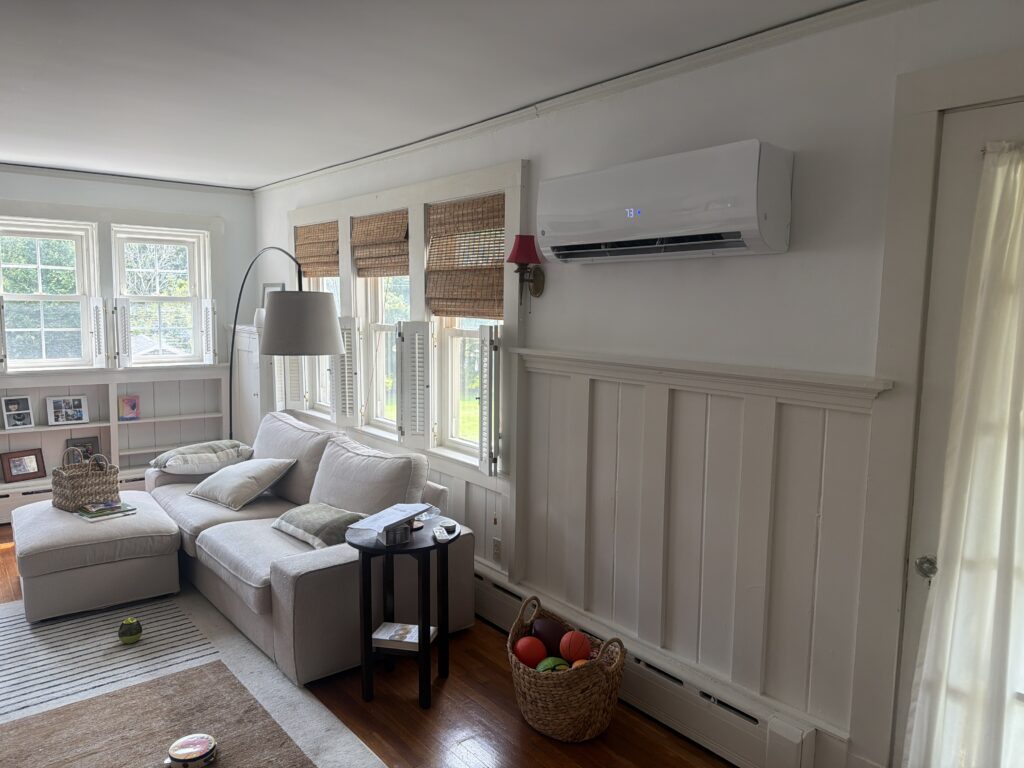
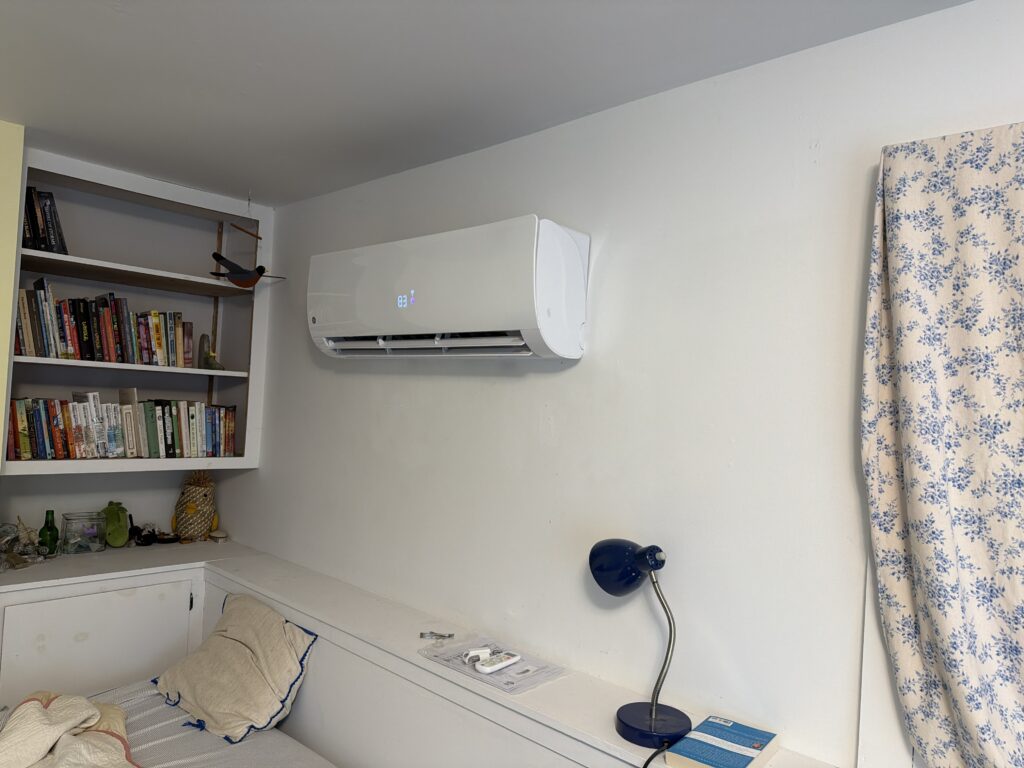
An outdoor condenser gets placed on a pad or wall bracket, positioned for service access and away from snow load off the roofline – a real consideration on a Belchertown lot with a long driveway and real winters. Indoor units – wall-mounted, ceiling cassette, or slim ducted depending on the room – get mounted, and a line set carrying refrigerant, power, and the condensate drain runs between the two through a wall penetration we seal and finish properly. Refrigerant line length has real limits before performance and efficiency suffer, which is part of why outdoor unit placement isn’t an afterthought.
Condensate management matters more than people expect – a wall unit that isn’t draining correctly becomes a leak inside the house, not outside it. And if the job involves a multi-zone system or a load that’s going to push your electrical panel, we check capacity before we promise a install date, not after. All of this work is permitted and inspected. That’s not paperwork for its own sake – it’s the difference between a system that’s documented and insurable and one that technically runs until it doesn’t.
- Walk-through and load calculation to confirm zones, unit placement, and equipment sizing
- Electrical assessment: dedicated circuits for each indoor and outdoor unit, and whether the panel has capacity for them
- Line set routing between condenser and each indoor head, sized and insulated to spec
- Indoor unit mounting (wall-mounted, ceiling cassette, or slim ducted) and outdoor condenser placement
- Condensate management, inside and out
- Permitting and inspection on both the mechanical and electrical work
- Commissioning: refrigerant charge, airflow, and control operation verified before we call it done
Most single or two-zone installs in a Belchertown house run one to two days once equipment is on site. Whole-house ductless retrofits, or jobs that turn up an electrical panel that needs attention first, take longer – and we’ll tell you that before the crew shows up, not during.
What it costs
A single-zone mini-split install in Belchertown typically runs {PRICE_LOW} to {PRICE_HIGH}, with the range driven by a short list of real factors: how many zones you’re installing, whether you’re using wall-mounted heads or something less visible like a ceiling cassette or slim ducted unit, how far the line set has to run between indoor and outdoor units, whether your electrical panel has room for the new circuit or needs work first, and how easy the house is to access – a ranch on a slab is a different job than a center-village house with tight wall cavities and an older panel. We won’t quote a number before we’ve seen the house and run the load calculation. Anyone who will is guessing.
- Number of zones and indoor units
- Indoor unit type: wall-mounted, ceiling cassette, or slim ducted, which vary in cost and complexity
- Line set length between condenser and indoor units
- Electrical capacity, and whether the panel needs additional circuits or a change-out
- Access: attic runs, exterior penetrations, distance from condenser to units
If the panel does need attention – and in some of Belchertown’s older housing stock it does – that’s work we handle in-house, permitted and inspected under our own electrical licensing, not farmed out to a sub we’re hoping shows up on schedule.
Rebates and incentives
Mass Save exists, it applies to qualifying heat pump installations, and the specifics – what qualifies, what the current incentive structure looks like, what paperwork is involved – change often enough that we’d rather walk you through your specific situation than quote you a figure that might be wrong by the time you read this. [EXTERNAL LINK: masssave.com – for current program details and eligibility] has the authoritative, current information, and our Mass Save heat pump rebates page covers how we help homeowners work through it. We’ll tell you plainly what we think applies to your house and what we don’t know yet.
Get a Quote
If you’re in Belchertown and looking at a single room that never gets comfortable, a finished space with no ductwork, or equipment old enough that replacement is the real conversation, call Powers Air at {PHONE}. You’ll talk to Drew, not a scheduler reading from a script, and the first real step is a load calculation done against your actual house. See our ductless mini-split installation page for how we approach this everywhere in the territory, or visit our Belchertown HVAC services page for the rest of what we handle in town.
frequently asked questions
Can a ductless mini-split actually heat a Belchertown house through the winter?
A cold-climate rated mini-split can handle a real New England winter as primary heat, but it needs to be specified for that job – not every unit on the market is rated to hold capacity down near zero. We size and spec around your actual design temperature, and we're upfront about where backup heat still belongs in the plan.
My house has no ductwork at all - is ductless my only option?
For most older Belchertown houses with steam or hot water heat and no ducts, yes – ductless is the practical path to both heating and cooling without opening walls and ceilings to run duct where there's no chase for it. It's also usually the more efficient option room for room.
Does it matter that my house runs on propane instead of gas?
It matters a lot. Propane and oil cost more per unit of heat than natural gas, which changes the payback math on a heat pump in your favor compared to a house with gas service. We'll run the comparison against your actual usage rather than a general rule.
How many zones do I actually need?
That depends on the load calculation, not a guess based on room count. Some additions or bonus rooms need one zone; a whole-house retrofit might need four or five matched to a single or paired outdoor unit. We spec it to the house, not to a package deal.
What if my electrical panel can't handle a new mini-split circuit?
We check panel capacity before we promise an install date. If it needs an upgrade, we handle that in-house under our own electrical licensing, permitted and inspected, rather than sending you to find a separate electrician.