
Ductless Mini-Split Installation in South Hadley, MA
Walk the blocks around the Village Commons and you’re looking at a lot of pre-war construction built for radiators, not ductwork. Head out toward Route 116 or the newer subdivisions past the college and you find post-war ranches and split-levels that got a forced-air furnace somewhere along the way but never got whole-house air conditioning. Both situations end up at the same answer more often than people expect: a ductless system sized for the actual house, not a generic box pulled off a truck.
- Powers Air HVAC, based in Granby, MA
South Hadley is also a town where a good number of houses aren’t lived in by the people making the HVAC decision. Mount Holyoke draws faculty rentals and student housing into the mix alongside long-time owner-occupied homes, and that changes what matters in a quote. A landlord wants reliability and low callback risk. A homeowner planning to stay twenty years wants efficiency and comfort in the room they actually use. Both are legitimate priorities and they lead to different equipment choices.
- Additions and bump-outs that were never tied into the main heating system
- Finished attics and basements that run twenty degrees off the rest of the house
- Whole houses with radiators or baseboard and no ducts to tap into at all
- Individual units in a converted multifamily, where each tenant needs their own zone and their own thermostat, not a shared system nobody controls
- Rooms at the far end of an existing duct run that never got enough air to begin with
This page is about what a mini-split actually solves in a South Hadley house, how we size one correctly, and what you should expect to pay and to ask for in a quote.
What South Hadley homes are working with
A meaningful share of the housing stock here predates central ductwork entirely. Steam or hot water radiators heat the house, there’s no trunk line running through the basement or attic, and the furnace-and-ducts conversation never really applies. For these houses, running sheet metal through finished walls and ceilings to add central air isn’t a renovation anyone wants to pay for. A ductless system solves the same comfort problem with a line set run through a wall penetration and no demolition. That’s the honest pitch for ductless in the older sections of South Hadley, not a sales line.
Fuel source matters too. Plenty of South Hadley homes, especially outside the center and in the older neighborhoods near the river, run on delivered oil or propane rather than natural gas. When your alternative to electric heat is a fuel truck instead of a gas line, the math on a heat pump looks different than it does in a town with cheap piped gas. You’re not comparing electric resistance heat against gas – you’re comparing it against oil deliveries, and that comparison usually favors a cold-climate heat pump for a big chunk of the heating season, with backup heat covering the coldest stretches. The other recurring pattern here is additions and finished spaces – a bonus room over a garage, a finished attic, a converted sunporch – that the main system was never ducted to reach. Those rooms are classic single-zone or small multi-zone candidates.
How we size and specify the system
Before any equipment gets specified, we run a load calculation on the space – a Manual J, done properly, not estimated off square footage. That calculation accounts for insulation, window area and orientation, air leakage, and how the room is actually used. It tells us how much heating and cooling capacity the space needs in BTUs, and it’s the only honest starting point for picking equipment.
Oversizing is the most common mistake we see in this trade, and it doesn’t make a system better – it makes it worse. An oversized unit short-cycles: it blasts the room to temperature fast, shuts off, and runs in brief bursts that never dehumidify properly and never settle into the steady, efficient operation these systems are designed for. It also wears the compressor harder over its life. Bigger is not safer here. Correctly sized is safer.
For cold-climate performance, we look at the unit’s rated capacity at low outdoor temperatures and its HSPF2 rating, not just its nameplate BTU number at 47°F. A unit that looks identical to a competitor’s on paper can fall off a cliff in output once it’s zero degrees outside. That’s the number that actually tells you how the system behaves on a January night in South Hadley, and it’s the number a lot of quotes skip entirely.
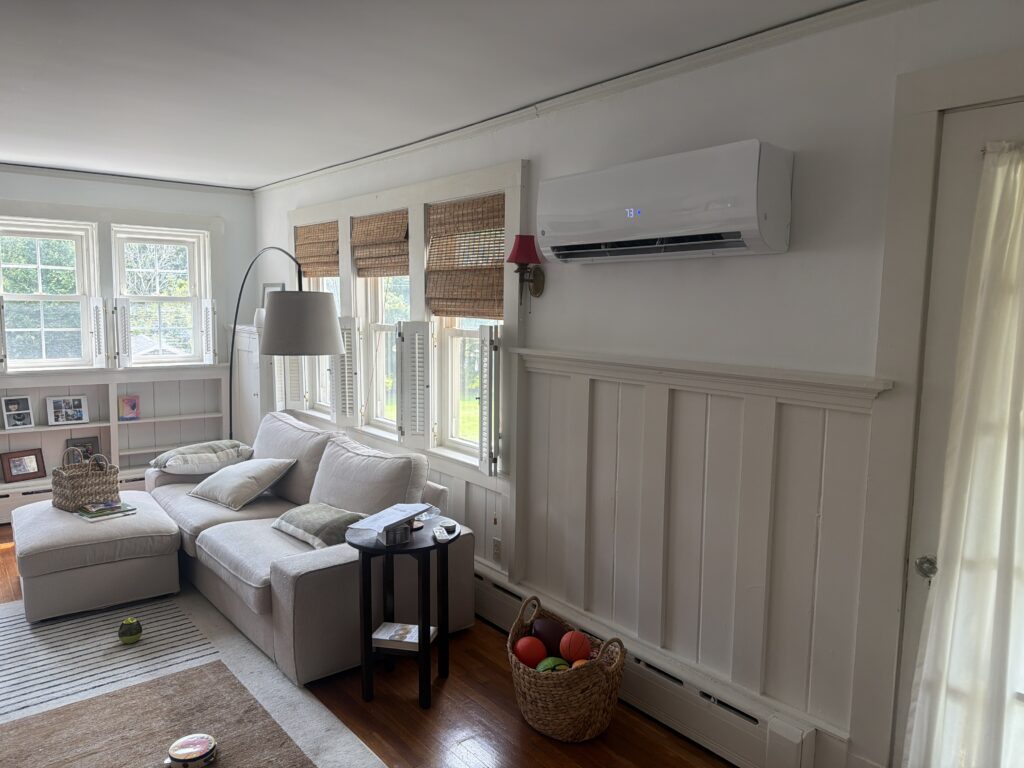
A quote that’s worth trusting lists the load calculation results, the specific indoor and outdoor unit models with their cold-climate ratings, the line set lengths and routing, and whether your electrical service has the capacity for the new circuit. If a bid shows up as a flat price with a brand name and no numbers behind it, that’s the sign to ask more questions before you sign anything.
- The load calculation the sizing is based on, room by room or zone by zone
- Which cold-climate rated equipment is being specified and why, including its rated capacity at low outdoor temperatures, not just at 47°F
- Whether the design accounts for backup or auxiliary heat on the coldest days, and what that backup source is
- Line set length and routing, since refrigerant line runs have real limits before performance and warranty coverage are affected
- Where condensate goes and how it drains
We’ll also tell you plainly if ductless isn’t the right call – some South Hadley homes with existing, well-sized ductwork are better served by a ducted heat pump or a central AC addition, and we’d rather say that up front than sell you zones you don’t need.
What the work involves
Installation starts with placement – indoor head location for airflow and aesthetics, outdoor condenser location for service access and sound, and the shortest reasonable line set run between them since refrigerant line length affects system performance and has real manufacturer limits. We run the line set, control wiring, and condensate drain through a wall penetration, mount and level both units, evacuate the lines to pull moisture and air out of the system, and charge it to the manufacturer’s spec rather than eyeballing it. Condensate management matters more than people expect – a drain line that isn’t pitched correctly will eventually show up as a water stain on a ceiling or wall, so we plan that route before anything gets mounted. For multi-zone installs we also check the outdoor unit’s total combined capacity against the sum of the indoor heads, since those numbers aren’t simply additive the way people assume.
- Walk-through and load calculation to confirm zones, unit placement, and equipment sizing
- Electrical assessment: dedicated circuits for each indoor and outdoor unit, and whether the panel has capacity for them
- Line set routing between condenser and each indoor head, sized and insulated to spec
- Indoor unit mounting (wall-mounted, ceiling cassette, or slim ducted) and outdoor condenser placement
- Condensate management, inside and out
- Permitting and inspection on both the mechanical and electrical work
- Commissioning: refrigerant charge, airflow, and control operation verified before we call it done
If the job involves a larger electrical load – a bigger multi-zone system or a whole-house heat pump conversion – we check your panel’s available capacity as part of the quote, because that’s in-house electrical work we handle directly, permitted and inspected, not something we hand off to a subcontractor and hope lines up.
What it costs
A single-zone mini-split for one room in South Hadley typically runs in the {PRICE_LOW} to {PRICE_HIGH} range installed, and multi-zone systems covering several rooms or a whole floor scale up from there. What moves the number: how many zones you’re running, whether you’re using standard wall-mounted heads or a ceiling cassette or floor-mounted unit for a specific room, how long the line set runs are and how much wall or floor penetration is involved, whether your electrical panel has room for the new circuit or needs work first, and how accessible the install locations are. We won’t give you a number before we’ve seen the space and run the load calculation – anyone who quotes a whole-house system over the phone without stepping inside is guessing.
- Number of zones and indoor units
- Indoor unit type: wall-mounted, ceiling cassette, or slim ducted, which vary in cost and complexity
- Line set length between condenser and indoor units
- Electrical capacity, and whether the panel needs additional circuits or a change-out
- Access: attic runs, exterior penetrations, distance from condenser to units
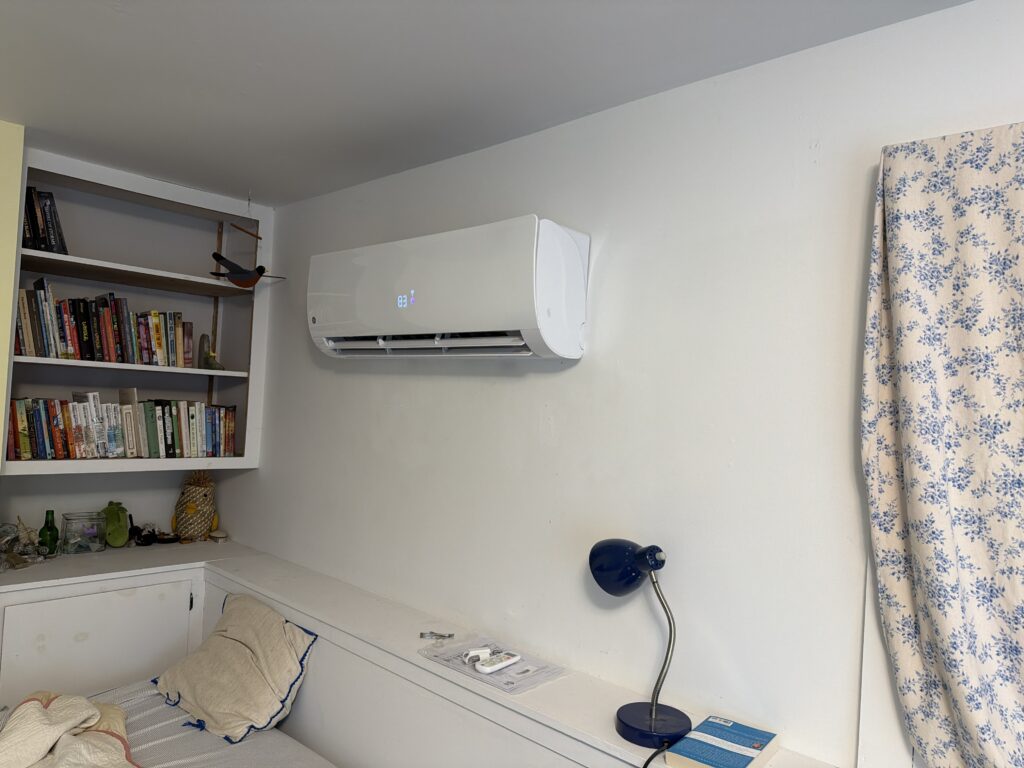
Student rental properties and multifamily conversions near the college sometimes add complexity – separate metering, shared wall considerations, or landlord preferences for simpler single-zone units per unit rather than a complex multi-zone layout. We’ll walk through those tradeoffs specifically if that’s your situation.
Rebates and incentives
Massachusetts runs the Mass Save program, which offers incentives for qualifying heat pump installations, and it’s worth understanding before you finalize a system since eligibility depends on the equipment specified and the work performed. Rules and amounts change, so rather than quote you a figure that might be out of date by the time you read this, we’ll help you work out what actually applies to your specific South Hadley home once we know the scope. You can also review current program details directly. [EXTERNAL LINK: masssave.com – current program requirements and participating equipment]
Get a Quote
If you’re dealing with a room that never gets comfortable, an addition with no ductwork, or an older South Hadley home that’s never had central air, we’ll come take a real look, run the load calculation, and give you a quote with numbers behind it. Drew does the assessment himself, so what you discuss on-site is what shows up on the quote. Call {PHONE} to set up a time.
frequently asked questions
Is ductless a good fit for an older South Hadley home with radiators and no ductwork?
Often yes. If your house heats with steam or hot water radiators, there's no ductwork to tie into and no good way to add central air without major demolition. A ductless system solves that by running a small line set through a wall instead of sheet metal through your walls and ceilings.
How many zones does a typical South Hadley house need?
It depends on layout, not square footage alone. A single problem room – a converted attic or garage addition – might need just one zone. A whole-floor or whole-house ductless setup usually needs a properly calculated multi-zone system, which we size room by room rather than guessing a number up front.
Do mini-splits actually keep up with Massachusetts winters?
Cold-climate rated units are designed for it, but capacity does drop as the temperature drops, which is why we look at a unit's rated output at low outdoor temperatures, not just its standard nameplate number, and plan backup heat for the coldest stretches of the year.
Will I qualify for a Mass Save rebate on a mini-split?
It depends on the equipment and scope of the project, and program rules change over time, so we can't quote a figure here. We'll help you understand what might apply to your specific house once we know what system makes sense, and you can also check current program details directly with Mass Save.
Can Powers Air handle the electrical work if my panel needs an upgrade for a mini-split?
Yes, that's in-house licensed electrical work, not a referral to someone else. If a larger multi-zone system needs more capacity than your panel has available, we assess that as part of the quote and perform the work permitted and inspected.