
Furnace Installation and Replacement in Chicopee, MA
Chicopee’s housing stock splits pretty cleanly into two eras: the dense two and three family blocks that went up around the mills and the river, and the post-war single-family neighborhoods that spread out toward Fairview and Westover. A lot of both have a furnace in the basement that’s older than the current owner’s time in the house, tied into ductwork that was sized for a different system and sometimes a different fuel entirely.
That’s the starting point for most furnace calls we get out of Chicopee. Not “we want a new furnace,” but “this one is making noise and it’s twenty years old and we don’t know what’s next.”
- Powers Air HVAC, based in Granby, MA
Furnace Installation and Replacement in Chicopee
Chicopee is the second largest market in the territory we cover out of Granby, and it behaves differently than the smaller towns around it. You’ve got a strong commercial and light industrial base, a lot of two and three family properties where the owner lives in one unit and rents the others, and buyers who have usually priced out more than one contractor before they call anyone back. That’s a reasonable way to shop for a furnace. It just means the quote needs to hold up to scrutiny, and that starts with sizing the system to the actual house instead of guessing off the old equipment’s nameplate.
We install and replace furnaces across Chicopee whether the house has natural gas on the street, runs on delivered oil, or sits on propane out past the gas main’s reach. All three fuel types show up in this city depending on the block, and the right furnace spec depends on which one you’ve got before we talk about anything else.
What Chicopee homes are working with
Gas availability in Chicopee is better than in a lot of the smaller towns we serve, but it’s not universal. The older mill-adjacent neighborhoods and most of the post-war development have natural gas service, which keeps furnace operating costs predictable and makes a straight gas furnace replacement a simple, defensible call in a lot of cases. Head toward the edges of the city or into some of the older rural-feeling pockets and you’ll find homes still running on delivered oil or propane, where the fuel cost math shifts and it’s worth at least discussing whether a heat pump with a backup furnace makes more sense than furnace alone.
The multifamily stock is the other variable that matters here. A two or three family building usually means either one furnace serving the whole structure through a shared duct system, or separate furnaces per unit, each with its own, often undersized, ductwork squeezed into whatever chase or closet was available when the building was converted from steam decades ago. Landlords and owner-occupants ask for different things from a quote. An owner-occupant wants comfort and a fuel bill that makes sense. A landlord wants a reliable unit that won’t generate a 2 AM call, installed without disrupting a tenant who isn’t going to be home for a load calculation. We size and spec for both, but we tell you up front which one we’re building the quote around.
How we size and specify the system
Every furnace quote we write starts with a Manual J load calculation, not a sticker on the old unit. The load calculation accounts for the house’s actual square footage, insulation, window area, and air leakage, and it tells us how much heat the house loses on a design-cold day. That number, not the size of the furnace currently installed, is what determines the replacement.
Oversizing is the most common mistake in this business and it’s almost always sold as a feature. A bigger furnace heats the house faster, which sounds good, but it means the burner cycles on and off more often instead of running a long, steady cycle. Short cycling wears out ignitors and blower motors faster, leaves rooms unevenly heated, and does nothing for efficiency despite the higher upfront cost. A correctly sized furnace runs longer, quieter cycles and actually holds temperature better room to room.
If you’re getting quotes and one of them doesn’t reference a load calculation at all, that’s worth noticing. A real quote tells you the furnace’s input and output BTU rating, the AFUE efficiency rating, what it assumes about your existing ductwork’s static pressure, and whether that ductwork needs modification to handle the new unit’s airflow. Anything shorter than that is a price, not a specification.
What the work involves
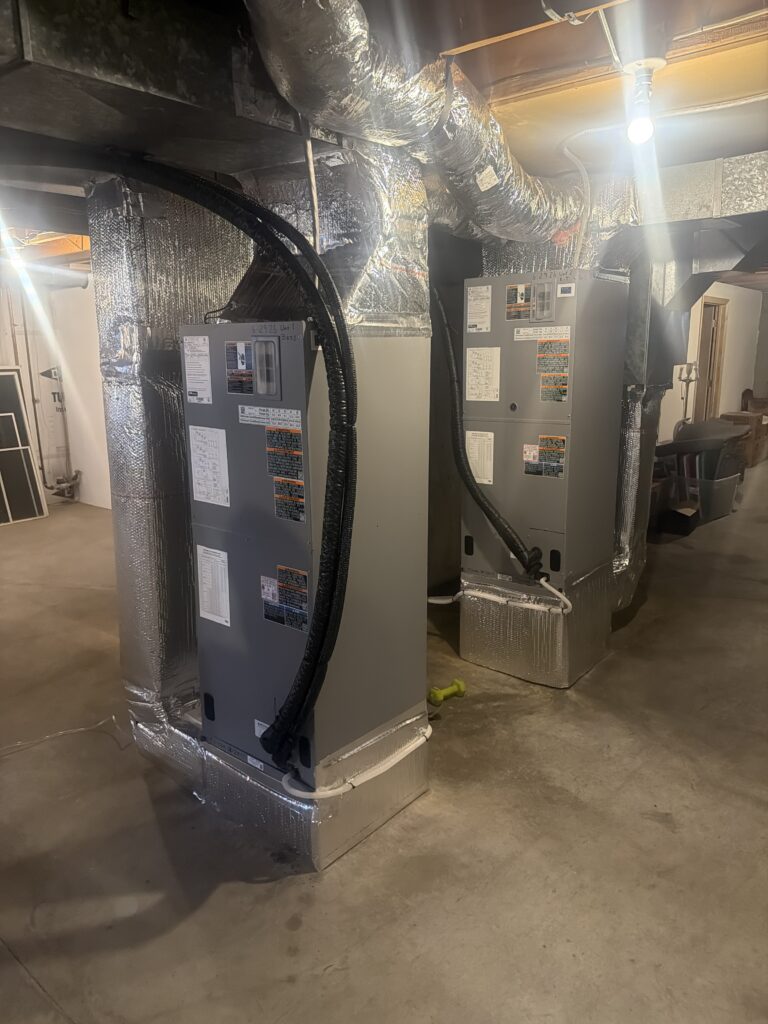
A furnace swap touches more than the box itself. We disconnect and remove the old unit, inspect and often reseal the supply and return plenum connections, and check the venting, whether that’s a chimney liner for an older atmospheric-vent furnace or PVC for a newer high-efficiency, sealed-combustion unit. Ductwork gets evaluated for static pressure and airflow balance, not just reused because it’s already there. Gas line sizing gets checked against the new furnace’s input rating if you’re on natural gas or propane, and if the furnace is paired with a central air system, we confirm the coil and refrigerant lines are compatible before anything gets fired up.
Permits and inspection apply to furnace replacement in Chicopee the same as anywhere else in Massachusetts, and we pull them as a matter of course. It’s not optional paperwork, it’s what confirms the gas connection, venting, and combustion safety checks were actually done and verified by someone other than the installer. A contractor skipping the permit step is usually the same one who skipped the load calculation.
- Removing and disposing of the old furnace, along with any associated oil tank or gas line modifications
- Sizing and, where needed, modifying supply and return ductwork so static pressure matches the new equipment
- Installing proper combustion air and venting: direct vent PVC for a high-efficiency condensing furnace, or a lined chimney for a conventional one
- Setting up condensate drainage for high-efficiency furnaces, which produce acidic condensate that needs to go somewhere specific, not just the nearest floor drain
- Pulling permits and scheduling the required inspections
- Commissioning the system: verifying gas pressure or oil nozzle sizing, airflow, and temperature rise against manufacturer specs before we call the job done
What it costs
Furnace installation and replacement in Chicopee generally runs between {PRICE_LOW} and {PRICE_HIGH}, and where you land in that range depends on specifics, not negotiation. Fuel type matters: a straight gas-to-gas swap is usually the simplest job, while converting from oil to gas or adding propane line work adds cost and time. Venting type matters too, since a high-efficiency furnace needing new PVC venting through an exterior wall is a different job than reusing an existing chimney liner. Ductwork condition is often the biggest variable in older Chicopee two and three families, where undersized or leaky duct runs may need modification before the new furnace can perform the way it’s rated to. Access also plays a role: a basement furnace in a single-family home is a different install than a unit tucked into a tight mechanical closet in a multifamily conversion. We walk the house, calculate the load, and give you a number built around your specific setup before any work starts, not a range pulled from a phone call.
- Whether it's a straight swap or a fuel conversion, oil to gas, oil to propane, or adding a heat pump into the mix as primary or backup heat
- Ductwork condition, and whether the existing supply and return can handle the new unit or need rework
- Venting type, direct vent versus relining an existing chimney
- Electrical service, since some high-efficiency furnaces and any accompanying heat pump equipment need panel capacity that older services don't have
- Access: basement height, oil tank removal, and how far the equipment has to travel from the truck
None of this gets decided over the phone. If you want a real number, it starts with someone walking your basement, checking your ductwork or venting, and running the numbers your house actually produces.
Rebates and incentives
Mass Save offers incentives that can apply to qualifying heating equipment and home energy upgrades, and the programme is worth understanding before you finalize a furnace decision, especially if you’re also weighing a heat pump as part of the plan. Rules and incentive amounts change and depend on your specific home and equipment choice, so we won’t quote a figure here. What we can do is walk through what might apply to your house once we know what you’re replacing and what you’re replacing it with. Full programme details are at masssave.com [EXTERNAL LINK: Mass Save official site, for current programme rules and eligibility], and if you’re exploring a heat pump instead of or alongside a furnace, our Mass Save heat pump rebates page has more background.
Permits and Inspection
Furnace replacement in Massachusetts requires a permit and inspection, covering the gas or oil connection, venting, and combustion safety of the completed install. We handle the permit filing as part of the job and schedule the inspection once the furnace is installed and running. It adds a step to the timeline but it’s the only way to confirm the work was actually done to code, not just finished and closed up.
frequently asked questions
Should I replace my furnace with the same fuel type or switch?
It depends on what's already running to your house. If you've got natural gas on the street, a gas furnace replacement is usually the simplest and most cost-effective path. If you're on delivered oil or propane, it's worth at least discussing a heat pump with furnace backup, since the fuel cost math in Chicopee's non-gas pockets is different enough to change the answer for some houses.
How long does a furnace installation take in Chicopee?
A straightforward like-for-like swap in a single-family home with accessible ductwork is usually a one-day job. Multifamily installs, duct modifications, or venting changes can extend that, which is part of why we scope the job in person before giving a timeline along with the price.
My furnace is in a shared basement serving a two or three family. Does that change the install?
It can. Shared systems often mean one furnace sized for the whole building's load, and sizing it correctly matters even more because an oversized or undersized unit affects every unit's comfort, not just one. We size for the full building when that's the setup.
Do you install both gas and oil furnaces?
Yes. We install and replace gas, oil, and propane furnaces depending on what the house already has and what makes sense going forward. The fuel source changes the venting and connection work, not whether we can do the job.
Is a permit actually required for a furnace swap, or is that optional?
It's required under Massachusetts code, not optional. The permit and inspection verify the gas or oil connection and venting were installed correctly. We pull the permit as a standard part of every furnace job.