
EV Charger Installation in Northampton, MA
Northampton is the strongest electrification market in the territory we serve, and it is also the most technically literate audience on this site. This is the town where a reader will actually want to know what a load calculation under the Massachusetts Electrical Code looks like rather than skip past it. So that is how we are going to write this page: what the car needs, what the panel can give it, and where the money actually goes.
- Powers Air HVAC, based in Granby, MA
Powers Air is based in Granby and run by Drew Powers. Drew holds the electrical licensing for this work and it is performed in-house, by him or under his direct oversight, not farmed out to a subcontractor you never meet. He would rather tell you a job is not worth doing than sell you a charger your car can’t use or a circuit your panel can’t support.
Where the Car Parks and What That Means
A home charger only makes sense where a car sits still, on your own property, for hours at a stretch. That is the real qualifying question, and it is why this page exists for Northampton specifically rather than for every town in the footprint. Northampton has the housing stock for it: single-family homes with driveways and detached garages out toward Florence and Leeds, carriage houses and converted barns around the hill neighborhoods, plenty of off-street parking that a lot of the denser two- and three-family blocks in surrounding towns simply don’t have.
It also has the Victorian and pre-Victorian downtown stock, where knob-and-tube wiring still turns up in sections that haven’t been touched since the last renovation. That matters for a charger install because the circuit it needs and the panel it draws from have to meet current code regardless of what else is still on the system. We look at both the parking and the wiring before we talk about equipment.
- Single-family home with a driveway or garage. The straightforward case. The main cost driver is distance from the panel to where the car sits, and whether the run is exposed in a garage or fished through finished walls.
- Small multi-family conversions. A lot of the older housing here was carved into two or three units over the decades, often still fed by one aging panel with circuits nobody has traced in thirty years.
- Larger apartment or condo buildings. Stacked meter banks, a house panel sized in a different era for hallway lighting and laundry, and a question that is rarely about the charger itself.
If your car lives on the street, or in a shared lot with no assigned spot, a home charger isn’t a realistic project no matter what any installer tells you. We’ll say that up front rather than sell you a unit that ends up charging through an extension cord out a window, which is neither safe nor something we’ll install.
Level 2, and What Your Car Can Actually Take
Every EV charger conversation starts with a number that doesn’t matter as much as people think: the charger’s maximum output. A 48-amp or 19.2 kW unit sounds impressive, but your car’s onboard charger is the actual limit, and most EVs on the road cap out well below that, often in the 7.7 to 11.5 kW range. Buy a charger rated above what your car can accept and you’ve spent money on capacity you will never use.
There are two ways a Level 2 charger gets connected, and the code treats them differently for a reason. A hardwired unit is permanently connected, rated for continuous use at its full nameplate amperage, and generally the better choice for a garage or exterior wall where it will run every night for years. A plug-in unit on a NEMA 14-50 receptacle is more flexible, can be removed or swapped, and is derated under the continuous-load rule, meaning the circuit has to be sized at 125 percent of the charger’s draw rather than 100 percent. Neither is wrong. Which one makes sense depends on how you use the car and what the panel can support.
As for range: a typical Level 2 setup charging overnight adds somewhere in the range of 20 to 40 miles of range per hour of charging, depending on the vehicle and the circuit size. For almost every daily driving pattern, that means a full charge by morning regardless of whether you installed the biggest unit on the shelf or a modest one sized correctly for your car.
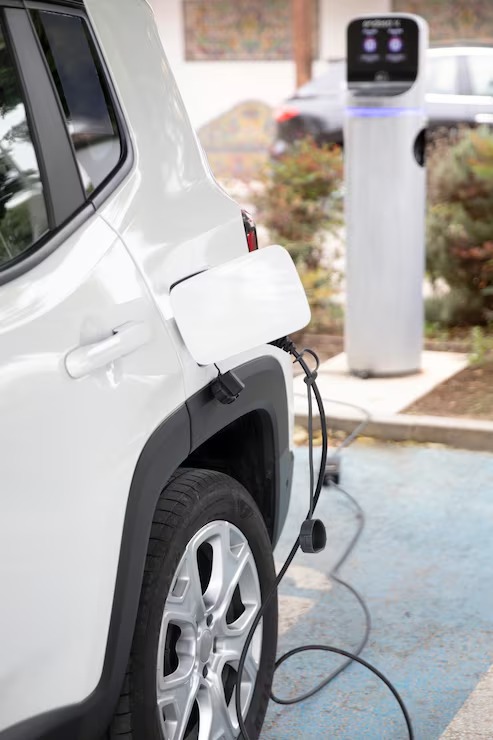
- Hardwired connection. No receptacle in the circuit at all. Typically the choice for higher-amperage installs, and there is no plug and cord sitting outdoors year after year to work loose or corrode.
- Plug-in on a NEMA 14-50 receptacle. The same style of receptacle used for a range or a welder. You can unplug the charger and take a portable unit with you, but code treats a cord-and-plug load differently than a hardwired one, and that changes some of the sizing and protection requirements.
We’ll walk through your vehicle’s onboard charger spec with you before we spec equipment. It takes five minutes and it’s the difference between buying the right unit once and buying the wrong one twice.
Whether Your Panel Has Room
This is the question that decides whether this is a same-day electrical job or a two-phase project, and it’s the one a lot of installers skip past because the answer is sometimes inconvenient. A Level 2 charger is a large continuous load, often the single biggest circuit in the house. A home already running a heat pump, a heat pump water heater, an induction range and central air has a lot of electrical demand stacked on one panel, and an older 100-amp service that was fine for a house with a gas furnace and an electric dryer may not have headroom left for a charger on top of it.
The only honest way to answer this is a load calculation, done to Massachusetts Electrical Code, that adds up your actual connected load against what the service is rated for. More often than you’d expect, the answer comes back yes, there’s room, no panel work required. When it doesn’t, a load management device that shares capacity between the charger and other large loads is frequently a cheaper fix than a full service upgrade, and it’s worth pricing before you assume you need a bigger panel.
If your panel does need work, that’s a separate job and a separate conversation. We cover what that looks like on our Northampton panel upgrade page, and if the load in question is specifically a heat pump plus a charger plus other electric loads, the heat pump panel upgrade page walks through that combination directly.
What the Work Involves
Once the panel question is settled and the equipment is chosen, the job itself has a few parts: running a dedicated 240-volt circuit from the panel to the charger location, mounting the charger on a wall or post, and landing the connection, either hardwired or into a properly rated receptacle. What drives the labor isn’t the charger, it’s the run. A charger mounted on the garage wall nearest the panel is a quick job. A charger mounted at the far end of a detached garage, or on the opposite side of a finished basement from the service panel, means a longer run and more labor, sometimes through finished walls or ceilings where the wire has to be fished rather than surface-mounted.
We won’t describe the circuit work step by step here, because there isn’t a version of landing conductors in a panel that’s safe for someone to attempt from a web page. That part of the job is ours. What you need to understand going in is where the charger will physically sit, how far that is from the panel, and whether getting there means an easy run along a garage wall or something more involved.
- A load calculation confirming the panel can carry the new circuit, or sizing a load management approach if it can't.
- Planning the run from the panel to the charger location, whether surface-run, fished through finished space, or trenched to a detached garage.
- Pulling the electrical permit before any work begins.
- Installing the dedicated circuit and charger or receptacle, sized and protected to code.
- Scheduling and passing the town inspection, which is what makes it code-compliant rather than just working.
What It Costs
A straightforward installation, charger mounted close to the panel with an easy run in an unfinished garage, typically falls in the range of {PRICE_LOW} to {PRICE_HIGH}, including the permit and inspection. What moves that number: the distance from the panel to where the car actually parks, whether the run is surface-mounted conduit in an open garage or has to be fished through finished living space, whether the wall is masonry (common enough in Northampton’s older stock), whether a trench is needed to reach a detached garage or barn, and whether the panel itself needs any work before the circuit can be added.
We’ll say this plainly: a quote that comes in noticeably lower than everyone else’s is usually missing the permit and inspection, not because the installer forgot, but because skipping it is how they got the number down. That’s not a smaller version of the same job. It’s a different, unpermitted job wearing the same price tag until an inspector or an insurance claim finds it.
- Distance from the panel to where the car actually parks.
- Whether the run is surface-mounted in an open garage or has to be fished through finished walls and ceilings.
- Whether the wall is masonry, which changes how the run is fastened and routed.
- Whether a trench is needed to reach a detached garage.
- Whether the panel itself needs work, from a load management device up to a full upgrade.
- Whether the permit and inspection are included in the quote at all.
Utility and state incentive programs for EV chargers exist and change often enough that we won’t quote figures here. We can help you work out what currently applies once we know your utility and your equipment, rather than promise a number that may not hold by the time the job is scheduled.
Permits and Inspection
EV charger circuits are permitted and inspected electrical work in Northampton and in every town we serve, full stop. The permit covers the circuit sizing, the panel capacity, and the termination, and the inspection confirms it was done to code before you ever plug a car into it. We pull the permit and schedule the inspection as a standard part of the job, not an upsell. It’s required, and it’s also the thing that protects you if there’s ever a question about the work down the road, whether that’s an insurance claim or a future sale of the house.
Get a Quote
If you’ve got off-street parking in Northampton and you’re ready to figure out what a Level 2 charger actually takes for your house, Drew will walk the panel, look at the run, and tell you straight whether it’s a simple install or a panel question first. Call {PHONE} to set up a time. For the broader picture of how this works across our whole service area, see the EV charger installation hub, and if you’re comparing this against other Northampton electrical or HVAC work, start at the Northampton town page.
frequently asked questions
Can I install an EV charger if my car is parked on the street?
Not as a home charger project. Level 2 charging requires a dedicated circuit to a fixed location on your own property where the car sits for hours. If there's no off-street parking, a home charger isn't a workable setup regardless of equipment.
Do I need a bigger electrical panel to add an EV charger?
Sometimes, but not as often as people assume. A load calculation done to the Massachusetts Electrical Code tells us whether your existing service has headroom. Many homes do. When they don't, a load management device is often cheaper than a full panel upgrade.
Should I get a hardwired charger or one that plugs into a NEMA 14-50 outlet?
Hardwired units are rated for full continuous use and are generally the better choice for a permanent garage installation. Plug-in units on a 14-50 receptacle are more flexible but are derated under the code's continuous-load rule, meaning the circuit needs extra sizing headroom.
How much range does an overnight Level 2 charge actually add?
Typically 20 to 40 miles of range per hour of charging, depending on the vehicle and circuit size. For most daily driving, a full overnight charge happens regardless of whether the charger is a smaller or larger unit, since the car's onboard charger is usually the real limit.
Is the permit and inspection really necessary for a home charger?
Yes. It's required in Northampton and everywhere we work, and it's the part of the job a cheap quote is most likely skipping. We include the permit and inspection as a standard part of every install, not an add-on.