
Ductless Mini-Split Installation in Granby, MA
Granby is a town of farmhouses and ranches on big lots, not a grid of tract homes with gas lines running under every street. If your house is heated with oil or propane right now, you are not unusual here, you are the majority. That single fact changes the math on a heat pump more than almost anything else we talk about on a sales call.
- Powers Air HVAC, based in Granby, MA
A lot of the houses we work on in Granby were built before central ductwork was standard, or they have an addition, a converted barn, a finished basement, or a bonus room over the garage that was never part of the original heating plan. Mini-splits exist for exactly that problem. No ducts to fight, no tearing open plaster to run metal, just a line set and a condensate line between an outdoor unit and one or more indoor heads.
- Additions and bump-outs that were never tied into the main heating system
- Finished attics and basements that run twenty degrees off the rest of the house
- Whole houses with radiators or baseboard and no ducts to tap into at all
- Individual units in a converted multifamily, where each tenant needs their own zone and their own thermostat, not a shared system nobody controls
- Rooms at the far end of an existing duct run that never got enough air to begin with
This page is about what that installation actually involves in a Granby house, how we size it so it performs instead of just existing, and what you should expect to pay and to get in return.
What Granby homes are working with
There is no significant natural gas distribution out here, which means most Granby homes run on delivered oil or propane for heat. That is expensive fuel, bought a tank at a time, with price swings you have no control over. A heat pump that offsets a big chunk of that oil or propane use with electricity you’re already paying for anyway has a far better payback in Granby than the same system would in a town piped for cheap gas. We say this on every rural town page in our territory because it is true everywhere out here, and it is especially true in Granby.
The housing stock splits a few ways: older farmhouses from the 1800s and early 1900s, often with steam or hot water radiators and zero ductwork, plus a good amount of post-war and later single-family construction on larger lots where you’ll find a mix of forced hot water baseboard and, less often, functioning forced air. Most of what we see is owner-occupied, not rental stock, and homeowners here tend to be in the house for the long haul, which matters when we talk about equipment that should last 12 to 15-plus years and payback periods that make sense over time. If your house has radiators and no ducts, ductless isn’t a workaround, it’s the correct tool for the job.
How we size and specify the system
Every recommendation starts with a load calculation, a Manual J, done for your specific house, not a square-footage guess scribbled on the back of a business card. We look at insulation, window area and orientation, ceiling height, air leakage, and how the space is actually used, because a sunny south-facing bonus room and a shaded north-facing bedroom of the same square footage need different capacity.
The most common mistake in this business is oversizing. A bigger unit sounds safer, but an oversized mini-split short cycles, meaning it blasts the space to temperature and shuts off before it ever dehumidifies the air or settles into a steady, efficient run. You end up with a room that feels clammy in summer and a compressor that wears out faster from constant starts and stops. Right-sized is more comfortable than oversized, every time, and it costs less to run.
Cold climate performance matters just as much as square footage. We look at the cold-climate rating and HSPF2 number for any unit we quote, because capacity drops as outdoor temperature drops, and you need to know what a given head can actually deliver at 5 degrees, not just at 47. If you’re planning to rely on the mini-split as your primary heat source through a Granby winter, we talk honestly about backup or auxiliary heat and where the crossover point sits for your specific equipment.
If a quote lands in your hands with no load calculation behind it and no mention of line set length or electrical capacity, that’s a warning sign, not a bargain. We will walk you through exactly what’s in ours.
A proper quote covers the number and location of indoor heads, the outdoor unit’s rated output at design temperature, line set routing and length, electrical requirements for the outdoor disconnect and indoor heads, and condensate management. If any of that is missing, ask why.
- The load calculation the sizing is based on, room by room or zone by zone
- Which cold-climate rated equipment is being specified and why, including its rated capacity at low outdoor temperatures, not just at 47°F
- Whether the design accounts for backup or auxiliary heat on the coldest days, and what that backup source is
- Line set length and routing, since refrigerant line runs have real limits before performance and warranty coverage are affected
- Where condensate goes and how it drains
We also check your existing electrical panel capacity as part of the quote. Older Granby farmhouses sometimes have a panel that’s maxed out before you even add a heat pump. Since we handle panel upgrades in-house under our own electrical licensing, permitted and inspected, we can fold that into one project instead of sending you to find a separate electrician.
What the work involves
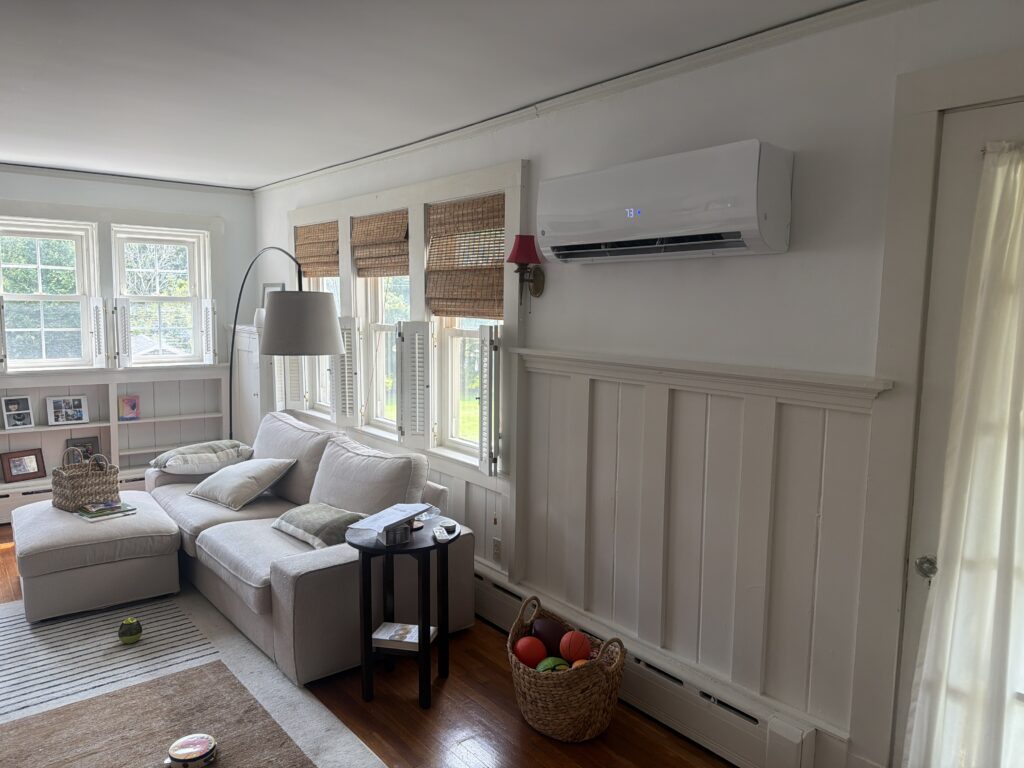
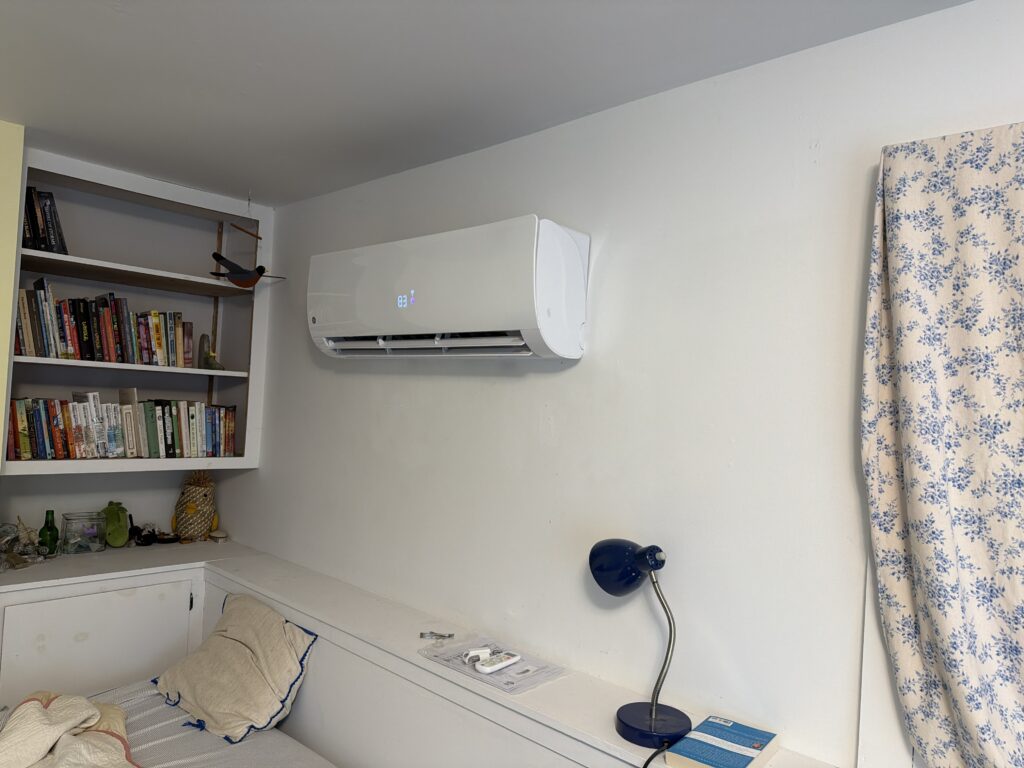
Installation day starts with setting the outdoor condenser on a pad or wall bracket in a spot that won’t get buried by snow drift or ice coming off a roofline, which matters more here than in a sheltered suburban yard. Indoor heads get mounted high on a wall or ceiling where airflow will actually reach the room, not just wherever is easiest to drill.
We run the line set, the insulated copper tubing carrying refrigerant between outdoor and indoor units, through the wall at the shortest practical path, because every extra foot of run affects performance and adds to labor. Refrigerant line length has real limits per manufacturer spec, and in a sprawling farmhouse with the outdoor unit far from the room you want conditioned, that limit can actually drive where equipment gets placed. Condensate drainage gets routed so it doesn’t dump onto a foundation or a walkway where it’ll turn into ice in January. Once everything’s connected, we evacuate the lines, charge the system to spec, and test it under real operation, not just power it on and call it done.
If electrical capacity is tight, that work happens as part of the same visit by us, not a referral to someone else, with a permit pulled and the work inspected.
- Walk-through and load calculation to confirm zones, unit placement, and equipment sizing
- Electrical assessment: dedicated circuits for each indoor and outdoor unit, and whether the panel has capacity for them
- Line set routing between condenser and each indoor head, sized and insulated to spec
- Indoor unit mounting (wall-mounted, ceiling cassette, or slim ducted) and outdoor condenser placement
- Condensate management, inside and out
- Permitting and inspection on both the mechanical and electrical work
- Commissioning: refrigerant charge, airflow, and control operation verified before we call it done
Most single and two-zone installs in a Granby house take one day. Larger multi-zone jobs, or ones involving electrical panel work, usually run a day and a half to two days depending on access and how much line set needs to travel.
What it costs
A straightforward single-zone mini-split in Granby typically runs {PRICE_LOW} to {PRICE_HIGH} installed. Multi-zone systems covering several rooms cost more, and the swing between a simple job and a complicated one comes down to a handful of things: how many indoor heads you need, whether you want wall-mounted heads or a lower-profile ceiling or floor-mounted unit, how far the line sets have to travel, whether your electrical panel has room for the new circuit or needs upgrading first, and how accessible the install locations are. A one-story ranch with an easy exterior wall is a different job than a three-story farmhouse with the outdoor unit placement 40 feet from the target room. We give you a real number after we’ve actually looked at the house, not a phone quote.
- Number of zones and indoor units
- Indoor unit type: wall-mounted, ceiling cassette, or slim ducted, which vary in cost and complexity
- Line set length between condenser and indoor units
- Electrical capacity, and whether the panel needs additional circuits or a change-out
- Access: attic runs, exterior penetrations, distance from condenser to units
We never price a repair or install sight unseen, and we’ll tell you plainly if a job isn’t a good fit for ductless before we take your money for it.
Rebates and incentives
Mass Save offers incentives for qualifying heat pump installations, and the details, eligibility, and amounts change over time, so we’re not going to quote you a figure here that might be outdated by the time you read this. What we can do is look at your specific house and help you understand what you might qualify for and how to apply. For the current program details, check masssave.com directly, or see our Mass Save heat pump rebates page for a general breakdown of how the program works. [EXTERNAL LINK: masssave.com, the authoritative source for current Mass Save program rules and eligibility]
Get a Quote
If you’re dealing with a room a forced hot water system never reached, a farmhouse with radiators and no ducts, or just a heating oil bill that’s gotten out of hand, call Powers Air at {PHONE}. Drew will walk the house with you, run the numbers, and tell you straight whether ductless is the right call before anything gets quoted.
frequently asked questions
Can a mini-split really heat a Granby house through a cold winter?
Cold-climate mini-splits are rated to keep delivering heat well below freezing, but capacity does drop as the temperature drops. Whether a given system can carry your whole house through a January cold snap depends on the unit's cold-climate rating, your home's heat loss, and whether you keep a backup heat source. We size for your specific house and tell you honestly where the crossover point is, rather than promising a single unit will do everything in every condition.
Do I need ductwork for a mini-split?
No. That's the entire point of a ductless system. Refrigerant lines run between an outdoor condenser and one or more indoor heads, so homes with radiators or baseboard heat and no ducts at all, which describes a lot of older Granby farmhouses, are perfectly suited to it.
How many indoor units do I need?
It depends on your layout, not a rule of thumb. A single-zone system can handle one room or an open area well. Multiple rooms with different exposures and uses usually call for a multi-zone system with a head in each space, sized individually based on a load calculation, not a flat per-square-foot number.
Will a mini-split actually save money if I'm on oil or propane?
In a town like Granby with limited natural gas service, the math tends to favor heat pumps more than it would in a gas-piped town, because you're offsetting expensive delivered fuel rather than cheap piped gas. The exact savings depend on your current fuel use, insulation, and how much of your heating load the mini-split is designed to carry. We'll go over your specific numbers rather than a generic estimate.
What if my electrical panel can't handle a new mini-split?
We check panel capacity as part of every quote. If your panel needs more room or a full upgrade, we handle that in-house under our own electrical licensing, with a permit pulled and the work inspected, instead of sending you to find a separate electrician for a second project.