
Air Conditioning Repair in Chicopee, MA
Chicopee’s housing stock splits roughly into two eras that break down very differently when the AC quits: post-war ranches and capes with a furnace and a condenser bolted on later, and the older two and three family stock along the river where a lot of units are window shakers or ductless heads because there was never a duct system to tie into. Whichever one you’ve got, the diagnosis starts the same way – find out what’s actually failed before anyone talks about fixing it.
- Powers Air HVAC, based in Granby, MA
If your central air is blowing warm, short cycling, tripping a breaker, or just not keeping up on a 90 degree afternoon, call {PHONE}. You’ll get Drew, not a call center reading from a script, and he’ll walk through what the system is doing before he drives out so he shows up with the right part instead of guessing twice.
- No cold air, or air that is barely cooler than the room
- Ice forming on the outdoor unit or the line set
- Short cycling, where the system turns on and off every few minutes instead of running a full cycle
- A breaker that trips repeatedly when the AC starts
- Water pooling near an indoor unit, or a stain on the ceiling below one
- A system that has gotten noticeably louder, especially on startup
What Chicopee homes are working with
At around 55,600 people, Chicopee is the second largest market in this territory, and the building stock reflects a city that grew in two distinct waves. There’s a heavy concentration of post-war single-family homes built from the late 1940s through the 1960s, usually with a basement furnace and a central air system added or upgraded at some point rather than designed in from the start. Then there’s the older mill-era housing closer to the river and the downtown core – plenty of two and three family properties, often owner-occupied on one floor with the rest rented out, where steam or hot water radiators handle heat and cooling has historically meant a window unit in the bedroom.
Both housing types create real repair and sizing questions. In the post-war homes, the original ductwork is frequently undersized for the AC tonnage someone installed decades later, which shows up as poor airflow, uneven cooling between rooms, or a system that short cycles because static pressure is too high. In the multifamily stock, the question is usually whether to keep patching window units or move to a ductless setup that can cool a whole floor cleanly. Chicopee buyers tend to be practical and price-aware – a lot of these are owner-occupiers who also manage the unit downstairs, and they want a straight answer on repair versus replace, not a sales pitch. Natural gas service is available through much of Chicopee proper, but plenty of surrounding pockets still run on oil or propane, which matters when you start talking about what a heat pump could do for the house beyond just summer cooling.
How we size and specify the system
Repair calls and replacement quotes get treated differently, but the same principle runs under both: you can’t size or diagnose a system correctly without understanding the house’s actual load. If your 15-year-old condenser is on its last compressor and we’re talking replacement, that conversation starts with a Manual J load calculation, not a guess based on square footage or “what’s on there now.” A huge share of the comfort complaints we see in Chicopee – rooms that never cool evenly, systems that run constantly without catching up – trace back to equipment that was oversized from the start. An oversized unit cools the air fast, shuts off before it’s pulled the humidity out, and short cycles for the rest of its life, which is harder on the compressor and worse for comfort than a correctly sized unit that runs longer, steadier cycles.
If you’re getting quotes and one of them doesn’t reference a load calculation, that’s worth noticing. A real quote tells you the tonnage and why, the SEER2 rating of the equipment, what the ductwork needs if anything, and what the line set run and electrical requirements look like. Anything shorter than that is a number, not a specification.
- The load calculation behind the recommendation, not just a model number
- Equipment capacity at your actual design temperature, not just at the 47°F rating
- What the electrical service needs to support it, and whether the panel has room
- Line set length and routing, and what that does to performance
- What backup or auxiliary heat looks like, if the system also handles heating
What the work involves
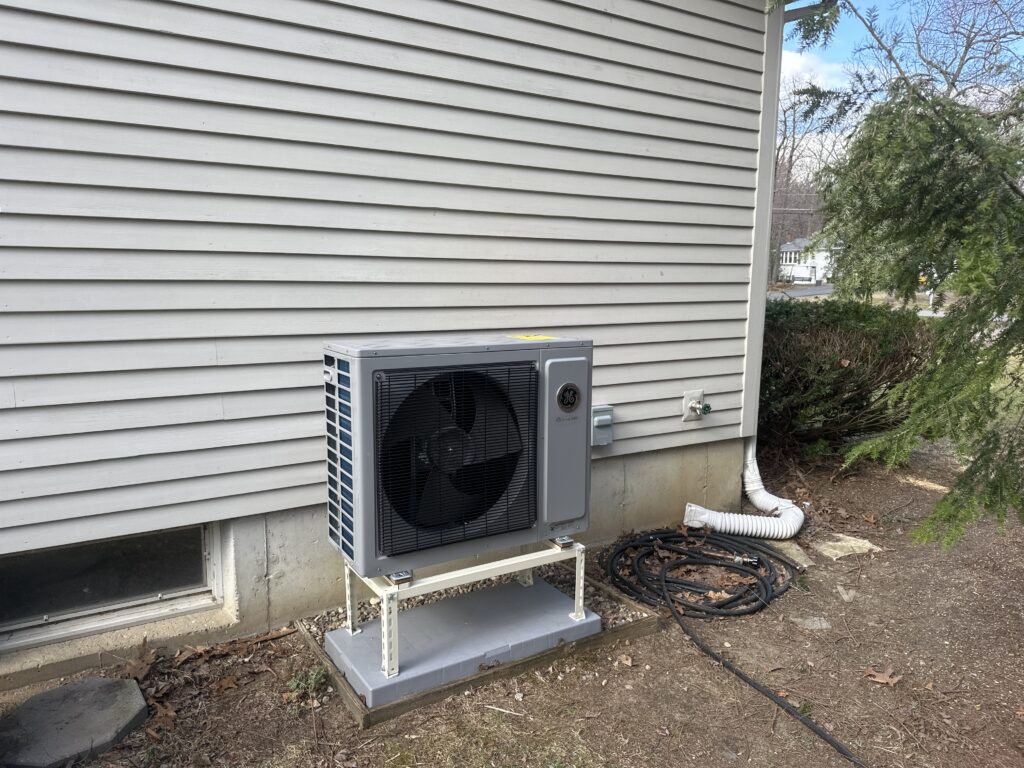
Most repair calls in Chicopee this time of year fall into a handful of buckets: a failed capacitor or contactor (quick fix), a dirty condenser coil choking airflow and killing capacity (also quick, but often ignored for years), a refrigerant leak that needs to be located and sealed rather than just recharged, or a compressor on its way out, which on an older R-22 system usually means it’s time to talk replacement instead of chasing refrigerant that costs more than the repair. We check static pressure in the ductwork on central systems because a filter or duct restriction can masquerade as a refrigerant problem and send you down the wrong repair path entirely. On ductless systems, which show up a lot in Chicopee’s older triple-deckers, we’re checking the line set, the condensate drain, and the controls board along with refrigerant charge, since a mini-split head that’s “not cooling” is frequently an airflow or drainage issue rather than a refrigerant one.
What the work involves
We tell you what we find in plain terms – what’s broken, what it takes to fix it, and whether fixing it is actually the right move given the system’s age and condition. If a repair doesn’t make sense, we’ll say so and tell you what a correctly sized replacement would look like instead of stretching out a system that’s done.
- Checking refrigerant charge and finding the source of a leak, rather than just topping it off
- Testing the capacitor, contactor, and other electrical components that fail from heat and age
- Inspecting the condenser coil and airflow, since a restricted coil is one of the most common reasons a system runs constantly without cooling
- Checking the condensate line and pan, since a clogged line is a common cause of water damage around indoor units
- Reviewing thermostat wiring and settings, which is sometimes the actual issue behind what looks like an equipment failure
What it costs
Repair costs vary enough that a flat number would be misleading – a capacitor swap is a different conversation entirely from a leak repair on an old system, so we diagnose first and quote the actual fix, not a guess. If you’re past repair and looking at replacement, installed central air or ductless systems in this area generally run from {PRICE_LOW} to {PRICE_HIGH} depending on a handful of factors: how many zones the house needs, whether you’re going ducted or ductless, how long the refrigerant line set run is, whether your electrical panel has capacity for the new equipment or needs work first, and how accessible the install site is. A triple-decker converting three floors to ductless costs differently than a single-family ranch adding one outdoor condenser. We walk through what’s driving the number before you commit to anything.
Rebates and incentives
Mass Save offers incentives for qualifying heat pump equipment, and it’s worth understanding what might apply before you commit to a system, especially if a repair is turning into a replacement conversation. The program’s rules and amounts change and depend on your specific equipment and household, so rather than quote figures that might be out of date by the time you read this, check masssave.com [EXTERNAL LINK: Mass Save program site, the authoritative source for current rebate rules and eligibility] directly, or see our breakdown of Mass Save heat pump rebates for how the program generally works. We can help you figure out what applies to your specific house once we know what equipment makes sense for it.
- Number of zones or indoor units involved
- Whether the issue is electrical, mechanical, or refrigerant-related
- Access to the outdoor unit and any indoor equipment
- Age and condition of the system, including whether parts are still available
- Whether the underlying issue points to an electrical service or panel limitation
Get a quote
If your AC is down in July, don’t wait on a callback from a dispatcher. Call {PHONE} and you’ll reach Drew directly – the person who will either be on your roof or standing behind the tech who is. If it’s a repair, we diagnose it straight and tell you honestly whether it’s worth fixing. If it’s time to replace, we start with a load calculation, not a sales pitch, and give you a specification you can actually evaluate. For general background on AC and heat pump repair across our service area, see the Air Conditioning Repair hub, and for more on what we do around Chicopee, visit the Chicopee, MA page.
Why Chicopee Homeowners Call Us First
Chicopee’s mix of older triple-deckers and newer builds near the Mass Pike means no two cooling systems behave the same way. We’ve worked on enough of them to spot a failing capacitor, a refrigerant leak, or a clogged coil quickly, instead of guessing and swapping parts.
- Straight answers about repair vs. replacement
- Technicians who know local ductwork quirks
- Honest pricing before any work starts
frequently asked questions
How fast can you get to a no-cool call in Chicopee?
Call {PHONE} and you will talk to Drew directly, not a dispatcher reading a script. Summer no-cool calls get priority because a dead system in a July heat wave is not something that waits. He will ask what the unit is doing (or not doing) over the phone so he shows up with the right parts the first time.
My central air is running but not cooling. Is that a quick fix?
Sometimes. A dirty outdoor coil, low airflow from a clogged filter, or a refrigerant leak can all look the same from inside the house – warm air out of the vents – but they are very different repairs. A leak needs to be found and fixed, not just topped off, or you will be back here again next summer.
Is it worth repairing an old central air system or should I replace it?
Depends on the age, the refrigerant type, and what is actually broken. A compressor failure on an older R-22 system is usually a replace decision because that refrigerant is expensive and being phased out. A failed capacitor or contactor on a five-year-old unit is almost always worth fixing.
Do you work on window units or ductless systems too?
Yes. Ductless mini-splits are common in Chicopee's older triple-deckers and mill-era housing that never had ductwork installed, and they need the same honest diagnosis as a central system – refrigerant charge, line set condition, and controls.
What if my AC is original to the house and parts aren't available anymore?
That happens more than you'd think with the post-war housing stock here. If a part is obsolete, we will tell you straight rather than stall for a week trying to source something that doesn't exist, and we will lay out what a replacement system would actually cost.