
Air Conditioning Repair in Hadley, MA
A good share of the houses between Route 9 and the river in Hadley are working farmhouses or former ones, some with two and three additions tacked on over the decades, each with its own idea of insulation and ductwork. Plenty never had central air ducted in at all, because the original heat was steam or hot water baseboard, which means the cooling system you do have is often a patchwork of window units, a single mini-split head, or a central air system squeezed onto an undersized duct run that was never meant to carry cold air efficiently.
- Powers Air HVAC, based in Granby, MA
If your system quit on the one day you needed it, call {PHONE}. You’ll talk to Drew or whoever is actually running the truck that day, not a call center reading a script, and you’ll get a straight answer about what’s wrong and when someone can get there.
- No cold air, or air that is barely cooler than the room
- Ice forming on the outdoor unit or the line set
- Short cycling, where the system turns on and off every few minutes instead of running a full cycle
- A breaker that trips repeatedly when the AC starts
- Water pooling near an indoor unit, or a stain on the ceiling below one
- A system that has gotten noticeably louder, especially on startup
What Hadley homes are working with
Hadley is a small town by population, around 5,300 people, but it carries an outsized commercial footprint because of the Route 9 retail corridor running through it. That matters for cooling because it means the town has a real mix of housing types and usage patterns: the farmhouses and converted agricultural properties set back from the main road, newer construction built to serve the commercial growth, and a scattering of multifamily and rental units closer to the UMass Hadley border that see different wear patterns than an owner-occupied single family home.
Natural gas service is inconsistent across this part of the valley, and a lot of Hadley households still heat with delivered oil or propane. That’s a heating conversation more than a cooling one, but it shapes the electrical panel and the mechanical room every time we’re in a basement here – a house with an oil burner and a coal-era remnant chimney often has a 100-amp panel that’s already working hard, which is relevant the moment you start talking about adding or upgrading a heat pump or central air condenser. The older farmhouse stock, especially the ones with additions, is also where ductwork tends to be absent or badly undersized, which is exactly the situation where a ductless system outperforms trying to force central air through duct runs that were never sized for it.
How we size and specify the system
Before anyone tells you what equipment you need, the house needs a load calculation, not a guess based on square footage or what the last guy had. A Manual J calculation accounts for insulation levels, window area and orientation, air sealing, and the actual floor plan, and it’s the only honest way to land on the right tonnage for a central air system or the right BTU output for a mini-split head.
Oversizing is the single most common failure we see walking into a Hadley basement or attic. A system that’s too big for the house cools the air fast and shuts off before it has time to pull humidity out, so the house feels clammy and cold at the same time, runs short cycles that wear out the compressor faster, and costs more to run than a correctly sized unit that cycles longer and steadier. Bigger is not better here. It’s worse, reliably.
A quote that doesn’t reference a load calculation, specific equipment model numbers, refrigerant line length, and electrical requirements isn’t a quote, it’s a guess with a price attached. If someone hands you a number before they’ve looked at your ductwork, your panel, and your actual square footage, that’s worth being skeptical of.
- The load calculation behind the recommendation, not just a model number
- Equipment capacity at your actual design temperature, not just at the 47°F rating
- What the electrical service needs to support it, and whether the panel has room
- Line set length and routing, and what that does to performance
- What backup or auxiliary heat looks like, if the system also handles heating
Repair work doesn’t always need a full load calculation – plenty of calls are a failed capacitor, a dirty condenser coil, a tripped breaker, or a refrigerant leak. But the diagnostic approach is the same discipline: find out what’s actually happening before guessing at parts.
What the work involves
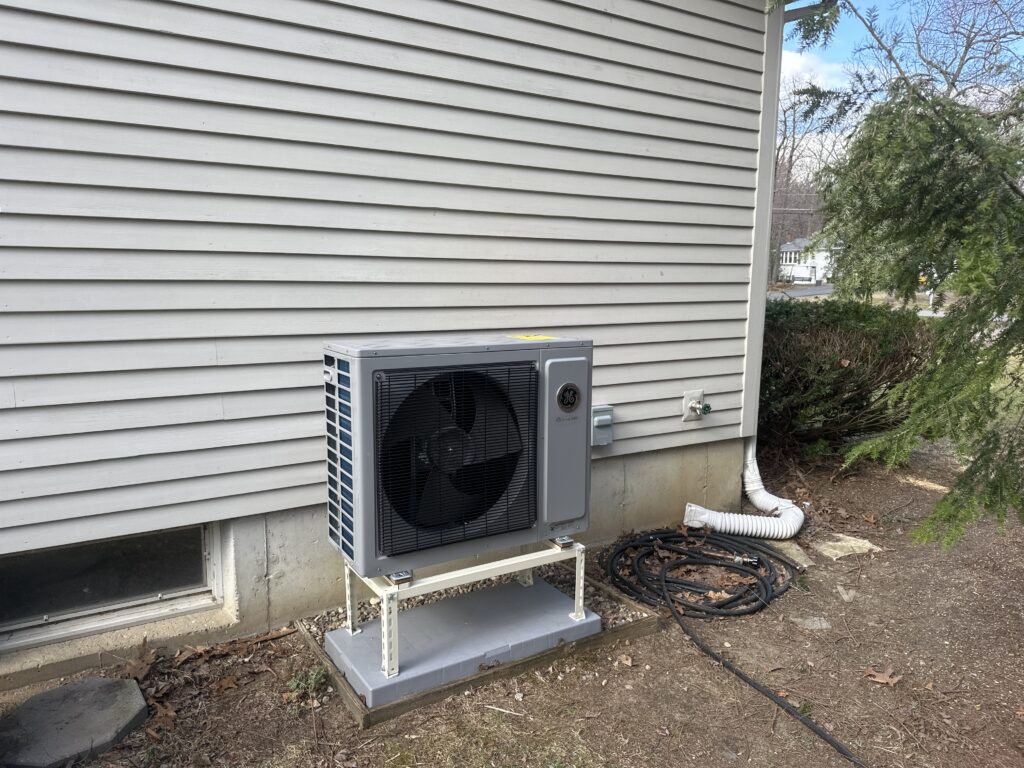
A repair call starts with listening to how the system is actually behaving – is it not starting at all, running but not cooling, cycling too short, or freezing up. From there it’s a sequence: check the electrical connections and capacitor, check refrigerant charge and look for signs of a leak, check the condenser coil for dirt or restricted airflow, and check the air handler or indoor unit for a clogged filter or frozen coil that’s choking the whole system.
On ductless systems specifically, that also means checking the outdoor unit’s defrost cycle operation, the condensate drain line for clogs, which is a common summer callback, and the indoor head’s filters and coil for the dust and pet hair buildup that quietly tanks performance over a season. On central air systems with ductwork, we’ll check static pressure if airflow seems weak, since restricted ductwork can make a perfectly good condenser look like it’s failing.
Most repairs get diagnosed and often completed same visit. Anything requiring a part on backorder or a bigger decision, like whether to repair an aging R-22 system versus replace it, gets explained clearly before any work beyond diagnosis happens.
- Checking refrigerant charge and finding the source of a leak, rather than just topping it off
- Testing the capacitor, contactor, and other electrical components that fail from heat and age
- Inspecting the condenser coil and airflow, since a restricted coil is one of the most common reasons a system runs constantly without cooling
- Checking the condensate line and pan, since a clogged line is a common cause of water damage around indoor units
- Reviewing thermostat wiring and settings, which is sometimes the actual issue behind what looks like an equipment failure
If the honest answer is that the system is too old or too far gone to be worth repairing again, we’ll tell you that plainly, including what a correctly sized replacement would look like for your specific house.
What it costs
Most straightforward central air and mini-split repairs in Hadley run between {PRICE_LOW} and {PRICE_HIGH}, covering diagnosis and the common fixes: capacitors, contactors, refrigerant leak repair and recharge, condensate issues, and coil cleaning. Where it moves is the specifics – whether the refrigerant type is still available and affordable, whether a part needs to be sourced for an older or less common model, how accessible the unit is for the repair, and whether the issue is a symptom of a bigger problem like an undersized duct system or a panel that can’t support the load.
We won’t quote you a repair price over the phone without knowing what’s actually wrong, and we won’t pad a simple fix into a bigger job. If replacement genuinely makes more financial sense than another repair on an old unit, we’ll walk through that math with you instead of just fixing what’s in front of us.
- Number of zones or indoor units involved
- Whether the issue is electrical, mechanical, or refrigerant-related
- Access to the outdoor unit and any indoor equipment
- Age and condition of the system, including whether parts are still available
- Whether the underlying issue points to an electrical service or panel limitation
Rebates and incentives
Massachusetts runs the Mass Save program, which offers incentives tied to efficiency upgrades including certain heat pump and cooling equipment installations. The specifics of what qualifies, what documentation is needed, and what the incentive amounts are change periodically, and eligibility depends on your specific equipment and situation, so we’d rather help you work out what actually applies to your house than quote you a number that might be outdated by the time you read this. You can review current program details directly at masssave.com [EXTERNAL LINK: Mass Save official program site, for current, authoritative rebate details], and our page on Mass Save heat pump rebates walks through how the program generally works for homeowners in this area.
Get a quote
Call {PHONE} and describe what the system is doing. If it’s a no-cool emergency, say so, and we’ll get there as fast as the schedule honestly allows. If you’re weighing repair against replacement on an aging system, we can talk through that on the phone before anyone comes out, so you’re not paying for a diagnostic visit on a decision you’ve already made. Either way, you’re talking to the person doing the work, not someone reading from a script.
frequently asked questions
How fast can you get to Hadley for a no-cool call?
AC failures on a 90-degree day get priority because they are genuinely urgent, especially for anyone elderly or dealing with a medical condition in the house. Call and describe what the system is doing – not cooling, short cycling, tripping a breaker – and you will get a real answer about timing from the person who is actually coming out, not a scheduling queue.
My central air is running constantly but the house still feels warm. What does that mean?
A few possibilities: the system is undercharged on refrigerant, the ductwork has enough static pressure loss that it cannot move the air it is making, or the unit was undersized or oversized for the house to begin with. Short cycling, long runtimes without recovery, and uneven temperatures room to room are all diagnostic clues, and the fix depends on which one you actually have.
Is it worth repairing an old central air system or should I replace it?
Depends on the age, the refrigerant type, and what is actually broken. A compressor failure on a system older than 12 to 15 years is usually the point where replacement makes more sense than repair, especially if it still uses R-22. A failed capacitor or contactor on a newer unit is a straightforward, inexpensive fix. We will tell you honestly which situation you are in.
Do you work on ductless mini-splits too, or just central air?
Both, and in a lot of Hadley's older farmhouses the mini-split is the primary cooling system rather than a central air add-on. Diagnosing a ductless unit involves checking refrigerant charge, the outdoor unit's operation, condensate drainage, and the indoor head's filters and coil, same logic as central air but different hardware.
Can you fix a system someone else installed badly?
Yes, and it comes up more than you would think. Undersized line sets, units mounted with no service clearance, refrigerant charge set by feel instead of by measurement. We will tell you what we find and what it will take to get the system performing the way it should, even if that means redoing part of the original installation.