
Ductless Mini-Split Installation in Chicopee, MA
Chicopee is a city of brick mill blocks along the river and a lot of two and three family housing built before anyone thought about central air. Plenty of those units are still heated with an oil-fired boiler and cast iron radiators, with no duct path anywhere in the structure, and no easy way to add one without tearing into plaster and framing.
- Powers Air HVAC, based in Granby, MA
That’s the situation ductless was built for. A mini-split gets heating and cooling into rooms that were never going to get them any other way, using a line set run instead of a duct chase, and it does it without opening every wall in the house to find out what’s behind it.
- Additions and bump-outs that were never tied into the main heating system
- Finished attics and basements that run twenty degrees off the rest of the house
- Whole houses with radiators or baseboard and no ducts to tap into at all
- Individual units in a converted multifamily, where each tenant needs their own zone and their own thermostat, not a shared system nobody controls
- Rooms at the far end of an existing duct run that never got enough air to begin with
Drew runs Powers Air out of Granby and handles the sizing and the install himself, with subcontractors for the plumbing side when a job needs it. You’re talking to the person who will be in your basement or on your roof deck, not someone reading a script off a call sheet.
What Chicopee homes are working with
At roughly 55,600 residents, Chicopee is the second largest market in this territory, and the housing stock reflects a city that grew in waves rather than one developer’s subdivision. You’ve got dense post-war ranches and capes on small lots, mid-century multi-family buildings, and older mill-era triple-deckers near the river corridor that predate central heating as we know it today. A large share of the housing here is two and three family, which changes the math on a mini-split project in a real way: a landlord sizing a system for a rental unit has different priorities than an owner-occupant conditioning their own living space, and the electrical service feeding an older triple-decker is often not what a single-family homeowner is dealing with.
Natural gas service is inconsistent across the city depending on the block, and a meaningful number of Chicopee homes still run on delivered oil or propane for heat. That matters because the economics of a heat pump change when the alternative isn’t a gas furnace burning cheap fuel, it’s an oil tank that gets filled a few times a winter at whatever the delivery price happens to be that month. Buyers here tend to be practical and price-aware, which is the right instinct. The answer isn’t to assume ductless is automatically cheaper to run. It’s to run the numbers on your specific house and your specific fuel situation before deciding what makes sense.
How we size and specify the system
Every recommendation starts with a load calculation, not a guess based on square footage. A Manual J accounts for insulation levels, window count and orientation, ceiling height, air sealing, and how the rooms are actually used, and it tells us how much heating and cooling capacity the space genuinely needs. Skip that step and you’re sizing by instinct, which is how homes end up with equipment that’s wrong in both directions.
Oversizing is the mistake I see most often from other quotes, and it doesn’t make a house more comfortable, it makes it less. An oversized unit satisfies the thermostat fast and shuts off before it’s had time to properly dehumidify the air or distribute temperature evenly through the room. That means more cycling, more wear on the compressor, and a house that feels clammy in summer even though the system is technically keeping up with the setpoint. The cold-climate heat pumps we install are rated for real HSPF2 performance and have documented capacity curves down to sub-zero temperatures, and matching that data to your actual load is what makes the system work the way it’s supposed to in a Chicopee winter.
A proper quote should show you the load calculation, the specific indoor and outdoor unit models being proposed, projected line set routing, and how backup or auxiliary heat is handled if you’re going fully ductless. If a bid shows up with just a price and a brand name, that’s a sign the contractor skipped the step that actually determines whether the system will perform.
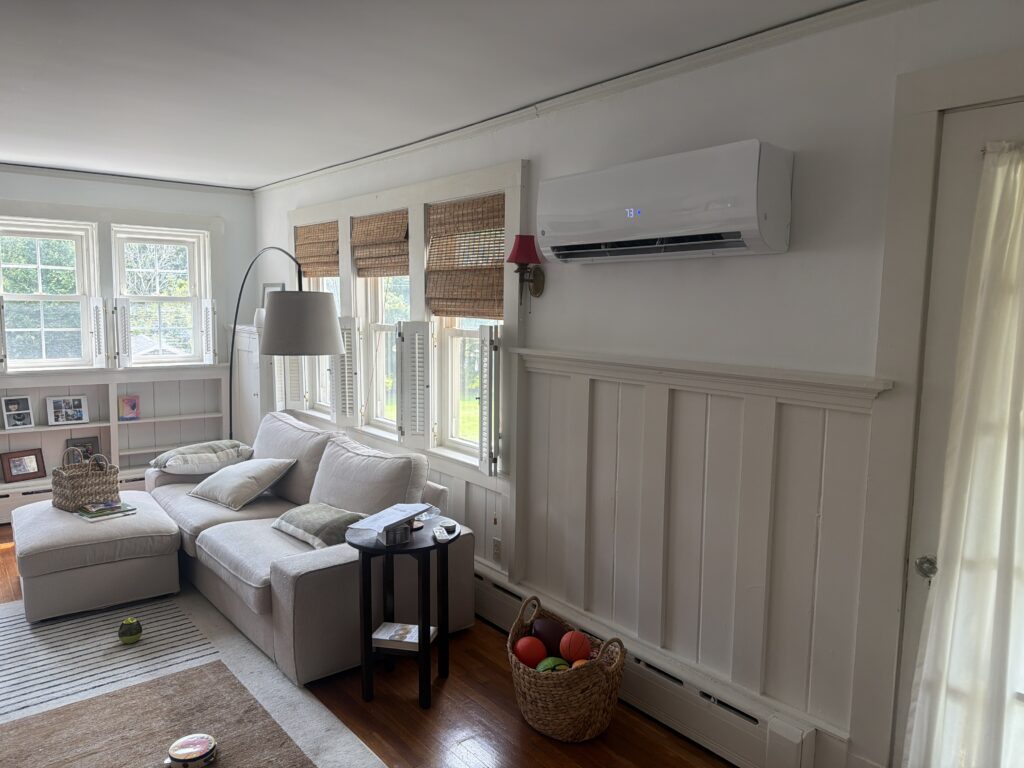
We also look hard at what the house already has going for it before we commit to a system layout. An attic that was finished without any heat source, a basement rec room that’s always ten degrees off from the rest of the house, a sunroom addition tacked onto the back of a triple-decker. Those are the rooms ductless was designed to solve, and in a city with this much multi-family and converted-space housing, there’s usually more than one of them per property.
- The load calculation the sizing is based on, room by room or zone by zone
- Which cold-climate rated equipment is being specified and why, including its rated capacity at low outdoor temperatures, not just at 47°F
- Whether the design accounts for backup or auxiliary heat on the coldest days, and what that backup source is
- Line set length and routing, since refrigerant line runs have real limits before performance and warranty coverage are affected
- Where condensate goes and how it drains
Refrigerant line length and elevation change both have real limits set by the manufacturer, and they factor into whether a single outdoor condenser can serve multiple indoor heads or whether a property needs more than one outdoor unit. On a triple-decker with three separate living units, that’s often the difference between one tidy install and three smaller ones that each need their own electrical circuit.
What the work involves
Installation starts with where the outdoor condenser sits, which on multi-family Chicopee properties usually comes down to available wall space, setback from property lines, and keeping the unit clear of snow load and roof runoff. Indoor head placement follows the load calculation, not just where it’s easiest to run a line, because airflow pattern matters for comfort as much as raw capacity does.
The line set carries refrigerant lines, electrical wiring, and the condensate drain through a wall penetration, and it gets insulated and routed to minimize both heat loss and the chance of a slow condensate leak showing up inside a wall cavity down the line. We check your electrical panel capacity before we finalize a quote, because older Chicopee multi-family wiring sometimes doesn’t have the spare capacity for another circuit without panel work first. Powers Air handles panel upgrades and change-outs in-house, under electrical licensing, permitted and inspected, so if that’s part of what your project needs it doesn’t turn into a second contractor and a second schedule.
Final steps are a vacuum test on the line set to pull out moisture and air before the system is charged, a commissioning check against manufacturer specs, and a walkthrough of the controls so you know how to actually run the thing, including any dry mode or setback settings worth using in shoulder seasons.
- Walk-through and load calculation to confirm zones, unit placement, and equipment sizing
- Electrical assessment: dedicated circuits for each indoor and outdoor unit, and whether the panel has capacity for them
- Line set routing between condenser and each indoor head, sized and insulated to spec
- Indoor unit mounting (wall-mounted, ceiling cassette, or slim ducted) and outdoor condenser placement
- Condensate management, inside and out
- Permitting and inspection on both the mechanical and electrical work
- Commissioning: refrigerant charge, airflow, and control operation verified before we call it done
Static pressure matters on any job where you’re tying into existing ductwork for a hybrid approach, but on a fully ductless install in an un-ducted triple-decker, that consideration goes away entirely, which is part of why these projects move faster than a forced-air retrofit would.
What it costs
A straightforward single-zone mini-split installation in Chicopee typically runs between {PRICE_LOW} and {PRICE_HIGH}, with the final number moving based on a handful of specific factors: how many zones you’re installing, whether you’re using wall-mounted heads or a ducted cassette for a cleaner look in a finished space, how far the line set has to travel, whether your electrical panel has room for the new circuit or needs work first, and how accessible the install locations are in your particular building. A multi-zone system for a triple-decker with three separate living units costs more than a single zone in a ranch, but it also often replaces aging boiler zones or window units across the whole property at once. We’ll walk through the real number for your house before any work starts, not after.
- Number of zones and indoor units
- Indoor unit type: wall-mounted, ceiling cassette, or slim ducted, which vary in cost and complexity
- Line set length between condenser and indoor units
- Electrical capacity, and whether the panel needs additional circuits or a change-out
- Access: attic runs, exterior penetrations, distance from condenser to units
We don’t quote a price without seeing the space, because a number based on square footage alone ignores the electrical capacity question and the line set routing question, and both of those can move a quote meaningfully in either direction.
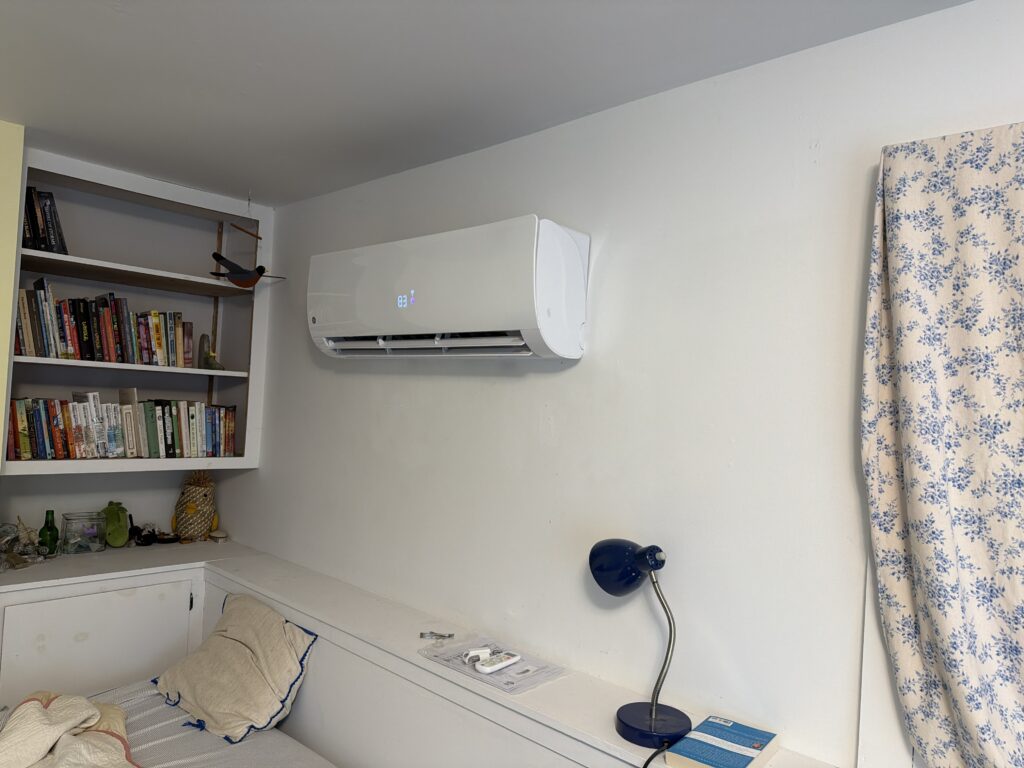
Rebates and incentives
Massachusetts runs the Mass Save program through the local utility sponsors, and cold-climate heat pump installations can qualify for incentives depending on the specifics of your project and your utility account. The rules and amounts change from year to year, and eligibility depends on factors like the equipment’s efficiency rating and how the system is configured, so it’s worth looking into before you assume what applies to your situation. We can help you work through what your specific Chicopee property might qualify for as part of the quoting process, and you can review current program details directly at masssave.com [EXTERNAL LINK: Mass Save program site, the authoritative source for current rebate rules since amounts and eligibility change year to year]. For a fuller breakdown of how the heat pump rebate process generally works, see our Mass Save heat pump rebates page.
Get a Quote
If you’ve got rooms in your Chicopee property that the existing heat never reaches, or you’re looking at a no-duct building and trying to figure out what a real heating and cooling upgrade looks like, we’ll come look at the house, run the load calculation, and give you a straight answer about what it needs and what it costs. Call {PHONE} to set up a time, or send details through the contact form and we’ll follow up directly. No dispatcher, no sales pitch, just the person who’ll actually be doing the work.
frequently asked questions
Can a mini-split actually heat a Chicopee home through a full winter?
Cold-climate mini-splits are built and rated to keep producing meaningful heat well below zero, which is a real change from the heat pumps of ten or fifteen years ago. The right system, sized correctly for your house, can be the primary heat source. We still talk through backup heat options as part of sizing, especially in older homes with higher heat loss, so you're never caught without a plan on the coldest nights.
My triple-decker has three separate units. Do I need three separate systems?
Not necessarily, but it depends on electrical service, outdoor unit placement options, and how the tenants want to control their own heat. Some multi-zone configurations can serve more than one living space off a single outdoor condenser, but each unit typically needs its own thermostat control and often its own circuit, so we evaluate it property by property.
Is ductless actually cheaper to run than my oil boiler?
It depends on your specific fuel costs, how your house is insulated, and how the system gets sized and used. Homes on delivered oil or propane tend to see the clearest case for ductless because the alternative fuel cost is higher and more volatile than gas. We run the comparison against your actual usage rather than a general assumption.
Will a mini-split work in a finished attic or basement that was never set up for heating?
Yes, and these are some of the most common installs we do. A finished attic or basement without an existing duct run is exactly the situation ductless solves, since the line set can run through a single small wall penetration instead of requiring new ductwork to be built into a space that wasn't designed for it.
What happens if my electrical panel can't handle a new circuit?
We check panel capacity before finalizing any quote. If your panel is at capacity or outdated, Powers Air handles panel upgrades and change-outs in-house as licensed, permitted, and inspected electrical work, so it gets folded into the same project instead of becoming a separate contractor and a separate delay.