
Air Conditioning Repair in Springfield, MA
Springfield has more triple-decker roofs under 600 feet of flat rubber membrane than almost anywhere else in this territory, and in August each one of those top-floor units turns into an oven by 4pm whether or not the AC is actually broken. A lot of the service calls here aren’t failures at all, they’re systems that were never sized for the heat load of a dark roof three stories up, now being asked to do a job they were never spec’d for.
Some of what we see is a genuine mechanical failure. A lot of it is a window unit or a mini-split condenser straining against a house that traps heat it was never built to shed. Either way, if your AC quit working on a 90 degree day, we’re not going to make you wait on hold to find that out.
- Powers Air HVAC, based in Granby, MA
Springfield is about 13 miles from where we’re based in Granby, and it’s the largest market we work in by a wide margin at just under 156,000 people. It’s also the most varied housing stock on the map. We treat it that way. A repair call in the Forest Park single-families is a different animal than one in the Six Corners triple-deckers, and the quote reflects that, not a flat rate off a card.
- No cold air, or air that is barely cooler than the room
- Ice forming on the outdoor unit or the line set
- Short cycling, where the system turns on and off every few minutes instead of running a full cycle
- A breaker that trips repeatedly when the AC starts
- Water pooling near an indoor unit, or a stain on the ceiling below one
- A system that has gotten noticeably louder, especially on startup
What Springfield homes are working with
The city’s bones are mostly pre-1950, with dense pockets of triple-decker and multifamily construction built right up against each other in the older neighborhoods, and larger single-family lots further out toward Sixteen Acres and East Forest Park. Natural gas service is available through a large part of Springfield, which is not the case in most of the towns we cover further out, so you’ll see more central air paired with a gas furnace here than you will in the delivered-oil and propane towns to the west. That changes the economics of the conversation. A lot of the small towns around Granby are deciding between oil and a heat pump with real savings on the table either way. In Springfield, if you already have gas and ductwork, the comparison against electric resistance backup is closer, and worth running the actual numbers on rather than assuming.
What doesn’t change is the age of the equipment. A huge share of the triple-decker and older multifamily stock has no central ductwork at all, just whatever a prior owner bolted on, often a through-wall or window unit per floor, or in better-updated buildings a ductless system serving each unit separately. Ownership matters too. A landlord with three units and three tenants wants the repair done once, done right, and documented, because a callback on a 95-degree day with an unhappy tenant costs more than the first visit would have. An owner-occupant in a single-family wants the system to last, and usually wants to know whether this repair is the last one before the equipment should just be replaced.
How we size and specify the system
Repair calls sometimes turn into replacement conversations, and when they do, we don’t start from a brand or a tonnage someone liked the look of. We start with a load calculation, Manual J style, room by room if the house warrants it. That number depends on square footage, insulation, window area and orientation, and for Springfield’s triple-deckers, how much heat the unit above or below is adding or pulling through shared floors and walls.
Oversizing is the most common mistake we find on service calls, not undersizing. An oversized system short-cycles, meaning it blasts cold air, shuts off before it’s actually dehumidified the space, and leaves the house feeling clammy even at the right temperature. That short-cycling also wears out compressors and contactors faster, which is a big part of why we get called to triple-deckers for a unit that’s only eight or nine years old. If someone hands you a quote with a tonnage on it and no load calculation behind it, that’s the clearest warning sign in this business. Ask what the number is based on. If the answer is square footage times a rule of thumb, keep looking.
- The load calculation behind the recommendation, not just a model number
- Equipment capacity at your actual design temperature, not just at the 47°F rating
- What the electrical service needs to support it, and whether the panel has room
- Line set length and routing, and what that does to performance
- What backup or auxiliary heat looks like, if the system also handles heating
On a repair call specifically, sizing matters even when you’re not replacing anything, because a system that was oversized from day one is going to keep failing the same way until that’s addressed, and we’ll tell you that honestly instead of just swapping the part that failed this time.
What the work involves
A repair visit starts with diagnosis, not a parts swap. We check refrigerant charge against manufacturer spec, not just a pressure gauge glance, because an overcharged or undercharged system can look fine on a quick check and still be the reason you’re not getting cold air. We check the condensate drain and pan, especially in multifamily buildings where a clogged drain line means water in the ceiling below, not just a puddle. We check capacitors, contactors and the compressor’s electrical draw against rated amps, since a compressor pulling high amps is usually a compressor on its way out even if it’s still running today.
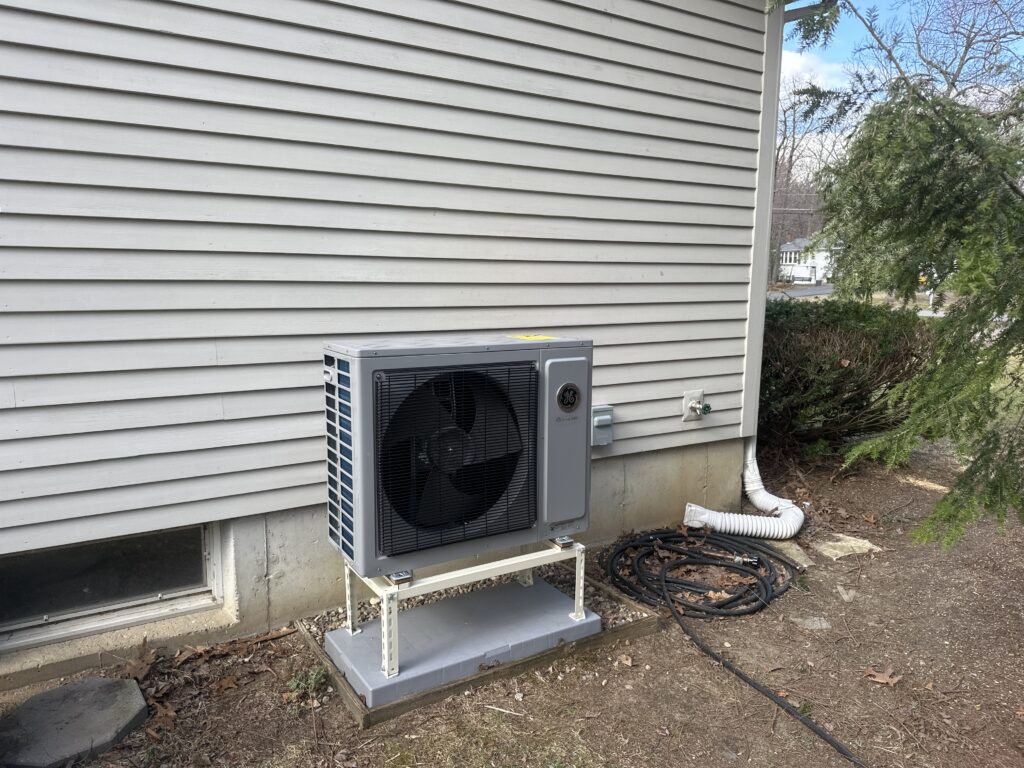
For ductless systems, which are common in Springfield’s updated multifamily units, we check the outdoor unit’s defrost cycle and fan operation, the indoor coil for restricted airflow, and the line set connections for slow refrigerant leaks, which are one of the most common reasons a mini-split loses capacity over a season or two without any dramatic failure. For central systems tied into existing ductwork, we also check static pressure, because undersized or leaky ductwork makes a perfectly good compressor work harder than it should and shows up on your bill before it shows up as a breakdown.
- Checking refrigerant charge and finding the source of a leak, rather than just topping it off
- Testing the capacitor, contactor, and other electrical components that fail from heat and age
- Inspecting the condenser coil and airflow, since a restricted coil is one of the most common reasons a system runs constantly without cooling
- Checking the condensate line and pan, since a clogged line is a common cause of water damage around indoor units
- Reviewing thermostat wiring and settings, which is sometimes the actual issue behind what looks like an equipment failure
We tell you what we found before we tell you what it costs to fix, and if the honest answer is that the unit is at the end of its service life, we’ll say that instead of patching it for another season.
What it costs
A straightforward repair, a capacitor, a contactor, a refrigerant leak repair and recharge, generally runs in the {PRICE_LOW} to {PRICE_HIGH} range in this territory, and we’ll give you that number after diagnosis, not before. What moves it: how many zones or units are involved if you’re in a multifamily building with separate systems per floor, whether the repair requires accessing a line set run through finished walls, the age and refrigerant type of the system, and whether the electrical circuit serving the unit needs any attention. A compressor failure on an older system often means the better financial move is replacement rather than repair, and we’ll walk you through that math rather than just quoting the expensive part.
- Number of zones or indoor units involved
- Whether the issue is electrical, mechanical, or refrigerant-related
- Access to the outdoor unit and any indoor equipment
- Age and condition of the system, including whether parts are still available
- Whether the underlying issue points to an electrical service or panel limitation
Rebates and incentives
If your repair call turns into a conversation about replacing the system, Mass Save is worth understanding before you sign anything. The program covers a range of equipment including heat pumps, and the specifics of what applies to a given house, and the amounts involved, change often enough that we won’t quote you a figure here. What we can do is look at your specific situation, electrical service, existing ductwork or lack of it, fuel type, and tell you what’s realistic to pursue. For the current program details directly from the source, see masssave.com, and for a deeper look at how heat pump rebates generally work in this territory, see our Mass Save heat pump rebates page.
Get a Quote
If your AC is out in Springfield right now, call {PHONE}. You’ll get Drew or someone from our small crew, not a dispatcher reading from a script. We’ll ask what the system is doing, roughly how old it is, and whether it’s central, ductless, or a window unit, so we show up with the right parts on the truck instead of guessing twice.
frequently asked questions
My AC is blowing air but it's not cold. What's going on?
This is usually low refrigerant from a slow leak, a failing compressor, or a dirty outdoor coil that can't reject heat properly. We check all three on a diagnostic visit rather than guessing, because the fix is completely different depending on which one it is.
Is it worth repairing an old AC system or should I just replace it?
It depends on the age, the refrigerant type, and what's actually failed. A compressor failure on a system over 12 to 15 years old is often the point where replacement makes more financial sense, especially if it uses an older refrigerant that's getting harder to source. We'll give you the honest comparison rather than just quoting the repair.
I live in a triple-decker and only my floor's unit is broken. Does that affect the other units?
Not mechanically if each floor has its own system, which is common in Springfield's updated multifamily buildings. But we do check whether heat from a neighboring unit's equipment is adding load to yours, which sometimes explains why one floor's AC struggles more than the others.
Do you work on window units and through-wall units, or only central and ductless systems?
We focus on central air and ductless mini-split systems, which make up most of our repair work. For older through-wall or window units we can advise on whether repair makes sense, but our strength is diagnosing and fixing central and ductless equipment correctly the first time.
How fast can you get to Springfield for an emergency repair?
We're based about 13 miles out in Granby and prioritize no-cool calls, especially during a heat wave. Call {PHONE} and we'll give you a realistic window rather than a vague promise.