
Air Conditioning Repair in Palmer, MA
If your central air quit on a 90-degree afternoon in Three Rivers or the compressor outside your Bondsville two-family just started tripping the breaker, you don’t need a sales pitch, you need someone who can look at the unit and tell you what’s actually wrong with it. That’s the call you’re making right now, and it’s the one we answer.
- Powers Air HVAC, based in Granby, MA
Palmer’s housing stock runs through several distinct building eras depending on which village you’re in, and the mechanical systems installed over the decades reflect that. A lot of the AC equipment we get called on here is either an old builder-grade condenser nobody’s touched since install, or a newer system that was sized off a square footage chart instead of an actual load calculation. Both fail for different reasons, and both get diagnosed the same way: we find the fault before we quote a fix.
- No cold air, or air that is barely cooler than the room
- Ice forming on the outdoor unit or the line set
- Short cycling, where the system turns on and off every few minutes instead of running a full cycle
- A breaker that trips repeatedly when the AC starts
- Water pooling near an indoor unit, or a stain on the ceiling below one
- A system that has gotten noticeably louder, especially on startup
Air Conditioning Repair in Palmer
We work on central air systems, ductless mini-splits, and heat pumps running in cooling mode anywhere in Palmer proper, Three Rivers, Thorndike and Bondsville. Weak airflow, a system that runs constantly without dropping the temperature, ice forming on the line set, a compressor that hums but won’t start, a breaker that trips repeatedly, water pooling near the air handler – these are the calls we get in July and August, and most of them have a straightforward mechanical cause once someone actually opens the unit up and checks refrigerant pressures, electrical draw and airflow across the coil. Drew does the diagnostic himself. You’re not describing the problem to a scheduler who relays it to whoever’s free.
What Palmer homes are working with
Palmer isn’t one housing stock, it’s several, stitched together by the villages that make up the town. Three Rivers and Bondsville have a concentration of older mill-village housing, two and three-family buildings and smaller single-family homes built close to the street, many of them still running on delivered oil or propane because natural gas service doesn’t reach every block. That matters for cooling because a house heated with oil or propane often has no existing ductwork at all – steam or hot water radiators handled heat, and central air was never part of the original build. In that situation, a failing window unit or an undersized ductless head gets replaced with a properly sized ductless system rather than a retrofit of ducts that were never there to begin with.
Palmer proper and the stretch along Route 20 look different again – a mix of older single-family homes, some newer construction, and a genuine commercial strip with retail and small office buildings that run packaged rooftop units or light commercial split systems. Lot sizes and house sizes vary enough across the town that a line set run which is simple in one neighborhood becomes a real routing challenge two streets over. We also see a mix of owner-occupied homes and rental multifamily, and that changes what a repair conversation looks like: a landlord usually wants the most durable fix for the budget, while an owner-occupier is often weighing repair against eventual replacement. We ask which situation you’re in before we recommend anything.
- The load calculation behind the recommendation, not just a model number
- Equipment capacity at your actual design temperature, not just at the 47°F rating
- What the electrical service needs to support it, and whether the panel has room
- Line set length and routing, and what that does to performance
- What backup or auxiliary heat looks like, if the system also handles heating
How we size and specify the system
When a repair turns into a replacement conversation, the first thing we do is a Manual J load calculation, not a guess based on square footage or what the old unit was rated for. Oversizing is the most common mistake we find in this territory, and it doesn’t make a house cooler, it makes it less comfortable. An oversized system satisfies the thermostat fast, short-cycles, and shuts off before it’s pulled real humidity out of the air, so the house feels clammy even at the set temperature. It also puts more wear on the compressor through constant starts and stops. A correctly sized system runs longer, steadier cycles, dehumidifies properly, and lasts longer doing it.
A quote that doesn’t include a load calculation, a plan for line set routing, and a statement of what electrical capacity the job needs is missing the information that actually determines whether the system will work right in your house. If someone hands you a number before they’ve looked at your panel, your ductwork or lack of it, and your actual heat gain, that’s a bid built on a guess. We’d rather tell you no to a job than install equipment that’s wrong for the house.
What the work involves
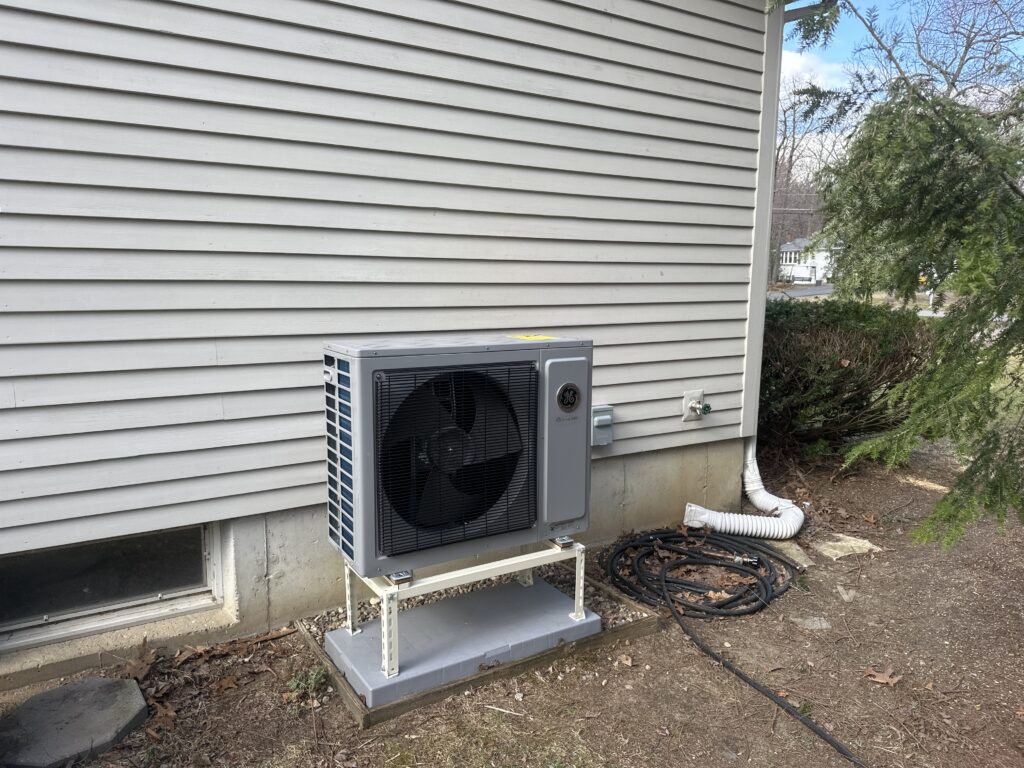
Most AC repair calls in Palmer don’t need a full system replacement. A refrigerant leak, a failed capacitor, a dirty condenser coil choking airflow, a clogged condensate line backing up into the air handler – these are common, fixable, and usually resolved in a single visit once we’ve confirmed what’s actually failing.
- Checking refrigerant charge and finding the source of a leak, rather than just topping it off
- Testing the capacitor, contactor, and other electrical components that fail from heat and age
- Inspecting the condenser coil and airflow, since a restricted coil is one of the most common reasons a system runs constantly without cooling
- Checking the condensate line and pan, since a clogged line is a common cause of water damage around indoor units
- Reviewing thermostat wiring and settings, which is sometimes the actual issue behind what looks like an equipment failure
What the work involves
A repair visit starts with diagnostics: refrigerant pressures, electrical readings at the compressor and capacitor, airflow across the evaporator coil, and a check of the condensate drain. Once we know what’s failed, we explain the fix and the cost before touching anything further. Common repairs include capacitor and contactor replacement, refrigerant leak location and recharge, coil cleaning, condensate line clearing, and electrical connection repairs at the disconnect or condenser. If the system is old enough or damaged enough that repair cost starts approaching replacement cost, we tell you that plainly and let you decide, we don’t push a replacement to pad the invoice.
What it costs
If your home’s electrical service is older or the panel is already at capacity, that can factor into both a repair and any future equipment upgrade. We hold the electrical licensing to handle panel work directly, permitted and inspected, as part of the same visit if it’s relevant to your cooling system.
- Number of zones or indoor units involved
- Whether the issue is electrical, mechanical, or refrigerant-related
- Access to the outdoor unit and any indoor equipment
- Age and condition of the system, including whether parts are still available
- Whether the underlying issue points to an electrical service or panel limitation
What it costs
Most straightforward AC repairs in Palmer run in the {PRICE_LOW} to {PRICE_HIGH} range, but the real number depends on what’s actually wrong and what the system needs. A capacitor swap is quick and inexpensive. A refrigerant leak that requires finding the leak point, repairing it and recharging the system costs more, and older systems using phased-out refrigerant add to that. If the repair call turns into a replacement conversation, cost is driven by the number of zones, whether you need ducted or ductless indoor units, how far the line set has to run, whether your electrical panel has capacity for the new equipment or needs upgrading, and how accessible the install location is. We give you real numbers after we’ve seen the job, not before.
Rebates and incentives
Mass Save offers incentives on qualifying heat pump equipment, and if your AC repair turns into a conversation about replacing an old central air system with a heat pump that handles both heating and cooling, it’s worth understanding what might apply to your specific house. Program details and amounts change, and eligibility depends on the equipment and the installation, so we’d rather walk through your situation directly than quote a figure that may not hold. You can see current program information at masssave.com [EXTERNAL LINK: Mass Save program overview, useful for homeowners checking current eligibility], and our Mass Save heat pump rebates page covers how the process generally works.
Get a Quote
If your AC is down and it’s hot, call {PHONE} and describe what’s happening. Drew answers, and if he’s on another job he’ll call back the same day. No call center, no dispatcher relaying notes, no estimate built on guesswork. For a broader look at our AC repair work across the territory, visit our Air Conditioning Repair hub, or see what else we handle in Palmer on our Palmer, MA page. If you’re weighing a ductless heat pump instead of repairing an aging central air system, our page on cold-climate heat pump performance explains what these systems actually do in a New England winter.
frequently asked questions
My AC is blowing warm air, what's usually wrong?
Most often it's a refrigerant issue, a failed capacitor, or a dirty condenser coil outside that can't shed heat properly. It can also be a frozen evaporator coil from restricted airflow, which actually makes the system blow warm once the ice builds up. We check pressures and airflow first before quoting anything.
Do you work on mini-splits as well as central air?
Yes. A lot of homes in Three Rivers and Bondsville run ductless systems instead of central air since the housing often has no ductwork at all, and that's a large part of what we install and repair.
How fast can you get to a no-cool call in Palmer?
We prioritize no-cool calls during the summer and typically get to Palmer the same day or the next morning depending on when you call. Drew answers the phone directly so you know where you stand right away.
Is it worth repairing an old AC system or should I replace it?
It depends on the age of the unit, the refrigerant type it uses, and how much the repair costs relative to replacement. We'll give you both numbers honestly so you can decide, rather than pushing a replacement by default.
Do you handle the electrical work if my panel can't support a new system?
Yes, we hold the electrical licensing to do panel upgrades and change-outs in-house, fully permitted and inspected, rather than referring that work out to someone else.