
Heat Pump Installation in Springfield, MA
Springfield has three-deckers from the early 1900s with knob-and-tube remnants in the walls, ranch houses from the 1950s expansion, and pockets of newer construction out toward the Longmeadow and East Longmeadow lines. A lot of that housing has no ductwork at all, and a lot of it is heated with oil or propane delivered by truck rather than gas piped in from the street. Those two facts change the heat pump conversation here more than almost anything else.
- Powers Air HVAC, based in Granby, MA
Heat Pump Installation in Springfield
Springfield is the biggest market Powers Air works in, with roughly 155,900 people spread across a city that is anything but uniform. The housing stock runs from dense triple-deckers in the North End and Six Corners to single-family neighborhoods in Sixteen Acres and East Forest Park, plus a real commercial and institutional base downtown and along the Boston Road corridor. Drew is based about 13 miles out in Granby, and he treats a Springfield job the same way he treats one five minutes from home: a load calculation first, a system sized to the actual building, and the same person on the quote as on the install.
The size of this market also means it has the thickest competition in the territory, including companies that will quote a heat pump off a square footage number over the phone. That is not how Drew works. A Springfield triple-decker and a Springfield ranch need completely different equipment, and the only way to know which is right is to go look.
What Springfield Homes Are Working With
Natural gas service exists in parts of Springfield, which is actually different from a lot of the smaller towns around it. That matters because a gas-heated home has a different economic case for a heat pump than an oil or propane one. If you are on delivered fuel, a cold-climate heat pump is usually a clear win on operating cost in addition to comfort. If you already have gas, the case shifts more toward air conditioning, shoulder-season efficiency, and reducing reliance on a system that still makes sense to keep as backup.
The older neighborhoods, the three-deckers and the pre-war multifamily stock near the city center, were built for steam or hot water radiators and never had ducts installed. That is the textbook case for ductless mini-splits: no demolition to run trunk lines through plaster and lath, no losses through uninsulated chases, and a system that can be zoned unit by unit if the building is a rental with separate tenants. The newer single-family areas on the outskirts are more likely to have central ducted systems already in place from an older gas or oil furnace, which opens up the option of a ducted heat pump or a hybrid setup that keeps the furnace as backup. A good chunk of Springfield’s housing is also rental or owner-occupied multifamily, which changes who is paying for what and how the project gets sequenced unit by unit.
How We Size and Specify the System
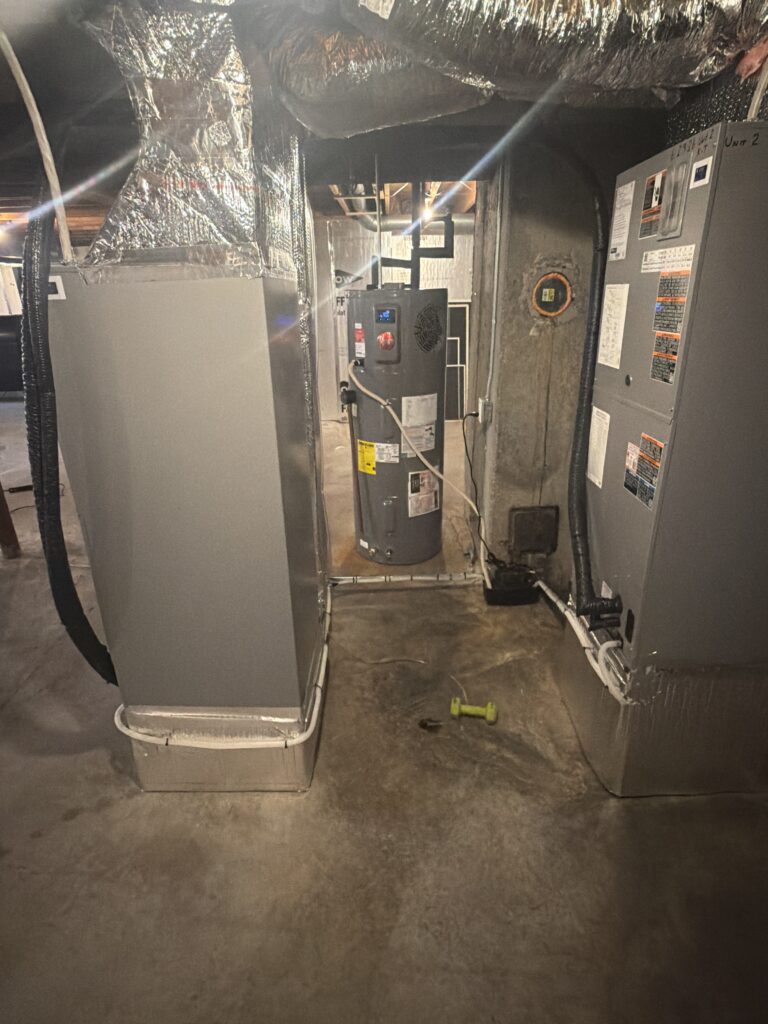
Every quote starts with a Manual J load calculation, not a guess based on square footage or what the last contractor installed. The load calculation accounts for insulation levels, window area and orientation, air leakage, and how the house actually holds heat, and it is the only honest way to land on the right size equipment.
Oversizing is the most common mistake in this trade, and it happens because bigger sounds safer. It is not. An oversized heat pump short-cycles, turning on and off instead of running long, steady, efficient cycles, and that leads to worse temperature swings, worse dehumidification in summer, and more wear on the compressor over the life of the equipment. A system sized to the real load runs longer at lower output, which is exactly what both your comfort and your utility bill want.
Cold-climate performance comes down to the equipment’s HSPF2 rating and its published capacity at low temperatures, not marketing language. A unit’s nameplate tonnage at 47°F tells you almost nothing about what it delivers at 5°F. The right system for Western Massachusetts is chosen off its low-temperature capacity curve and backed up with a plan for the coldest nights, whether that is maintaining the existing furnace or boiler as auxiliary heat or relying on a cold-climate unit rated to keep producing meaningful heat well below zero. A quote that does not reference a load calculation or mention backup heat strategy is a quote worth questioning.
What the Work Involves
A heat pump installation starts with the load calculation and a walk-through of the house, including where indoor heads or air handlers make sense, where the outdoor condenser can sit with clearance for snow and service access, and how long the line set run will need to be. Refrigerant line length and the number of elevation changes affect which equipment can be used and how it performs, so that gets mapped out before anything is ordered.
From there it is electrical capacity, line set and condensate routing, mounting the outdoor unit, setting indoor units or an air handler, running and charging the refrigerant lines, and commissioning the system to the manufacturer’s specifications. If the home’s electrical panel does not have room for a new circuit, that gets identified early rather than discovered mid-install, and since Powers Air holds the electrical licensing in-house (electrical license {ELECTRICAL_LICENCE}), panel work and the heat pump installation can be coordinated as one project instead of two separate contractors trying to schedule around each other.
- A load calculation and walkthrough to confirm zone locations
- Mounting the outdoor condenser and indoor units
- Running refrigerant line sets within the manufacturer's length and elevation limits
- Setting up a proper condensate drain
- Dedicated electrical circuits, including a check on panel capacity
- Commissioning the system and a walkthrough of the controls
Every job is permitted and inspected. That is not a formality Drew skips to save you money, and it is usually the thing a suspiciously low bid is quietly skipping. A permit means the work gets checked against code, and an inspection on the electrical side matters even more given that panel and circuit work touches service conductors directly.
What It Costs
Heat pump installation in Springfield generally runs between {PRICE_LOW} and {PRICE_HIGH}, and where a given job falls in that range depends on a handful of real variables: how many zones you need, whether you are running ductless indoor heads or a ducted air handler, how long the line set runs are, whether the electrical panel has capacity for a new circuit or needs upgrading first, and how accessible the attic, basement, or exterior wall penetrations are. A single-zone mini-split in a ranch with an easy outdoor unit location costs a lot less than a multi-zone system retrofitted into a three-decker with tight mechanical chases. You get a number after the load calculation and the walk-through, not before.
Rebates and Incentives
Mass Save exists, it changes periodically, and it is genuinely worth understanding before you finalize a system, since it can affect which equipment makes the most financial sense for your house. The specifics of what applies to a given project depend on the equipment, the home, and current program rules, so rather than restate numbers that are likely to be out of date by the time you read this, it is worth checking directly with [EXTERNAL LINK: masssave.com, to view current heat pump rebate and incentive details]. We can walk through your specific situation and help you understand what you may qualify for. For more background on how the program generally works, see our Mass Save heat pump rebates page.
Get a Quote
If you are in Springfield and trying to figure out whether a heat pump makes sense for a three-decker, a ranch, or a building with no ductwork at all, call Powers Air at {PHONE}. Drew does the load calculation and the walk-through himself, and the quote you get reflects the house he actually looked at, not a template. See our full heat pump installation page for how this works across the territory, visit the Springfield HVAC hub for other services in the city, or read more on cold-climate heat pump performance if you want the technical detail on how these systems hold up in a Western Massachusetts winter before you call.
frequently asked questions
Do heat pumps actually work in a Springfield winter?
Yes, provided the equipment is chosen for it. Cold-climate heat pumps are rated and tested to keep producing meaningful heat well below zero, which is well past what Springfield typically sees. The honest caveat is that capacity does drop as temperature drops, which is why backup heat strategy is part of the system design, not an afterthought.
Do I need to keep my furnace or boiler if I install a heat pump?
Not always, but it is often the smart move, especially on delivered oil or propane. Keeping the existing system as backup heat for the coldest nights gives you redundancy without requiring the heat pump to be oversized to cover an extreme that happens only a few days a year.
Can a heat pump work in a Springfield three-decker with no ductwork?
Yes, this is one of the clearest cases for ductless mini-splits. No ducts need to be installed, each unit can be zoned to a tenant or a room, and the equipment mounts with a small line set penetration rather than major demolition.
What size heat pump do I need?
It depends on the specific house, not a square footage rule of thumb. A Manual J load calculation accounts for insulation, windows, air leakage, and the building's actual construction, and that is what determines sizing, not a guess that leads to oversizing.
Does Powers Air handle the electrical work for a heat pump installation too?
Yes. Powers Air holds the electrical licensing in-house (license {ELECTRICAL_LICENCE}) and performs circuit and panel work as part of the project when needed, rather than referring it out to a separate contractor. All electrical work is permitted and inspected.