
Furnace Repair and Heating Service in Holyoke, MA
Furnace Repair and Heating Service in Holyoke
A big share of Holyoke’s housing went up when the mills were running flat out, which means steam radiators or hot water baseboard fed by a boiler in the basement, not a furnace and ductwork like you’d find in a 1970s ranch out in the hill towns. When that system struggles on a cold morning, or the pilot won’t hold, or one floor of a triple-decker is warm while the other is cold, you need someone who understands both what’s actually down there and what it would take to do better.
- Powers Air HVAC, based in Granby, MA
Call Powers Air and you get Drew on the phone, not a dispatcher reading from a script. He’ll ask what kind of heat you have, how old it is, and what’s actually going wrong before he talks about fixing or replacing anything. That’s the whole approach: diagnose first, sell second, and only replace equipment when repair stops making sense.
What Holyoke homes are working with
Holyoke’s housing stock skews old and dense. The triple-deckers and worker housing built around the turn of the last century were heated with coal-fired steam boilers that got converted to oil or gas over the decades, and a lot of those systems are still running on cast iron radiators with no ductwork anywhere in the building. If you own one of these, your heating options for anything beyond the existing boiler usually come down to ductless equipment, because running sheet metal through plaster walls and tight stairwells in a hundred-year-old multifamily is rarely practical or affordable.
Natural gas is available in parts of Holyoke, which puts it in a different position than most of the towns around Granby where oil and propane dominate. That changes the math on a furnace versus heat pump decision, because gas furnace operating costs here can be lower than delivered fuel costs elsewhere in the territory. But Holyoke also has a meaningful amount of commercial and industrial building stock, old mill buildings converted to apartments and small businesses, and a landlord-owned rental market where the person calling about the heat isn’t always the person living with it. All of that changes what the right fix looks like and who’s paying for it.
What Holyoke homes are working with
If you’re a landlord with a tenant complaint, the calculus is different again. Sometimes the fastest, cheapest path is a targeted boiler repair that gets heat back on today. Sometimes it’s worth having a real conversation about where that building is headed before you sink more money into a thirty-year-old boiler. Drew will tell you which situation you’re in.
How we size and specify the system
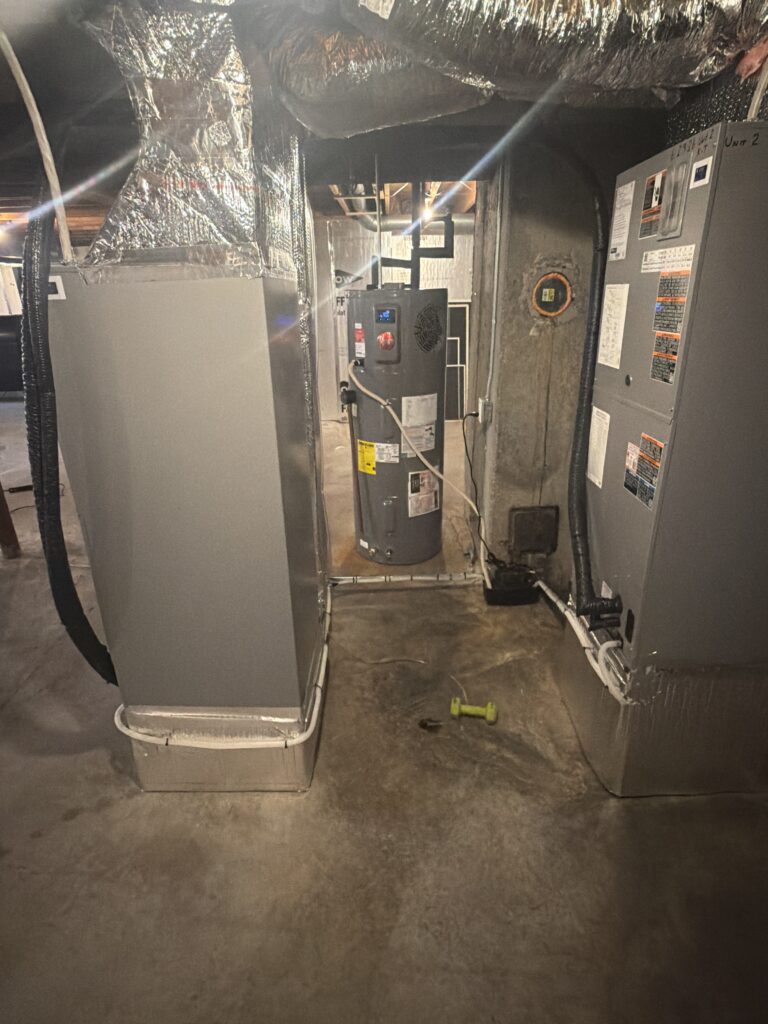
Before anyone talks about a new furnace, boiler, or heat pump, there should be a load calculation. That’s a room-by-room accounting of how much heat the building actually loses on a cold day, based on insulation, window area, air leakage, and square footage, not a guess based on the size of the old unit. The old unit was very possibly oversized to begin with. Oversizing is the single most common mistake in this trade, and it doesn’t make a house more comfortable, it makes it less comfortable: the system short-cycles, runs hot and cold instead of steady, wears out its components faster, and in a heat pump’s case, it struggles to modulate down low enough to run efficiently on a mild day.
A quote that doesn’t include a load calculation, or doesn’t reference one, is a quote you should be skeptical of. Ask what it’s based on. For a cold-climate heat pump recommendation, that means knowing the equipment’s rated capacity at low outdoor temperatures and its HSPF2 efficiency number, not just its nameplate tonnage. For a furnace or boiler, it means matching output to the actual heat loss of the building, not the size of the unit that’s failing.
- Gas service, or oil and propane
- Existing ductwork, radiators, or nothing at all
- Build era and how the house has been altered since
- House size, lot exposure, and insulation
- Owner occupied or rented, and how many units
How we size and specify the system
A real quote also spells out what’s included: the equipment model, the venting or flue work, electrical requirements, condensate handling if it applies, permit and inspection fees, and what happens if something unexpected turns up once the old unit comes out. If a quote is one number with no detail behind it, that’s worth asking about before you sign anything.
- The load calculation, or a clear reason it was not needed
- Equipment model, capacity at design temperature, and efficiency ratings
- Line set length and route, condensate drainage, and mounting locations
- Electrical requirements, and whether the panel needs work
- Warranty terms, and who performs the labour
What the work involves
A furnace or boiler repair call starts with diagnosis: checking the burner, ignition, draft, pressure, and controls to find out what actually failed, rather than replacing parts until something works. Common failures in Holyoke’s older systems are cracked heat exchangers, failed igniters or pilot assemblies, circulator pump failures on hot water systems, and pressure or feed issues on steam boilers that have been patched together for years. Some of these are a same-visit fix. Some point to a system near the end of its service life, and Drew will say so plainly instead of nursing a boiler along for another winter if that’s not really in your interest.
If the conversation moves toward replacement, the work involves removing the old unit, verifying venting and combustion air meet current code, running new electrical or gas connections as needed, setting and start-testing the new equipment, and leaving the space clean. For a heat pump installed alongside or instead of an old boiler, that also means line set routing from outdoor to indoor units and condensate drainage for each indoor head.
What it costs
Furnace and boiler repairs in Holyoke typically run from {PRICE_LOW} for a straightforward part replacement or diagnostic fix up to {PRICE_HIGH} for a more involved repair on an older steam system or a failure that requires several components. What moves the number: the age and type of your existing system, whether parts are still commonly stocked or need to be sourced for an older boiler, how accessible the unit is in the basement, and whether the electrical or gas service needs any work to support the fix. We’ll give you a number before any work starts, not after.
What it costs
If repair isn’t the right call anymore, a full replacement conversation starts with the same load calculation discussed above, and the number depends heavily on whether you’re staying with a furnace or boiler, moving to a ductless heat pump system, how many zones or units the building needs, and whether your electrical panel has the capacity to support new equipment.
- Number of zones and indoor units
- Indoor unit type, ducted or ductless
- Line set length and the route through the building
- Electrical service capacity, and whether the panel needs upgrading
- Access, including tight basements, upper floors, and exterior wall mounting
Rebates and incentives
Holyoke is served by Holyoke Gas and Electric, a municipal utility, which means the incentive programs available to homes here are not automatically the same as the Mass Save rebates that apply in towns served by the investor-owned utilities. Mass Save is a real program worth understanding generally, but what actually applies to your specific address in Holyoke depends on which utility programs you’re eligible for. We can walk through what applies to your house once we know the details. For general program information, see masssave.com and our page on Mass Save heat pump rebates, and check with Holyoke Gas and Electric directly for programs specific to their service territory. [EXTERNAL LINK: masssave.com, for general program information]
Permits and Inspection
Any furnace, boiler, or heat pump replacement in Holyoke requires a permit and inspection, and any electrical work tied to new heating equipment, including panel capacity for a heat pump or EV charger, is performed under licensing and inspected as required. That’s not a formality we tack on, it’s how you know the gas or electrical connections were actually checked by someone other than the person who installed them. If a bid comes in noticeably lower than everyone else’s, ask whether it includes the permit. That’s usually where the difference is.
Get a Quote
If your furnace or boiler is acting up, or you’re thinking about what comes after it, call Powers Air at {PHONE}. You’ll talk to Drew, he’ll ask what’s going on, and he’ll tell you honestly whether it’s a repair, a stopgap, or time to plan a replacement. For the full picture of heating and cooling options across the territory, see our Furnace Repair and Heating Service hub page and our Holyoke, MA town page.
frequently asked questions
My radiators are banging and some rooms are cold. Is that a furnace problem?
If you're on steam heat, that's almost never a furnace problem since there isn't one, it's a boiler and distribution issue. Banging radiators usually point to pitch, trapped air, or a pressure problem; cold rooms at the far end of the system often mean a venting or balance issue. We can diagnose which it is on a single visit.
Can I switch from my old boiler to a heat pump without adding ductwork?
Yes. That's the standard path for Holyoke's older multifamily and triple-decker housing. Ductless heat pump systems run on a line set rather than ductwork, so they work in buildings where running sheet metal isn't realistic.
Does natural gas availability in Holyoke change whether a heat pump makes sense?
It can. Where gas service is available and reasonably priced, the economics of a heat pump versus keeping a gas furnace are closer than in oil or propane towns. We'll look at your actual utility costs before recommending one path over the other.
I'm a landlord. Should I repair the boiler or replace it?
Depends on the age, the failure, and how long you plan to hold the building. A $400 part on a boiler with years of life left is an easy repair call. A major component failure on a 25-year-old unit is a different conversation, and we'll tell you honestly which situation you're in.
Do you handle the permit and inspection for heating replacements in Holyoke?
Yes, permitting and inspection are part of any furnace, boiler, or heat pump replacement we do. It's not optional and it's not an add-on fee we skip to look cheaper on a bid.