
Furnace Installation and Replacement in Easthampton, MA
A lot of Easthampton’s housing stock dates back to the mill era, and a good share of it has been renovated room by room rather than gutted all at once – which means the furnace in the basement is often a decade or two newer than the house around it, patched into ductwork or a venting arrangement nobody fully trusts anymore. Some of those basements still have the chimney liner from the original coal-to-oil conversion sitting next to a furnace that was never sized for the house it’s heating.
- Powers Air HVAC, based in Granby, MA
Furnace Installation and Replacement in Easthampton
When a furnace fails in February, the instinct is to replace it with whatever fits the existing ductwork and ship it out the door by dinner. That’s how a lot of Easthampton basements ended up with equipment that’s the wrong size, the wrong fuel for the house’s long-term plans, or both. A proper furnace installation starts with the house, not the catalog – what the ductwork can actually move, what the fuel situation is, and whether a straight furnace swap is even the right call anymore given what heat pumps can do in this market.
We’ll give you a straight answer on that before we give you a quote. If a furnace replacement is the right move for your house and your budget, we’ll spec it properly and install it to code. If a hybrid setup with a heat pump doing most of the work makes more sense, we’ll say that too.
What Easthampton homes are working with
Easthampton sits in an odd spot for fuel. Parts of town have natural gas service along the older corridors near the center, but plenty of streets – especially out toward the hilltowns side and in the newer subdivisions – run on delivered oil or propane. That single fact changes the furnace conversation completely. A gas furnace replacement is usually the cheapest path to comparable heat if you’ve already got the gas line. If you’re on oil or propane, you’re paying delivery fuel prices either way, and that’s exactly the situation where a heat pump starts to look financially different than it does in a gas town, even if you keep a furnace or boiler as backup for the coldest stretches.
The housing itself splits into two camps that matter for this job. There’s the converted mill building and the renovated 1800s and early 1900s housing near downtown – often retrofitted with ductwork at some point, sometimes awkwardly, sometimes well, and still running radiators or baseboard in parts of the house that never got touched. Then there’s the more typical mid-century and newer construction out from the center, built with a furnace and ducts from day one and generally easier to size for because the ductwork is more conventional. Easthampton’s renovation and arts culture also means more owners than average who are willing to spend on insulation and air sealing alongside the mechanical work, which actually changes what furnace size the house needs – a tighter envelope means a smaller unit does the job, not a bigger one.
How we size and specify the system
Every furnace quote we write starts with a load calculation, not a nameplate match to whatever’s down there now. A Manual J calculation looks at your square footage, insulation, window area, air leakage and local design temperature and tells us how much heat your house actually loses on the coldest night of the year. That number, not the size of the old furnace, is what determines the right output.
Oversizing is the most common mistake in this trade, and it happens because a bigger furnace feels like a safer bet. It isn’t. An oversized furnace short-cycles – it blasts heat, satisfies the thermostat fast, and shuts off before it’s run long enough to distribute that heat evenly or run your blower at a comfortable, consistent airflow. You get hot and cold swings, more noise, more wear on the ignition and heat exchanger from constant on-off cycling, and a shorter equipment life. A correctly sized furnace runs longer, steadier cycles and actually feels warmer even though it’s doing less work per hour.
If a contractor hands you a number with no load calculation behind it and no explanation of how they got there, that’s worth questioning before you sign anything. A real quote should tell you the calculated heating load, the proposed furnace’s output and efficiency rating, what happens to your existing ductwork (does it need modification, does static pressure support the airflow), and what venting change, if any, the new unit requires.
What the work involves
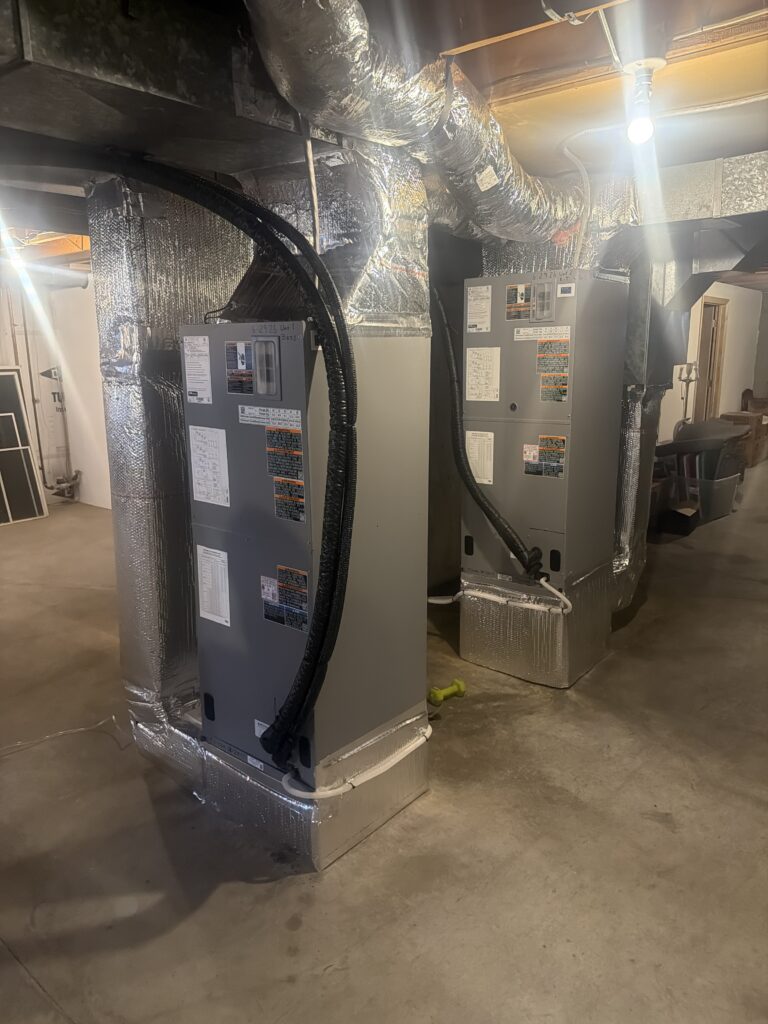
A furnace replacement is more than unbolting the old box and bolting in the new one. We remove the old unit and disconnect it from gas or oil supply and venting, then evaluate the ductwork connections and plenum for leaks, undersized returns, or damage that’s been quietly costing you efficiency for years. High-efficiency furnaces often need different venting than the unit they’re replacing – PVC intake and exhaust instead of a metal flue – so part of the job is routing that correctly through the wall or chimney, not assuming the old path still works.
From there it’s setting the new furnace, connecting fuel supply, venting, and ductwork, wiring it to the thermostat and any zoning in place, and commissioning it – checking gas pressure or oil nozzle sizing, verifying temperature rise across the heat exchanger, confirming airflow, and testing safety controls before we call it done. Permits get pulled and the work gets inspected. That’s not optional paperwork, it’s confirmation that a combustion appliance in your basement is vented and controlled the way code requires.
- Removing and disposing of the old furnace, along with any associated oil tank or gas line modifications
- Sizing and, where needed, modifying supply and return ductwork so static pressure matches the new equipment
- Installing proper combustion air and venting: direct vent PVC for a high-efficiency condensing furnace, or a lined chimney for a conventional one
- Setting up condensate drainage for high-efficiency furnaces, which produce acidic condensate that needs to go somewhere specific, not just the nearest floor drain
- Pulling permits and scheduling the required inspections
- Commissioning the system: verifying gas pressure or oil nozzle sizing, airflow, and temperature rise against manufacturer specs before we call the job done
What it costs
Furnace installation in Easthampton typically runs {PRICE_LOW} to {PRICE_HIGH}, and where you land in that range depends on a handful of real variables: the efficiency tier of the furnace itself, whether the existing ductwork needs modification or just reconnection, whether venting needs to be rerouted for a high-efficiency unit, fuel type and whether a gas or oil line needs work, and access – a furnace tucked in a finished basement corner with a low ceiling takes longer than one in an open mechanical room.
We’ll walk the specific job with you before quoting a number, and we’ll tell you up front if something about the house is going to push the price – old ductwork that needs rework, a chimney liner that’s not rated for the new venting, that kind of thing. No fixed price gets quoted sight unseen, and no number changes once we’ve looked at the job and agreed on scope.
- Whether it's a straight swap or a fuel conversion, oil to gas, oil to propane, or adding a heat pump into the mix as primary or backup heat
- Ductwork condition, and whether the existing supply and return can handle the new unit or need rework
- Venting type, direct vent versus relining an existing chimney
- Electrical service, since some high-efficiency furnaces and any accompanying heat pump equipment need panel capacity that older services don't have
- Access: basement height, oil tank removal, and how far the equipment has to travel from the truck
If you’re weighing a straight furnace swap against adding or switching to a heat pump, that’s worth a real conversation, not a sales pitch. Western Mass has enough delivered-fuel homes that the math on a heat pump, even paired with furnace backup, often looks different here than it does in a gas-piped suburb outside Boston.
Rebates and incentives
Mass Save offers incentives for qualifying heating equipment, and the specifics – what qualifies, what the current incentive levels are, and what paperwork is required – change often enough that we’d rather point you to the source than guess. Check masssave.com for current programme details, and see our Mass Save rebate guide for how the heat pump side of these programmes generally works. We’re happy to walk through what applies to your specific house once we know what equipment makes sense for it.
Permits and Inspection
Furnace replacement work in Massachusetts requires a permit, and for good reason – you’re dealing with combustion, venting, and in some cases gas or oil piping, all of which get inspected to confirm they’re safe before the job is closed out. We pull the permit, schedule the inspection, and stand there for it. A contractor who skips this step isn’t saving you money, they’re skipping the part where someone independent confirms the appliance in your basement won’t put carbon monoxide into your living space.
Get a Quote
If your furnace is on its way out or you want to know what a replacement would actually cost before it fails on the coldest night of the year, call {PHONE}. You’ll talk directly to the person who’ll be doing the load calculation and, if it comes to it, the install – not a dispatcher reading from a script.
frequently asked questions
How long does a furnace installation take in Easthampton?
A straightforward like-for-like furnace swap usually takes a day. If the job involves rerouting venting for a high-efficiency unit, modifying ductwork, or addressing a fuel line issue, it can run into a second day. We'll tell you which situation you're in before we start.
Can I replace an oil furnace with gas, or should I switch to a heat pump instead?
It depends on whether gas service actually runs to your street, what your current oil or propane costs are doing to your budget, and how your house is insulated. In a lot of Easthampton's older housing, a heat pump with furnace backup ends up being the more interesting option financially – we'll run the comparison honestly rather than default to whatever's easiest to install.
Do I need a permit for a furnace replacement?
Yes. Furnace work involves combustion, venting, and often fuel piping, all of which require a permit and inspection in Massachusetts. We handle that as part of every installation.
What size furnace does my house need?
The only reliable way to answer that is a Manual J load calculation based on your home's square footage, insulation, windows, and air leakage – not the size of the furnace you're replacing. We run that calculation before we quote a number.
Is it worth insulating before replacing the furnace?
Often yes, especially in older Easthampton housing that hasn't been fully renovated. A tighter envelope lowers your heating load, which can mean a smaller, less expensive furnace and lower bills for the life of the equipment. Worth discussing before you commit to a size.