
Heat Pump Installation in Hadley, MA
A lot of Hadley’s housing stock predates central air entirely, and a fair amount of it predates ductwork altogether. You’ve got farmhouses with additions tacked on in the 60s and 70s, barns converted to living space, and newer construction mixed in along the edges of the floodplain. None of it runs on natural gas, because Hadley has no gas distribution to speak of. If you’re heating with oil or propane right now, you already know what that bill looks like every February.
- Powers Air HVAC, based in Granby, MA
Heat Pump Installation in Hadley
Heat pumps make more sense in Hadley than in almost any gas-connected suburb east of here, and it’s not a sales pitch, it’s arithmetic. When the alternative is delivered fuel at delivered-fuel prices, a cold-climate heat pump with a reasonable backup strategy wins on cost most winters and wins on comfort every summer, because the same equipment gives you air conditioning you didn’t have before. The install itself has to be sized to the actual house, not to a rule of thumb, and that’s where most of the bad experiences with heat pumps in this area come from. Oversized or poorly specified systems short-cycle, don’t dehumidify, and struggle exactly when it gets cold, which is when people decide heat pumps don’t work. They work. They have to be installed right.
What Hadley Homes Are Working With
Residential Hadley splits into a few distinct categories, and each one changes the install. There’s working farmland property with the original farmhouse still standing, sometimes with a newer addition that was never properly conditioned, sometimes with knob-and-tube wiring still live in parts of the attic. There’s the older village core near Route 47 with balloon-frame construction and radiators fed by an oil-fired boiler, no ducts anywhere. And there’s the Route 9 corridor, where the retail and commercial footprint is disproportionately large for a town of 5,300 people, which means even a small residential company here needs to understand commercial rooftop and split-system work alongside the houses.
The addition scenario is the one I see most often and it’s the clearest case for ductless. A homeowner has a 1940s farmhouse with steam heat that’s fine for the original rooms, plus a family room or primary suite addition that’s always been too hot in summer and too cold in winter because nobody ran ductwork to it and the boiler zone doesn’t reach it well. A single or multi-zone mini-split solves that addition specifically without touching the rest of the house’s heating system. For whole-house conversions, it’s usually ducted or a mix, depending on whether there’s any existing duct to reuse and whether the electrical panel can support it.
How We Size and Specify the System
Every quote starts with a load calculation, not a walk-through and a guess. A Manual J looks at your actual envelope, insulation levels, window area, and air leakage, room by room, and tells us how many BTUs that space needs to lose and gain through a Western Massachusetts winter and summer. Skip that step and you’re sizing by square footage or by what the last company installed next door, and that’s how you end up with equipment that’s wrong for the house.
Oversizing is the far more common mistake, not undersizing. A heat pump that’s too big for the load short-cycles, meaning it blasts to temperature and shuts off instead of running long, steady, low cycles. Short cycling means worse dehumidification, more wear on the compressor, and a house that feels clammy in summer despite the thermostat reading the right number. The right-sized system runs longer at lower output more often, which is exactly how these units are designed to perform and how the efficiency numbers on the spec sheet actually get realized.
A real quote includes the load calculation results, the specific equipment model with its cold-climate performance data, where the line sets run and how long, what happens to capacity at your region’s design temperature, and the backup heat plan if one is needed. If a bid shows up as a flat number with a brand name and nothing behind it, that’s worth asking about before you sign anything.
What the Work Involves
Outdoor condenser placement matters more in Hadley than people expect, given how much snow load and drifting some of these farm properties see. We set the outdoor unit on a stand above expected snow accumulation, run the line set with attention to length limits and elevation change, and manage condensate drainage so it doesn’t dump next to a foundation or walkway where it’ll ice. Indoor units go in based on how the room actually loses and gains heat, not just where it looks convenient on a wall.
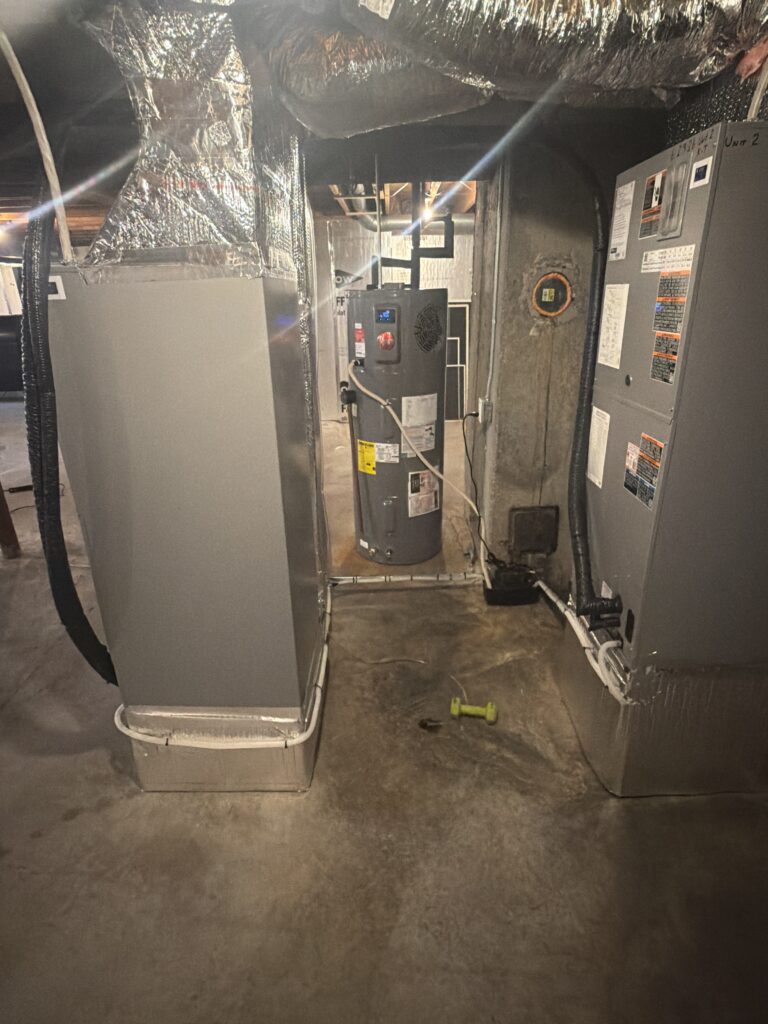
For ducted systems retrofitted into a house that had an oil furnace, we check static pressure in any existing ductwork before assuming it can carry the new system’s airflow. Undersized or leaky ducts choke a heat pump’s output just as badly as the wrong-sized equipment does. If the panel is older or near capacity, we flag that early, since we handle panel upgrades in-house under our own electrical licensing when a project needs more capacity, rather than sending you to find a separate electrician.
- A load calculation and walkthrough to confirm zone locations
- Mounting the outdoor condenser and indoor units
- Running refrigerant line sets within the manufacturer's length and elevation limits
- Setting up a proper condensate drain
- Dedicated electrical circuits, including a check on panel capacity
- Commissioning the system and a walkthrough of the controls
The cold-climate question comes up on almost every job in this territory, and it deserves a direct answer rather than a brochure answer. Modern cold-climate heat pumps are rated and tested down to -13°F and in some cases colder, and they maintain real heating capacity well below zero, it’s just reduced from their rated output at warmer temperatures. The equipment selection and the backup heat strategy both come from knowing your home’s design temperature and load, which is exactly what the load calculation is for. Done right, a heat pump carries a Hadley winter. Done wrong, with the wrong unit or no backup plan, it struggles on the coldest nights and that’s when people lose confidence in the technology that was never the problem in the first place.
What It Costs
A straightforward single-zone mini-split for one room or addition generally falls in the range of {PRICE_LOW} to {PRICE_HIGH} installed, with full whole-house multi-zone or ducted systems running higher depending on scope. What moves the number: how many zones and indoor heads you need, whether you’re doing ducted, ductless, or a mix, how long the line set runs have to be, whether the electrical panel has room or needs upgrading, and how accessible the install locations are, especially in an older farmhouse with finished walls and no existing chases. We walk through the real number for your house after the load calculation, not before.
Rebates and Incentives
Mass Save exists and it’s worth understanding before you finalize a system, since incentives and qualifying criteria shift over time and depend on the specific equipment and your home’s current heating fuel. We can help you work out what might apply to your situation as part of the quote process. For the current program details and eligibility, check masssave.com directly, and see our Mass Save heat pump rebates page for a general overview of how the program works.
Permits and Inspection
Heat pump installations in Hadley require a permit, and the electrical connection and any panel work are inspected. That’s true for the HVAC installation itself and especially true if the job includes panel capacity work, which we perform and permit under our own electrical licensing rather than farming it out. A contractor who skips the permit is usually the same one skipping the load calculation, and the lower bid reflects what’s missing, not what you’re saving.
Get a Quote
If you’re looking at a Hadley property, whether it’s a farmhouse addition that’s never been comfortable or a whole-house conversion off oil, call {PHONE} and you’ll talk to Drew directly about the house, not a script. We’ll set up a load calculation and walk the property before anyone talks equipment brands.
frequently asked questions
Do heat pumps actually work in a Hadley winter?
Yes, provided the equipment and backup strategy are matched to your home's actual heat loss at design temperature. Cold-climate heat pumps maintain real capacity well below zero, though reduced from their rated output. The failures people remember usually trace back to an undersized or poorly chosen unit, not the technology itself.
My house has no gas line. Does that change the math?
It changes it significantly in your favor. Comparing a heat pump against oil or propane delivery costs, which is the real comparison in Hadley, almost always looks better than comparing it against natural gas. That's the honest version of why heat pumps make more sense out here than in a gas-connected town.
Can a mini-split handle just my addition without touching the rest of the heating system?
Yes, and that's one of the most common and sensible projects we do. A single or multi-zone ductless system can condition an addition that a boiler zone never reached well, without any change to the radiators or ductwork serving the original part of the house.
What if my electrical panel can't support a new heat pump?
We check panel capacity as part of the quote, and if it needs upgrading, we handle that in-house under our own electrical licensing, permitted and inspected, rather than referring you out to find a separate electrician.
How do I know if a quote is missing something important?
Ask what the load calculation showed. A legitimate quote references specific BTU heat loss and gain numbers for your house and ties the equipment selection to that. A quote that's just a model number and a price with no calculation behind it is worth questioning.