
Furnace Installation and Replacement in Holyoke, MA
Walk a triple-decker neighborhood in Holyoke and you can usually guess what’s heating each unit before you ever see the basement. A lot of this city was built in the late 1800s and early 1900s around the mills and the canal system, and a lot of it was built with steam or hot water radiators and zero ductwork. Where a furnace does exist today, it’s often a replacement for an old oil boiler or a coal conversion that’s been swapped two or three times since, shoehorned into a basement that was never designed around a forced-air cabinet and a trunk line.
- Powers Air HVAC, based in Granby, MA
Furnace Installation and Replacement in Holyoke
If you’ve got ductwork already, or you’re adding it because the old system is done, a new furnace is a straightforward call and we treat it that way. We’re not going to upsell you into a heat pump conversion you didn’t ask for and we’re not going to quote a furnace over the phone without seeing the house. What we will do is size it correctly, match it to the ductwork or tell you honestly when the ductwork needs work too, and install it so the permit and inspection are clean and the warranty is actually backed by something real.
What Holyoke homes are working with
Holyoke’s housing stock skews older and denser than most of the towns around Granby. The triple-deckers and the multifamily blocks near downtown and the flats were built for steam or hot water heat, and plenty of them still run on it, unit by unit, with no duct trunk anywhere in the building. When a furnace conversion happens in one of these, it’s usually a gut renovation or a unit-by-unit owner decision, not a whole-building retrofit, and the ductwork has to be built from nothing, which changes both the cost and the layout options.
Natural gas is available in parts of Holyoke proper, which puts it in a different category than a lot of our more rural service area where oil and propane are the only delivered-fuel options. That matters for furnace economics specifically, because a gas furnace here can run at genuinely low operating cost compared to an oil-fired unit, and that’s worth factoring in before you default to whatever fuel the old equipment used. One more wrinkle specific to this city: Holyoke Gas and Electric is a municipal utility, not one of the investor-owned utilities that fund most of the rebate programs people hear about regionally. Its own incentive structure runs separately, and we’ll get into what that means for you in the rebates section below.
How we size and specify the system
Every furnace quote we write starts with a load calculation, not a tape measure on the old unit. Manual J accounts for your square footage, insulation, window area, infiltration, and the house’s actual heat loss on a design-day cold snap, and it’s the only honest way to land on the right output. The failure mode we see constantly in multifamily and older housing stock is an oversized furnace, usually because the last contractor matched the new unit’s size to whatever tonnage was already there, or just rounded up for safety margin. An oversized furnace short-cycles. It heats the space fast, shuts off before it’s dehumidified or evenly distributed the air, and turns back on again twenty minutes later. That’s harder on the blower motor, harder on the heat exchanger, and it leaves you with cold spots and a noisier system than a correctly sized unit would ever produce.
A real quote should show you the calculated heat loss, the proposed furnace output, the AFUE rating, and how the ductwork was evaluated, including static pressure if we’re reusing existing trunk and branch lines. If a bid lands in your inbox with just a brand name and a number and nothing behind it, that’s worth a second opinion before you sign.
What the work involves
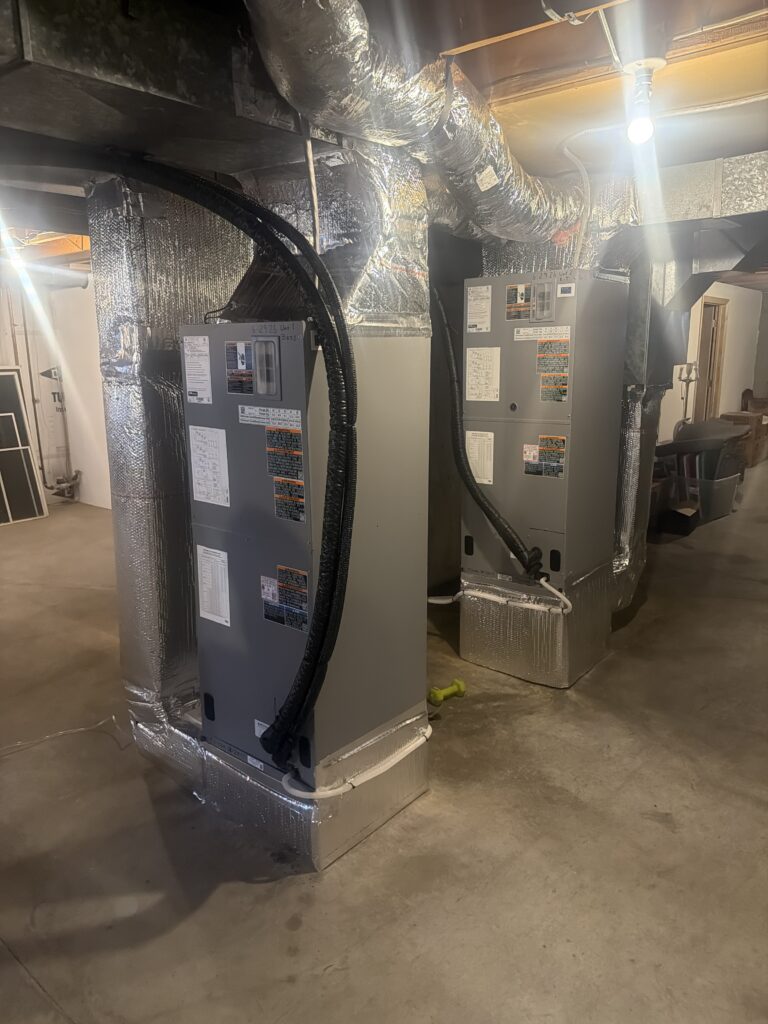
On a straight swap where the ductwork is sound, we pull the old unit, confirm the venting and combustion air requirements for the new furnace’s category, set the new cabinet, tie in the supply and return, and commission it with a combustion analyzer to confirm it’s burning clean at the rated input. On a conversion job, where we’re adding ductwork to a space that’s never had it, the bigger decisions happen up front: where the trunk line runs, how we get supply registers into each room without tearing apart finished ceilings, and where the return path lives. In a triple-decker unit, that often means working within joist bays and closets rather than dropping a soffit through a living room. We walk you through those tradeoffs before anything gets cut.
- Removing and disposing of the old furnace, along with any associated oil tank or gas line modifications
- Sizing and, where needed, modifying supply and return ductwork so static pressure matches the new equipment
- Installing proper combustion air and venting: direct vent PVC for a high-efficiency condensing furnace, or a lined chimney for a conventional one
- Setting up condensate drainage for high-efficiency furnaces, which produce acidic condensate that needs to go somewhere specific, not just the nearest floor drain
- Pulling permits and scheduling the required inspections
- Commissioning the system: verifying gas pressure or oil nozzle sizing, airflow, and temperature rise against manufacturer specs before we call the job done
What it costs
A furnace replacement where the ductwork stays as-is typically runs {PRICE_LOW} to {PRICE_HIGH} installed, and the spread depends on the furnace’s AFUE tier, the venting category, and whether the existing flue or gas line needs modification. Add ductwork from scratch, which is common in Holyoke’s older multifamily stock, and the number moves up meaningfully because you’re paying for sheet metal, registers, and labor in tight spaces, not just the furnace itself. Electrical capacity can factor in too, particularly if the furnace’s blower and controls need a dedicated circuit and your panel is already maxed out. We’ll flag that during the quote rather than discovering it mid-install.
- Whether it's a straight swap or a fuel conversion, oil to gas, oil to propane, or adding a heat pump into the mix as primary or backup heat
- Ductwork condition, and whether the existing supply and return can handle the new unit or need rework
- Venting type, direct vent versus relining an existing chimney
- Electrical service, since some high-efficiency furnaces and any accompanying heat pump equipment need panel capacity that older services don't have
- Access: basement height, oil tank removal, and how far the equipment has to travel from the truck
Rebates and incentives
Rebate programs change year to year, and the rules depend on which utility actually serves your address. Holyoke is a meaningful exception in our service area because Holyoke Gas and Electric is a municipal utility, and its incentive programs are structured separately from the Mass Save programs funded by the investor-owned utilities that cover most of the towns we work in. We’re not going to quote dollar figures or promise a specific rebate here, because the amounts and eligibility rules shift and because what applies in Holyoke isn’t the same as what applies two towns over. What we can do is walk through your specific situation and help you understand what’s realistically available before you commit to equipment. For general Mass Save program information, see [EXTERNAL LINK: masssave.com, the statewide energy efficiency program site] and our own Mass Save heat pump rebates page for how that program works where it does apply.
Permits and Inspection
Furnace installations in Massachusetts require a permit and inspection, full stop, and that’s true whether you’re swapping a like-for-like unit or running new ductwork into a space that’s never had it. We pull the permit, we schedule the inspection, and we build the job to the current Massachusetts building and gas code from the start rather than hoping it passes. A contractor who skips this step can usually beat our price on paper, but you’re the one left holding an uninspected system if there’s ever a claim, a sale, or a problem with combustion venting down the line.
Ready to Talk Through Your Options?
Holyoke’s mix of old mill-district two-families and hillside homes near the reservoir means no two furnace jobs look the same. Before you commit to a brand or a number, have someone walk your basement or utility closet, check your ductwork, and explain what’s actually driving the cost.
We’ll give you a straight answer on repair versus replacement, what size unit your house needs, and a written quote you can compare against anyone else’s – no guessing over the phone.
frequently asked questions
Can I put ductwork into an old triple-decker unit in Holyoke?
Usually, yes, but it takes planning around joist bays, closets, and ceiling heights rather than a straightforward duct run like you'd get in a newer ranch or colonial. We walk the unit with you first and show you the realistic path before you commit to a furnace over a ductless alternative.
Is gas furnace replacement cheaper than switching to a heat pump in Holyoke?
Where gas service already exists, a straight furnace swap is often the lower upfront cost if the ductwork is already in place. The comparison changes once you factor in rebates, electrification trends, and whether you also want air conditioning, which a heat pump provides and a furnace doesn't.
Does Holyoke Gas and Electric offer rebates for furnace upgrades?
HG&E runs its own incentive programs separately from the investor-owned utility programs that fund most Mass Save rebates. The specifics change, so we'd rather look at your account and your equipment plans directly than quote a number that might not apply.
How long does a furnace installation take?
A straight swap with existing ductwork is usually a single day. Adding new ductwork into a space that's never had it takes longer and depends heavily on how accessible the joist bays and chases are in that particular building.
What size furnace do I need for my Holyoke home?
That's exactly what the load calculation answers, and it's not a number we'll guess based on square footage alone. Insulation, window area, and how airtight the building envelope is all factor into the real heat loss number.