
Central Air Conditioning Installation in Amherst, MA
- Powers Air HVAC, based in Granby, MA
Central Air Conditioning Installation in Amherst
Central air makes sense when a house already has ductwork worth using, or when a landlord needs one system carrying both heating and cooling across several units. It isn’t always the right call. If a house has no ducts and never will, running new trunk lines through finished walls and ceilings to chase central air is usually more disruption and more money than a ductless system would ever cost. Drew will tell you that on the phone before he quotes anything, not after the job is half done.
Central air is usually the better fit when:
- Ductwork already exists and is in decent condition
- A furnace or air handler is already in place and just needs a matching outdoor condenser
- One thermostat and one system serving the whole house is genuinely simpler than several ductless zones
- Whole-house humidity control matters as much as temperature does
What Amherst homes are working with
Amherst is a university town, and that shapes the housing stock in a way most towns on this list don’t share. There’s a heavy concentration of rental and multifamily housing near campus, houses that started as single-family homes decades ago and got carved into two, three, or four units along the way. The heating systems in those buildings usually didn’t get divided as cleanly as the walls did, so it’s common to find one old boiler or furnace still trying to serve a building that’s now legally several separate apartments. For a landlord or property manager, adding cooling usually means deciding it zone by zone, unit by unit, rather than assuming one system can serve the whole structure the way it might have in 1965.
The other half of this market is owner-occupied, often older homes closer to downtown or out toward the edges of town where the lots get bigger, and it’s frequently a buyer who’s already thinking about electrification and asking informed questions before Drew even brings the topic up. Gas service doesn’t reach every street here. Away from the main corridors through town, plenty of houses run on delivered oil or propane, which changes the math on whether central air alone is the right call or whether it’s worth discussing a heat pump system that cools the house in summer and cuts oil use in winter.
How we size and specify the system
Every quote starts with a load calculation, not a tape measure and a guess. Square footage alone doesn’t tell you how much cooling a house needs. Window count and orientation, insulation, ceiling height, air leakage, and how the rooms actually get used all factor into a proper Manual J calculation. Skip that step and you get the most common mistake in this business: an oversized system.
What an oversized central air system actually does to a house:
- Short cycles: it cools the air fast and shuts off before it's run long enough to pull humidity out, so the house ends up cold and clammy at the same time
- Wears out faster, because more starts and stops means more stress on the compressor
- Costs more to buy and more to run than a correctly sized system would
- The load calculation itself, not just a tonnage number pulled from it
- The SEER2 rating of the equipment proposed and what that means for the summer electric bill
- Ductwork condition, and whether sealing or modification is part of the job
- Electrical circuit requirements for the outdoor condenser
- What's covered under manufacturer parts warranty versus labor warranty
What the work involves
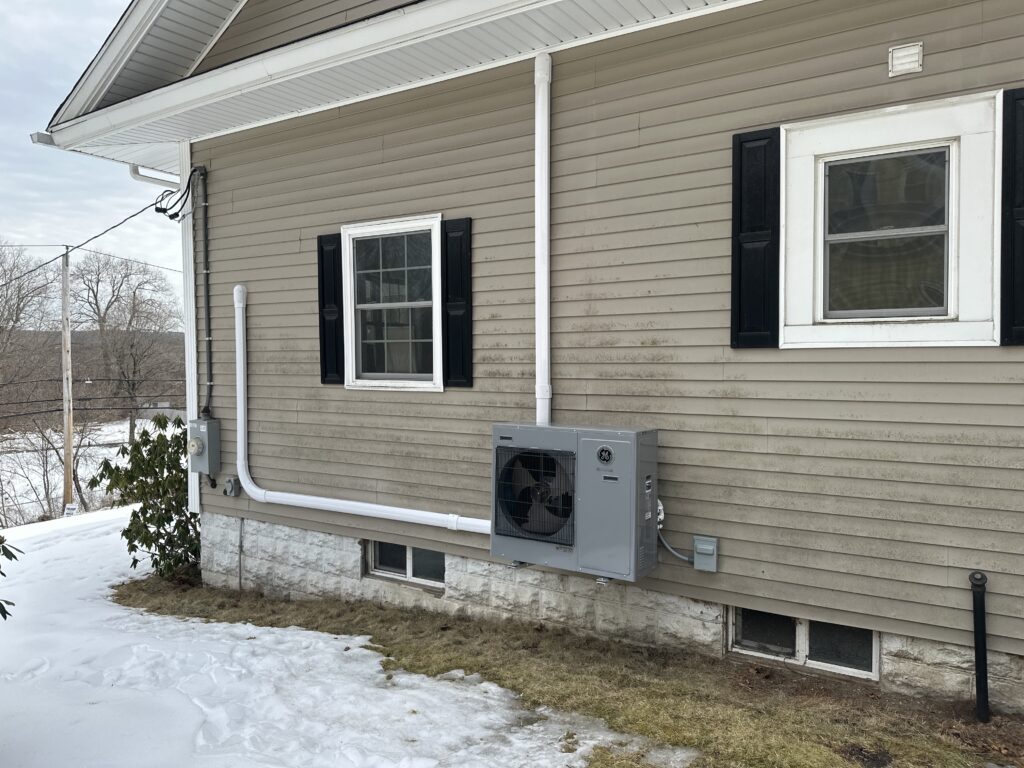
A central air installation on a house that already has ductwork usually runs one to two days. The work involves setting the outdoor condenser on a slab or wall bracket, running refrigerant line sets between the outdoor unit and the indoor coil, tying the indoor coil into the existing air handler or furnace plenum, running a condensate line to handle the water the system pulls out of the air, and wiring a dedicated electrical circuit to the condenser. If the existing ductwork is undersized or leaky, sealing or modifying it is part of getting the system to actually perform the way it’s rated to perform.
On buildings with no usable ductwork, or units that were split off a larger house, the job usually involves:
- A straight conversation about whether central air is still worth the disruption, or whether ductless is the better fit for that unit
- New duct runs through closets, dropped ceilings, or chases, placed to do the least damage to finished space
- Coordination on panel capacity if the building's electrical service can't support another circuit
Every install here is permitted and inspected. That isn’t optional, and it isn’t a line item that gets cut to beat a low bid. It’s worth asking about when you’re comparing quotes, because a number that’s meaningfully lower than the others is sometimes lower because it skipped the permit.
What it costs
A central air installation in this area typically ranges from low to high, with the final cost depending on several factors. A straightforward replacement using existing, properly sized ductwork will generally cost less than a project requiring new ductwork, electrical upgrades, or long line sets to connect the indoor and outdoor units. Multi-unit buildings may have higher costs per zone, but installing multiple systems at once can often be more cost-effective than completing separate installations over several years.
What moves the number:
- Number of zones or separate systems needed
- Whether ductwork exists, needs sealing, or needs to be built new
- Line set length between the indoor and outdoor equipment
- Whether the electrical panel has capacity for another circuit or needs work first
- Access, a condenser pad on an open side yard costs less to install than one on a tight lot with a fence and a neighbor's driveway in the way
Rebates and incentives
Get a Quote
Drew handles these quotes himself, not a salesperson working from a script. Whether it’s a single-family home near campus, an owner-occupied house with an oil tank in the basement, or a multi-unit rental overdue for real zone control, the process starts the same way: a look at the house, a load calculation, and straight answers about what will actually work.
Call 413-339-3194 to schedule a visit, or see Central Air Conditioning Installation for how this works across the rest of the territory. For everything else Powers Air handles in Amherst, see HVAC in Amherst.