
Ductless Mini-Split Installation in Palmer, MA
A lot of Palmer’s housing stock was built before anyone planned for central air, and a good chunk of it was built before anyone planned for ductwork at all. Three Rivers and Bondsville have mill-village triple deckers and workers’ cottages heated by steam or hot water radiators, which means there is no duct trunk hiding in the basement to extend. If you’ve got a room that never gets comfortable, or you’re finishing a space the original heating system never touched, that’s not a quirk of your house. That’s just what a 1900s mill village looks like when it needs air conditioning in 2024.
- Powers Air HVAC, based in Granby, MA
Ductless mini-splits exist for exactly this problem. One or more wall-mounted or ceiling-mounted indoor heads connect to an outdoor condenser through a refrigerant line set run through a 3-inch hole in the wall, no ductwork required. You get heating and cooling in a finished attic, a converted garage, an addition the old system can’t reach, or a whole house if you size it that way. For Palmer specifically, where propane and delivered oil heat are common and natural gas service is limited to parts of town, a cold-climate heat pump system also does something a furnace retrofit can’t: it changes your heating cost structure, not just your comfort.
- Additions and bump-outs that were never tied into the main heating system
- Finished attics and basements that run twenty degrees off the rest of the house
- Whole houses with radiators or baseboard and no ducts to tap into at all
- Individual units in a converted multifamily, where each tenant needs their own zone and their own thermostat, not a shared system nobody controls
- Rooms at the far end of an existing duct run that never got enough air to begin with
This is the work Powers Air does more of than anything else, and it’s the work I’m most particular about. I’m Drew Powers, I own this company, and when you call about a mini-split, you’re talking to the person who will size it, spec it, and very likely be the one standing on your roof or in your basement running the line set.
What Palmer homes are working with
Palmer isn’t one housing stock, it’s several, depending on which village you’re in. Three Rivers and Bondsville have the dense mill-village housing, built close together on small lots, often heated by oil-fired steam or hot water boilers with cast iron radiators and zero ductwork anywhere in the structure. A lot of this housing is rental or owner-occupied multifamily, two- and three-family homes where the owner is thinking about one unit or all three. Thorndike has a similar mix with more single-family homes mixed in. Out toward Palmer center and along the quieter roads off Route 20, you get more mid-century single-family construction, some with existing forced-air ductwork that’s undersized for today’s AC loads, some with none at all.
The commercial strip along Route 20 adds another wrinkle: older storefronts and small commercial buildings that need zoned comfort without the cost of a full rooftop unit replacement, which is a mini-split or VRF conversation in its own right. Across all of it, gas service is spotty enough that most Palmer households are on oil or propane delivery, which is the single biggest reason a heat pump pencils out differently here than it would in a town with cheap piped gas. You’re not comparing heat pump electricity against gas rates. You’re comparing it against oil and propane delivery prices, and that math usually favors the heat pump, especially for the cooling season you’re not currently paying for at all.
How we size and specify the system
Every mini-split quote I write starts with a room-by-room load calculation, not a tape measure and a guess. Manual J accounts for your square footage, sure, but also insulation levels, window area and orientation, ceiling height, air leakage, and how the rooms are actually used. A 400-square-foot addition on a slab needs a different BTU output than a 400-square-foot bedroom over an unheated garage, even though they’re the same size on paper.
Oversizing is the most common mistake I see from other installers, and it’s not a harmless one. An oversized mini-split short-cycles: it blasts the room to temperature fast, shuts off, and runs in brief bursts that never properly dehumidify the air or settle into a steady, efficient rhythm. You end up with a clammy room in summer and a unit that wears out its compressor faster, not a more comfortable house. The fix isn’t more capacity, it’s correct capacity.
I also look hard at cold-climate performance specs, not just the nameplate rating. The number that matters below zero is how much heating capacity the unit retains at your actual design temperature, and what the HSPF2 rating tells you about real-world seasonal efficiency rather than a lab test. If a system’s capacity falls off a cliff at 5 degrees, you need a plan for backup heat on the coldest nights, whether that’s keeping your existing oil or propane system as backup or sizing the mini-split to cover more of the load. Any quote you get should show you the load calculation, the specific equipment model and its cold-climate data, and where the line sets run. If it’s just a price and a unit size with no math behind it, that’s worth questioning before you sign anything.
For more on how cold-climate heat pumps actually perform through a Western Massachusetts winter, including what happens to capacity as temperatures drop, see our cold climate heat pump performance guide.
- The load calculation the sizing is based on, room by room or zone by zone
- Which cold-climate rated equipment is being specified and why, including its rated capacity at low outdoor temperatures, not just at 47°F
- Whether the design accounts for backup or auxiliary heat on the coldest days, and what that backup source is
- Line set length and routing, since refrigerant line runs have real limits before performance and warranty coverage are affected
- Where condensate goes and how it drains
If you’re still deciding between extending ductwork and going ductless, it usually comes down to what’s already in the walls. Homes with no existing ducts, like most of the Three Rivers and Bondsville housing stock, are straightforward ductless candidates. Homes with partial or undersized ductwork sometimes benefit from a hybrid approach, central air for the main living space and ductless heads for the rooms the ducts never reached.
What the work involves
A typical installation starts with the load calculation and a walkthrough of where indoor heads make sense, which is as much about sightlines and furniture placement as it is about airflow. From there we run the line set, usually a 3-inch wall penetration with refrigerant lines, electrical, and a condensate drain bundled together and routed to minimize visible exterior line cover. Line length matters here: every manufacturer has a maximum run and a point past which capacity and efficiency start to drop, so the outdoor unit placement isn’t arbitrary.
We mount the outdoor condenser on a pad or wall bracket with clearance for snow and airflow, which in Palmer’s winters means getting the height right the first time rather than coming back to raise it after the first big storm. Indoor heads go up, lines get connected and vacuum-tested to remove moisture and air from the refrigerant circuit, and the system gets charged to spec, not just topped off by feel. If your electrical panel is older or already near capacity, we flag that during the quote, not after the unit is on the wall, since Powers Air also handles panel upgrades in-house when a project needs one.
- Walk-through and load calculation to confirm zones, unit placement, and equipment sizing
- Electrical assessment: dedicated circuits for each indoor and outdoor unit, and whether the panel has capacity for them
- Line set routing between condenser and each indoor head, sized and insulated to spec
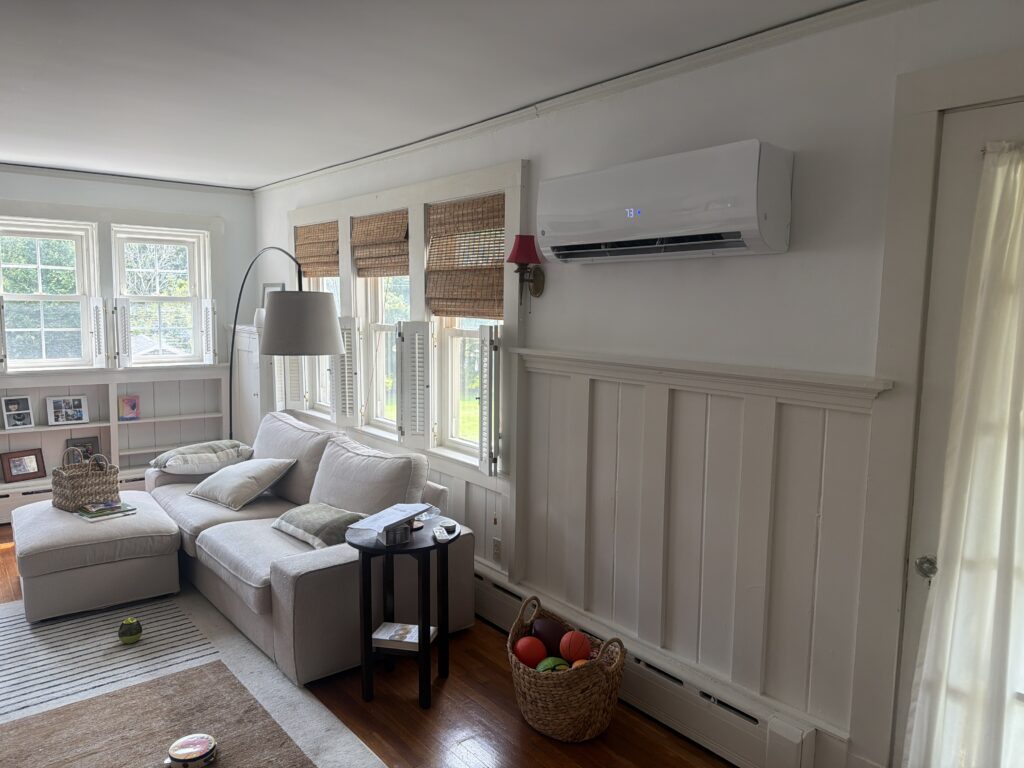
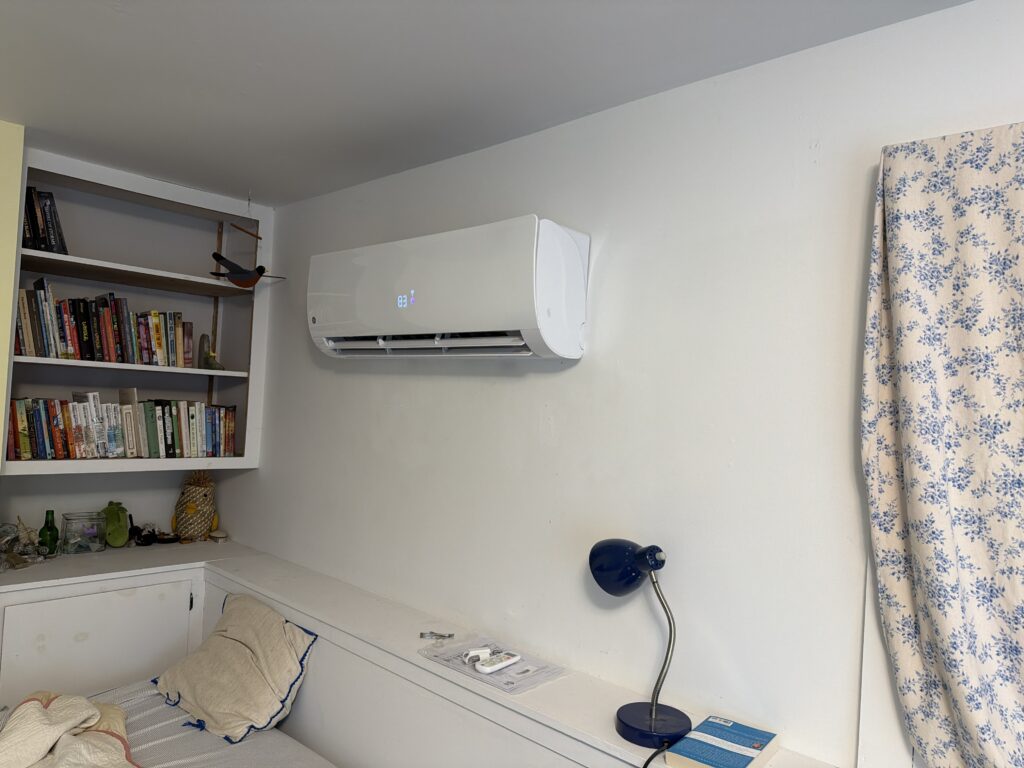
- Indoor unit mounting (wall-mounted, ceiling cassette, or slim ducted) and outdoor condenser placement
- Condensate management, inside and out
- Permitting and inspection on both the mechanical and electrical work
- Commissioning: refrigerant charge, airflow, and control operation verified before we call it done
Multi-zone systems, where one outdoor condenser feeds two to five indoor heads, are common in Palmer’s multifamily buildings and larger single-family homes where you want several rooms covered without cluttering the exterior wall with multiple condensers. Single-zone systems are usually the right call for an addition, a converted attic, or a standalone problem room.
What it costs
A single-zone mini-split for one room generally runs in the range of {PRICE_LOW} to {PRICE_HIGH} installed, and multi-zone systems covering several rooms or a whole floor climb from there. What actually moves the number: how many indoor heads you need, whether you’re using standard wall-mounted heads or a ceiling cassette or ducted slim unit for a cleaner look, how far the line sets have to run and whether that run is simple or has to navigate finished walls and multiple floors, whether your electrical panel has room for the new circuit or needs work first, and how accessible the install site is. A ground-floor room with a nearby exterior wall is a different job than a third-floor unit in a Three Rivers triple decker with limited attic access. I’ll walk through all of that before I give you a number, not after.
- Number of zones and indoor units
- Indoor unit type: wall-mounted, ceiling cassette, or slim ducted, which vary in cost and complexity
- Line set length between condenser and indoor units
- Electrical capacity, and whether the panel needs additional circuits or a change-out
- Access: attic runs, exterior penetrations, distance from condenser to units
I don’t quote off a square footage rule of thumb and I won’t give you a price over the phone before seeing the space. A real quote reflects the load calculation and the specific equipment, not a generic per-zone estimate.
Rebates and incentives
Mass Save offers incentives for qualifying heat pump installations, and the program is worth understanding before you finalize a system, since eligibility depends on the equipment’s efficiency rating and your specific situation. Rules and incentive amounts change, so rather than quote a figure here that may be out of date, I’ll point you to [EXTERNAL LINK: Mass Save official site, for current heat pump program details] and our own Mass Save heat pump rebates page, where we keep the general guidance current. When you’re ready to move forward, we can go through what applies to your specific project as part of the quote process.
Get a Quote
If you’ve got a room in your Palmer home that never gets comfortable, or you’re planning a finished space with no ductwork to tie into, call {PHONE} or send a message describing the space. I’ll come look at it, run the numbers, and tell you honestly what size system it actually needs, not the one that’s easiest to sell. For the full picture of what we install across Western Massachusetts, visit our ductless mini-split installation page, and see our Palmer, MA service area page for everything else we handle in town.
frequently asked questions
Can a mini-split really heat a Palmer home through the winter without the old oil or propane system?
Cold-climate mini-splits are rated to maintain heating capacity well below zero, and many Palmer homeowners run them as the primary heat source with the existing oil or propane system kept as backup for the coldest stretches. Whether a mini-split can fully replace your current system depends on the specific equipment and your home's heat loss, which is exactly what the load calculation answers.
Do I need new ductwork for a mini-split in an older Three Rivers or Bondsville home?
No. That's the point of a ductless system. Indoor heads connect to the outdoor unit through a small refrigerant line set run through the wall, so homes with steam or hot water radiators and no ducts at all are straightforward candidates.
How many indoor heads does a typical Palmer multifamily unit need?
It depends on the layout, but most two- and three-bedroom units use somewhere between two and four indoor heads on a multi-zone outdoor condenser, placed to cover the main living space and bedrooms individually rather than one unit trying to serve the whole floor.
What happens if my electrical panel can't handle a new mini-split circuit?
We check panel capacity during the quote, not after installation starts. If your panel is near capacity or outdated, Powers Air handles panel upgrades in-house as licensed electrical work, so it can be scheduled as part of the same project instead of becoming a separate headache.
Is a cheaper quote with no load calculation a problem?
Generally, yes. If a quote gives you a unit size and a price without showing you the room-by-room math behind it, there's a real chance the system is oversized or undersized for your space, which affects both comfort and how long the equipment lasts.