
Furnace Installation and Replacement in South Hadley, MA
Walk the older streets near Mount Holyoke and you’re looking at homes built before anyone planned for central heat of any kind – knob-and-tube wiring long since replaced, a boiler or furnace wedged into a basement that was never designed to hold one. Head out past the village center toward the newer subdivisions and you’re in post-war and later construction with ductwork already roughed in, but often undersized for anything beyond the original gas or oil furnace it was built around.
- Powers Air HVAC, based in Granby, MA
Furnace Installation and Replacement in South Hadley
When a furnace fails in South Hadley, the replacement decision isn’t just about swapping equipment. It’s about what that house can actually support – the fuel source already run to it, the condition of the ductwork, and in a lot of cases, whether the person making the call lives there or rents it out. We install and replace furnaces across town, from the mixed housing stock near campus to the larger lots further out, and we size every one of them off real numbers rather than a guess based on square footage.
A straight furnace swap is often the right call, especially where gas service already exists and the ductwork is sound. We’re not going to talk you into a heat pump you don’t want or steer you toward one if the house and the budget don’t support it. Our job is to tell you honestly what the options are and install whichever one fits.
What South Hadley homes are working with
South Hadley is a genuine mix, and that matters more here than in towns with one dominant housing type. Closer to the college and the village center, you’ll find older homes – many without natural gas on the street, running on delivered oil or propane, and more than a few still relying on converted gravity furnace ductwork that’s oversized in some rooms and starved in others. Further from campus, in the post-war and later neighborhoods, gas service is more common and the ductwork tends to be better matched to the house, but it’s rarely been inspected or adjusted since it was installed decades ago.
The other variable that shapes a lot of our South Hadley work is who owns the house. A good share of the housing near the college is faculty-owned or rented to students and staff, and landlords are usually deciding on a different basis than an owner-occupier – they want reliable equipment at a known cost, not necessarily the highest-efficiency unit on the market. We size and quote accordingly, and we’ll tell a landlord straight if a mid-efficiency furnace makes more financial sense than a premium one for a rental property, even though that’s not always the biggest-ticket recommendation.
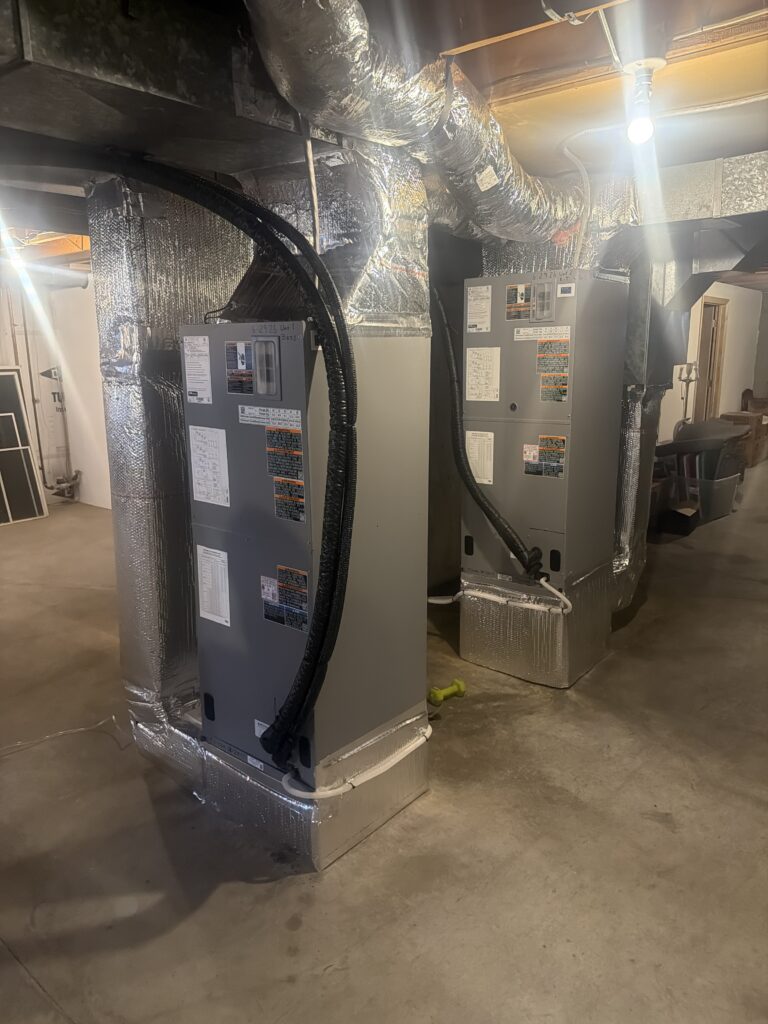
How we size and specify the system
Every furnace we spec starts with a load calculation, not a tape measure and a rule of thumb. A Manual J calculation accounts for your home’s actual insulation, window area, air leakage, and layout – not just square footage – and it tells us the real heat loss we’re designing against on the coldest day of the year.
Oversizing is the most common mistake in this business, and it doesn’t make a house more comfortable – it makes it less comfortable. An oversized furnace short-cycles: it blasts hot air, satisfies the thermostat fast, and shuts off before it’s run long enough to even out temperatures room to room or dehumidify properly. That short-cycling also wears out the blower motor and heat exchanger faster than steady, longer runtimes would.
Any quote you get should show the load calculation behind it, the furnace model and its AFUE rating, the ductwork changes needed if any, and the venting approach. If a contractor hands you a number with no calculation behind it, that’s the clearest warning sign in this industry – it means they’re sizing off the old unit or off a guess, and you’ll live with whatever that produces for the next fifteen years or more.
What the work involves
A furnace replacement in an existing mechanical closet or basement location is usually a one-day job: disconnect and remove the old unit, set the new furnace, connect supply and return ductwork, run gas or confirm oil hookup, wire the control circuit, and commission the system with a combustion analysis and static pressure check. If the ductwork needs modification – a common issue in South Hadley’s older converted systems where duct sizing was never updated for a modern high-efficiency furnace – that adds time and scope, and we’ll walk you through exactly what’s being changed and why before we start.
High-efficiency condensing furnaces also need a condensate drain and typically a different venting material than older atmospheric units, so part of our assessment is confirming there’s a practical path for both before we quote anything.
- Removing and disposing of the old furnace, along with any associated oil tank or gas line modifications
- Sizing and, where needed, modifying supply and return ductwork so static pressure matches the new equipment
- Installing proper combustion air and venting: direct vent PVC for a high-efficiency condensing furnace, or a lined chimney for a conventional one
- Setting up condensate drainage for high-efficiency furnaces, which produce acidic condensate that needs to go somewhere specific, not just the nearest floor drain
- Pulling permits and scheduling the required inspections
- Commissioning the system: verifying gas pressure or oil nozzle sizing, airflow, and temperature rise against manufacturer specs before we call the job done
What it costs
A furnace installation in South Hadley generally runs between {PRICE_LOW} and {PRICE_HIGH}, and where you land in that range depends on a handful of specifics: the AFUE efficiency tier you choose, whether existing ductwork needs modification or just reconnection, the length and routing of new venting, and access to the mechanical space. A straightforward swap in an accessible basement with sound ductwork sits at the lower end. A job that requires duct resizing, new venting runs, or work in a tight crawlspace costs more, and we’ll tell you which factors apply to your house before we give you a number, not after.
- Whether it's a straight swap or a fuel conversion, oil to gas, oil to propane, or adding a heat pump into the mix as primary or backup heat
- Ductwork condition, and whether the existing supply and return can handle the new unit or need rework
- Venting type, direct vent versus relining an existing chimney
- Electrical service, since some high-efficiency furnaces and any accompanying heat pump equipment need panel capacity that older services don't have
- Access: basement height, oil tank removal, and how far the equipment has to travel from the truck
If you’re also weighing a heat pump instead of a straight furnace replacement, it’s worth having that conversation before you commit either way, especially if your current system runs on delivered oil or propane. The math is different in a no-gas-service house than it is in a gas town, and we’ll lay out both sides honestly.
Rebates and incentives
Mass Save offers incentive programs that can apply to qualifying heating equipment, and the specifics change often enough that we’d rather help you check what currently applies to your situation than quote you a figure that might be out of date by the time you read this. [EXTERNAL LINK: masssave.com – program eligibility and current offerings] has the official program details. We can also walk through what might apply to your specific furnace replacement on our Mass Save rebates page.
Permits and Inspection
Furnace installations in South Hadley require a permit, and that permit exists for good reason – combustion equipment and venting that’s installed wrong doesn’t just fail, it can put carbon monoxide into a house with no warning. We pull the permit, the work gets inspected, and that’s not an upsell or extra paperwork for show. It’s the difference between a job that’s accountable and one where nobody checks the venting, the gas connection, or the combustion safety until something goes wrong.
Get a Quote
If your furnace is on its way out or you’re just tired of guessing what shape it’s in, call {PHONE} and we’ll set up a time to look at the house, run the load calculation, and give you a straight answer about what it needs. You’ll talk to the person doing the work, not a call center reading from a script.
frequently asked questions
How long does a furnace replacement take in South Hadley?
Most straightforward swaps are completed in a single day. If the job involves ductwork modification or new venting, it may take longer, and we'll tell you that upfront as part of the quote, not as a surprise once we've started.
Should I replace my furnace with the same size unit?
Not automatically. A lot of existing furnaces in South Hadley's older homes were oversized to begin with, often because the original installer sized off square footage rather than an actual load calculation. We run the numbers fresh rather than matching the old unit's output.
Is a heat pump a better option than a furnace in South Hadley?
It depends on the house. If you're on delivered oil or propane and your ductwork or electrical service can support it, a heat pump is worth a serious look. If gas service is already in place and the ductwork is in good shape, a high-efficiency furnace is often the simpler and more cost-effective call. We'll give you both sides before you decide.
Do I need a permit to replace a furnace?
Yes. Furnace installations require a permit and inspection in South Hadley, and that's not optional paperwork – it's what confirms the gas connection, venting, and combustion safety are done correctly.
What's the difference between AFUE ratings on new furnaces?
AFUE measures how much fuel the furnace actually converts to heat versus what's lost up the vent. A higher AFUE furnace costs more upfront but uses less fuel over its life. Which tier makes sense depends on your fuel costs and how long you plan to stay in the house, which is part of what we go over during the quote.