
Air Conditioning Repair
When your air conditioning quits in the middle of July, you don’t need a lecture on refrigerant cycles. You need someone who can tell you today whether it’s a twenty-minute fix or a system that’s done. That’s what a call to Powers Air gets you: Drew Powers, on the phone or in your basement, giving you a straight answer instead of a sales pitch. Call 413-339-3194 and we’ll get you on the schedule, usually the same day during the busy stretch of the summer.
- Powers Air HVAC, 2 Cedar St, Framingham MA 01702
What Air Conditioning Repair Involves
Air conditioning repair covers three kinds of equipment in this territory: central air systems tied into existing ductwork, heat pumps running in cooling mode, and ductless mini-splits. The symptoms overlap, but what’s actually wrong underneath rarely does, which is why a real diagnosis matters more than a guess.
Most calls come down to one of a handful of things: a failed capacitor or contactor, a refrigerant leak, a clogged or frozen coil, a condensate line backing up, a control board or thermostat wiring problem, or a compressor on its way out. The job is figuring out which one you actually have before touching anything.
- Blowing warm or barely-cool air
- Short cycling, meaning it turns on and off every few minutes instead of running a full cooling cycle
- Ice forming on the indoor coil or the outdoor line
- Water pooling around an indoor unit, air handler, or in the basement below it
- A breaker that trips every time the system tries to start
- A grinding, clicking, or humming noise from the outdoor condenser
- A mini-split head that runs constantly but never reaches the set temperature
Diagnosis means gauges on the refrigerant lines, a meter on the electrical components, and an actual read on airflow across the coil, not a part swapped on a hunch. If a capacitor is weak, we replace the capacitor. If the compressor is failing, we tell you that plainly, because that’s a different conversation entirely.
When It Is the Right Answer and When It Is Not
- Repair usually makes sense when: the failure is isolated to one component, such as a capacitor, contactor, fan motor, or control board
- The refrigerant leak is small and locatable, not evidence of a failing compressor
- The cost of the fix is a small fraction of what a new system would run
- The rest of the system, including ductwork or existing zoning, is functioning well
- Replacement usually makes more sense when: the compressor itself has failed
- The system runs on R-22 refrigerant, which has been phased out and is increasingly expensive and hard to source
- This is the third repair call in a couple of years on the same unit
- The house has no ductwork at all, in which case the real question isn't repairing central air, it's whether ductless makes more sense to begin with
- The home heats with oil or propane and has no ductwork, which changes the entire equation toward a heat pump conversation rather than patching an aging AC-only system
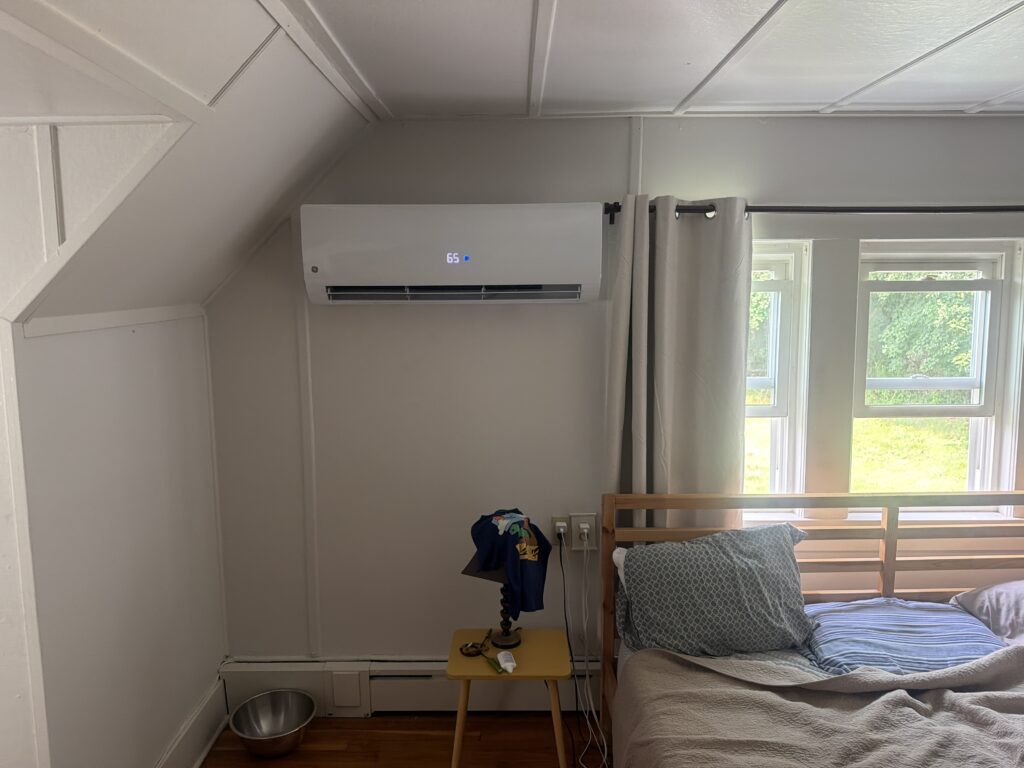
Two things about this territory shape that decision more than anything else. First, a lot of these towns have no natural gas distribution, so heating runs on delivered oil or propane. That changes heat pump economics here in a way that doesn’t apply in a gas town, and it’s worth understanding before you decide to just keep repairing an AC-only system. Second, a large share of the older housing stock, especially in the mill cities and older town centers, was built with steam or hot water radiators and never had ductwork installed at all. If that’s your house, central air repair isn’t really the conversation. Ductless is.
We’ll tell you honestly which category you’re in. Sometimes that means a forty-dollar part and you’re back in business by dinner. Sometimes it means a longer conversation about what actually makes sense for the house.
How We Size and Specify
If repair turns into a replacement conversation, sizing is where most installs go wrong, and it’s usually the installer’s fault, not the equipment’s. A system sized off square footage alone, without a real Manual J load calculation, tends to run oversized. An oversized system cools the air fast, shuts off, and cycles again a few minutes later. It never runs long enough to pull humidity out of the air, so the house feels clammy even though the thermostat says it’s at temperature. Bigger is not better. Correctly sized is better.
A proper load calculation accounts for square footage, insulation levels, window count and orientation, ceiling height, and how the house actually holds or loses heat, not just its footprint.
For heat pumps specifically, sizing also means looking at cold-climate performance: the HSPF2 rating, how much heating capacity the unit retains as outdoor temperatures drop, and whether backup or auxiliary heat is needed to cover the coldest stretches of a Massachusetts winter. For central air going back into existing ductwork, it means checking static pressure in that ductwork before assuming it can handle a bigger unit. Old ducts sized for an old system can choke a new one, and a static pressure problem shows up as noise, poor airflow to certain rooms, and a system that never lives up to its rating.
Residential & Commercial HVAC Experts
Equipment and What Actually Differs Between Systems
- Line set length has real limits. A mini-split head placed too far from the outdoor unit loses efficiency and can create refrigerant charge problems down the line
- Single-zone systems condition one room or area well. Multi-zone systems let you run several indoor heads off one outdoor condenser, but each zone needs to be sized on its own, not just divided evenly
- A ducted mini-split can serve a small addition or a partial section of a house that has no existing ductwork, without conditioning the whole home through one system
- SEER2 and HSPF2 ratings tell you the equipment's rated efficiency, but real-world performance depends just as much on correct sizing and installation as it does on the number on the spec sheet
- Variable-speed compressors run longer at lower output, which controls humidity and temperature swings far better than a single-stage compressor that's either fully on or fully off
- Indoor head style, wall-mounted, ceiling cassette, or floor-mounted, is a real decision, not just an aesthetic one, depending on the room's layout and where the line set can actually run
What It Costs
If repair turns into a replacement conversation, sizing is where most installs go wrong, and it’s usually the installer’s fault, not the equipment’s. A system sized off square footage alone, without a real Manual J load calculation, tends to run oversized. An oversized system cools the air fast, shuts off, and cycles again a few minutes later. It never runs long enough to pull humidity out of the air, so the house feels clammy even though the thermostat says it’s at temperature. Bigger is not better. Correctly sized is better.
A proper load calculation accounts for square footage, insulation levels, window count and orientation, ceiling height, and how the house actually holds or loses heat, not just its footprint.
For heat pumps specifically, sizing also means looking at cold-climate performance: the HSPF2 rating, how much heating capacity the unit retains as outdoor temperatures drop, and whether backup or auxiliary heat is needed to cover the coldest stretches of a Massachusetts winter. For central air going back into existing ductwork, it means checking static pressure in that ductwork before assuming it can handle a bigger unit. Old ducts sized for an old system can choke a new one, and a static pressure problem shows up as noise, poor airflow to certain rooms, and a system that never lives up to its rating.
Residential & Commercial HVAC Experts
What It Costs
- The age of the unit and what refrigerant it uses, since older R-22 systems cost more to service than current R-410A equipment
- Whether the failed part is common or a specialty item that has to be sourced
- Whether it's a single, isolated failure or a symptom pointing toward a bigger problem, like a failing compressor
- The condition of the ductwork feeding a central air system, if ductwork is involved at all
- Whether the brand and model are common in this area or a boutique line with a longer wait on parts
- Indoor head style, wall-mounted, ceiling cassette, or floor-mounted, is a real decision, not just an aesthetic one, depending on the room's layout and where the line set can actually run
Rebates and Incentives
Massachusetts runs the Mass Save program, which offers incentives on certain qualifying heating and cooling equipment, including some heat pump installations. It’s worth understanding before you make a decision on repair versus replacement, since it can change the math depending on what you’re replacing and with what. What applies depends on your specific equipment, your utility, and the details of the project, so we’ll help you work through what might apply to your situation as part of the conversation, rather than promising a number upfront that may not hold up once the specifics are in.
Where We Work
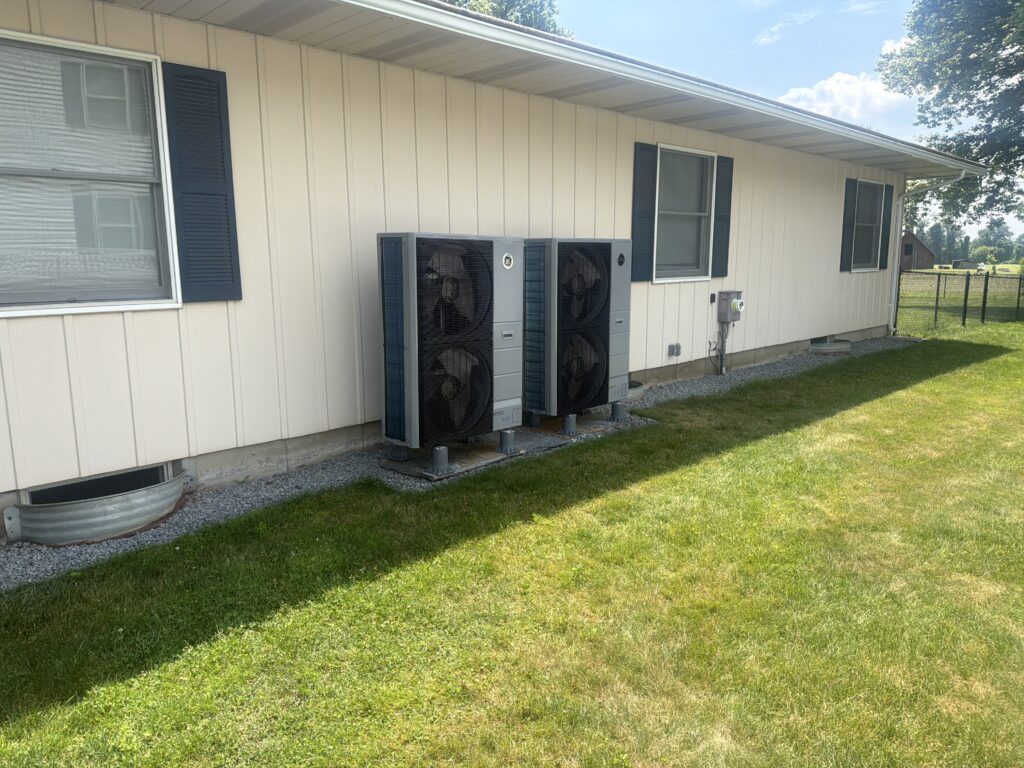
Powers Air handles air conditioning repair across the towns we serve. See the full Service Areas page for the complete list, which currently includes [and towns name Granby, South Hadley, Holyoke, Belchertown, Hadley, Ludlow, Easthampton, Northampton, Amherst, Chicopee, Springfield, Palmer . If you’re not sure whether your address falls inside that territory, call and ask. It takes thirty seconds to find out.
Get a Quote
If your air conditioning has stopped working right, or isn’t keeping up the way it used to, call 413-339-3194. You’ll talk to Drew directly about what’s going on, not a call center reading from a script, and you’ll get a straight answer about whether it’s a repair, a bigger issue, or worth talking through replacement options.
frequently asked questions
My AC is blowing air but it's not cold. What's wrong?
That usually points to one of a few things: a refrigerant leak, a dirty or frozen coil restricting airflow, or a failing compressor. It’s not something to diagnose by ear over the phone. We’ll want to get gauges on it to know for sure.