
Heat Pump Installation in Holyoke, MA
Walk through most Holyoke neighborhoods and you’re looking at buildings from the 1870s through the 1920s, a lot of them triple-deckers built when the canals ran the mills and housing went up fast and dense. Many of those buildings still run on a boiler in the basement feeding steam or hot water radiators, with no ductwork anywhere in the structure.
- Powers Air HVAC, based in Granby, MA
Heat Pump Installation in Holyoke
That combination, old masonry multifamily construction with no ducts, is exactly the situation ductless and ducted mini-split heat pumps were built to solve. You don’t need to open walls or find a chase for a trunk line. A single outdoor condenser can feed multiple wall-mounted or ceiling cassette indoor heads, one per unit or one per floor, and each zone runs independently. For a three-family with three separate utility accounts, that independence matters as much as the heating itself.
Powers Air installs heat pump systems across Holyoke’s housing stock, from a single-zone system in a two-bedroom unit to multi-zone setups covering an entire triple-decker, plus central air conversions and ductwork work in the smaller number of buildings that do have forced air. The work is done or directly supervised by Drew Powers, not handed off to whoever’s available that week.
What Holyoke Homes Are Working With
Holyoke’s building stock skews older and denser than most of the towns around Granby. Brick and wood-frame multifamily dominates in the flats and up through the Churchill and Highlands neighborhoods, much of it owner-occupied two- and three-family housing where the owner lives in one unit and rents the others. That ownership pattern changes the math on a heat pump project: a landlord weighing a $9,000 unit’s worth of equipment against a tenant’s electric bill thinks about it differently than someone heating their own living space, and we talk through that difference honestly before anyone signs anything.
Natural gas service is more available in Holyoke than in a lot of the rural towns we cover, since it’s a denser city with established gas mains, but plenty of the older multifamily stock still runs on oil-fired boilers that were never converted, especially on the upper floors and in buildings where retrofitting gas piping to every unit was never worth the cost. One detail specific to Holyoke that changes how we talk about incentives here: Holyoke Gas and Electric is a municipal utility, not one of the investor-owned utilities that fund most Mass Save rebates. That means the rebate pathway for a Holyoke address is not automatically identical to a rebate pathway in Granby or South Hadley, and it’s worth sorting out before you assume a number you saw online applies to your address.
How We Size and Specify the System
Every heat pump quote we write starts with a load calculation, not a guess based on square footage. A Manual J load calc accounts for your actual wall and window construction, insulation levels, air leakage, ceiling height, and orientation, and it tells us how much heating and cooling capacity the house genuinely needs, room by room if the building has multiple zones.
Oversizing is the single most common failure we see in other people’s installs. A heat pump that’s too big for the space short-cycles, meaning it turns on, satisfies the thermostat fast, and shuts off before it’s run long enough to properly dehumidify or distribute heat evenly. That leaves rooms feeling clammy in summer and uneven in winter, and it adds wear to the compressor from constant starting and stopping. Bigger is not better with a heat pump. Right-sized is better.
A legitimate quote should show you the calculated heating and cooling load, the manufacturer’s cold-climate performance data at your design temperature, the proposed indoor unit locations and line set routing, and how backup heat is handled if the outdoor unit’s output drops below your home’s load on the coldest nights. If a bid shows up as a single number with no load calculation behind it, that’s worth asking about before you sign anything.
What the Work Involves
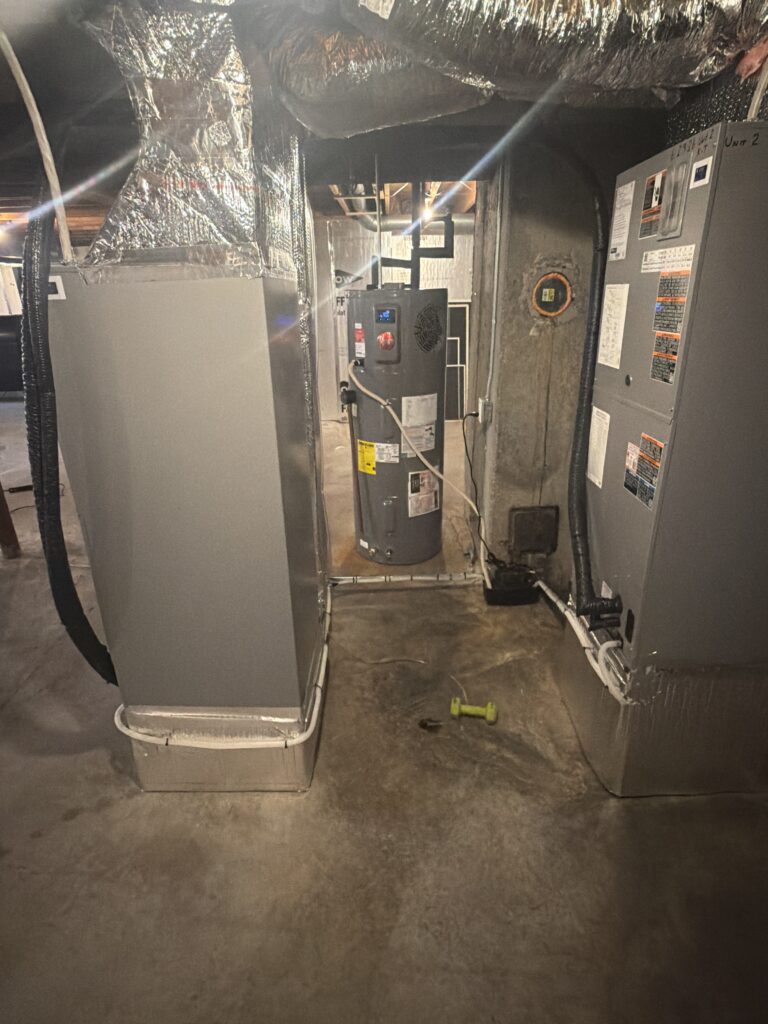
Installation starts with the load calculation and a walkthrough of the building, checking electrical service capacity, condensate drainage paths, and where line sets can run between indoor and outdoor units without excessive length or elbows, since both affect efficiency and cold-weather capacity. For multifamily buildings we also map out where each unit’s outdoor condenser will sit, since three units sharing one small backyard or a tight side alley takes planning.
From there we mount the outdoor condenser or condensers, run refrigerant line sets to each indoor head, set the indoor units, and pull a vacuum on the line set to remove moisture and air before the system is charged with refrigerant. Condensate lines get run to a safe drain point, and electrical circuits are sized and installed to code. If your panel doesn’t have capacity for the new circuits, that gets identified during the estimate, not discovered mid-job, and panel work is something we handle in-house as licensed electrical work rather than farming it out.
- A load calculation and walkthrough to confirm zone locations
- Mounting the outdoor condenser and indoor units
- Running refrigerant line sets within the manufacturer's length and elevation limits
- Setting up a proper condensate drain
- Dedicated electrical circuits, including a check on panel capacity
- Commissioning the system and a walkthrough of the controls
Cold weather is usually the first question, and it should be. Modern cold-climate heat pumps with strong HSPF2 ratings maintain real heating capacity well below zero, and the equipment we spec for Holyoke installs is selected specifically against your home’s design temperature, not a national average. Below a certain outdoor temperature, capacity does taper, which is why we talk through backup heat options, whether that’s keeping an existing oil or electric system as backup or sizing the heat pump to cover the vast majority of your heating hours on its own. The honest answer is that a well-sized cold-climate heat pump handles a typical Western Mass winter as primary heat for most homes, and we’ll tell you plainly if your house is the exception.
What it costs
Most single and multi-zone residential heat pump installs in Holyoke fall between {PRICE_LOW} and {PRICE_HIGH}, and the spread comes down to a handful of real variables: how many zones you’re conditioning, whether you’re using wall-mounted heads, ceiling cassettes, or a ducted air handler, how far the line sets have to run between indoor and outdoor units, whether your electrical panel has room for new circuits or needs upgrading, and how accessible the install locations are in an older building. A triple-decker with three separate systems costs more than a single-family ranch, but it also means each tenant controls and pays for their own heat, which changes the return on investment for a landlord. We walk through the actual drivers for your building during the estimate rather than quoting off a square footage figure.
Rebates and incentives
There are incentive programs that apply to heat pump installations, and it’s worth understanding what might apply to your address before you budget for a project. Because Holyoke Gas and Electric is a municipal utility rather than an investor-owned utility, the incentive pathway here is not identical to what’s published for most Mass Save-area towns, and rules and amounts change, so we won’t quote a number here that might not hold by the time you call. We can help you work out what actually applies to your specific address and building type as part of the estimate. For general program information see masssave.com [EXTERNAL LINK: Mass Save program overview for homeowners researching heat pump incentives], and for a deeper look at how rebate eligibility typically works across our service area visit our Mass Save heat pump rebates page.
Permits and Inspection
Heat pump installations in Massachusetts require permits, and electrical work tied to a new system, whether that’s a dedicated circuit or a panel upgrade to support it, is pulled and inspected under Powers Air’s electrical licensing ({ELECTRICAL_LICENCE}). That inspection step protects you as the homeowner or building owner, since it confirms the circuits, disconnects, and condensate handling were done to code rather than to whatever a lower bid was willing to skip. In a city with Holyoke’s density and building age, permitted work also matters if you ever sell or need insurance documentation on an older building.
Get a Quote
If you’re weighing a heat pump for a Holyoke triple-decker, a single-family home, or a small commercial space, we’ll come look at the building, run the load calculation, and give you a specific recommendation, not a generic package. Call {PHONE} or reach out through the site to set up a time. You can also see the full range of what we install on our heat pump installation hub page, or check out our Holyoke, MA town page for the rest of what we cover in the area.
frequently asked questions
Do heat pumps actually work in Holyoke winters?
Yes, when they're sized and specified correctly. Cold-climate heat pumps maintain meaningful heating capacity well below zero degrees, and we select equipment against your home's actual design temperature rather than assuming one model fits every house. We'll also discuss backup heat options so you know exactly how the system behaves on the coldest nights of the year.
Can a heat pump work in a triple-decker with no existing ductwork?
Yes. Ductless mini-split systems were designed for exactly this situation. One outdoor condenser can serve multiple indoor heads, which lets each floor or unit in a multifamily building run its own zone without any ductwork installation.
Does Holyoke Gas and Electric offer the same rebates as other towns?
Not automatically. Holyoke Gas and Electric is a municipal utility, and incentive programs for municipal utility customers can differ from the Mass Save rebates funded by investor-owned utilities elsewhere in the state. We can help you work out what applies to your specific address.
How do I know if a quote is actually sized correctly?
A legitimate quote should be backed by a load calculation showing the heating and cooling demand of your specific building, not just a number based on square footage. If a bid doesn't mention a load calculation, that's worth asking about.
Will a heat pump replace my oil boiler entirely?
It depends on the building and your goals. Some homeowners replace oil heat entirely with a heat pump sized to cover the full heating load, while others keep the existing boiler as backup for the coldest stretches. We'll lay out both paths and what each means for cost and comfort.