
Furnace Installation and Replacement in Granby, MA
Granby doesn’t have natural gas running down most of its roads. If your furnace is on its way out, you’re almost certainly choosing between oil, propane, or electric resistance as the backup fuel, not flipping a switch to cheap piped gas like a homeowner in a denser town might. That single fact changes the math on this decision more than anything else, and it’s worth sorting out before you commit to a like-for-like replacement.
- Powers Air HVAC, based in Granby, MA
Furnace Installation and Replacement in Granby
When a furnace dies in Granby, it’s usually an oil-fired unit in a basement that’s been doing the job since the house was built or since the last owner replaced it sometime in the 80s or 90s. We install and replace conventional furnaces here, and we’ll do it right if that’s the correct call for your house. But we’ll also tell you honestly when it isn’t, because on a delivered-fuel property the alternative – a cold-climate heat pump, sometimes paired with a smaller backup furnace rather than a full-size one – often costs less to run month to month and year to year. That’s not a sales pitch, it’s arithmetic specific to towns without gas mains.
If a full furnace replacement is genuinely the right move for your situation – a rental property, a house with ductwork already sized for forced air, a buyer who wants the lowest upfront cost – we’ll spec it properly: correct fuel type, correct AFUE rating, correct airflow for your existing ducts, and a venting setup that meets code for your specific chimney or direct-vent configuration.
What Granby homes are working with
Granby is a small town, somewhere around 6,300 people, spread across farmland, wooded lots, and a scattering of subdivisions, with very little density anywhere. That rural layout means no gas infrastructure was ever extended out here, so the housing stock runs almost entirely on delivered oil, propane, or electric heat. We see a lot of older farmhouses, some dating back well over a century, mixed in with post-war ranches and capes and a newer wave of larger single-family homes built on big lots since the 1990s. Basements, additions, and barns-turned-living-space are common, and each tends to complicate the ductwork or heating zone layout in its own way.
The farmhouses and older capes frequently have no ductwork at all – they were built around cast iron radiators fed by a boiler, not a forced-air furnace. If that’s your house, a furnace replacement isn’t even on the table; you’re either staying with hydronic heat or looking at ductless mini-splits, which don’t need ducts at all. The newer homes on larger lots, built from the 70s onward, are more likely to have forced-air systems with real duct runs, which is where a furnace replacement actually applies. Granby is also overwhelmingly owner-occupied single-family, so most of the calls we get are homeowners planning for the long haul, not landlords looking for the cheapest box that passes inspection.
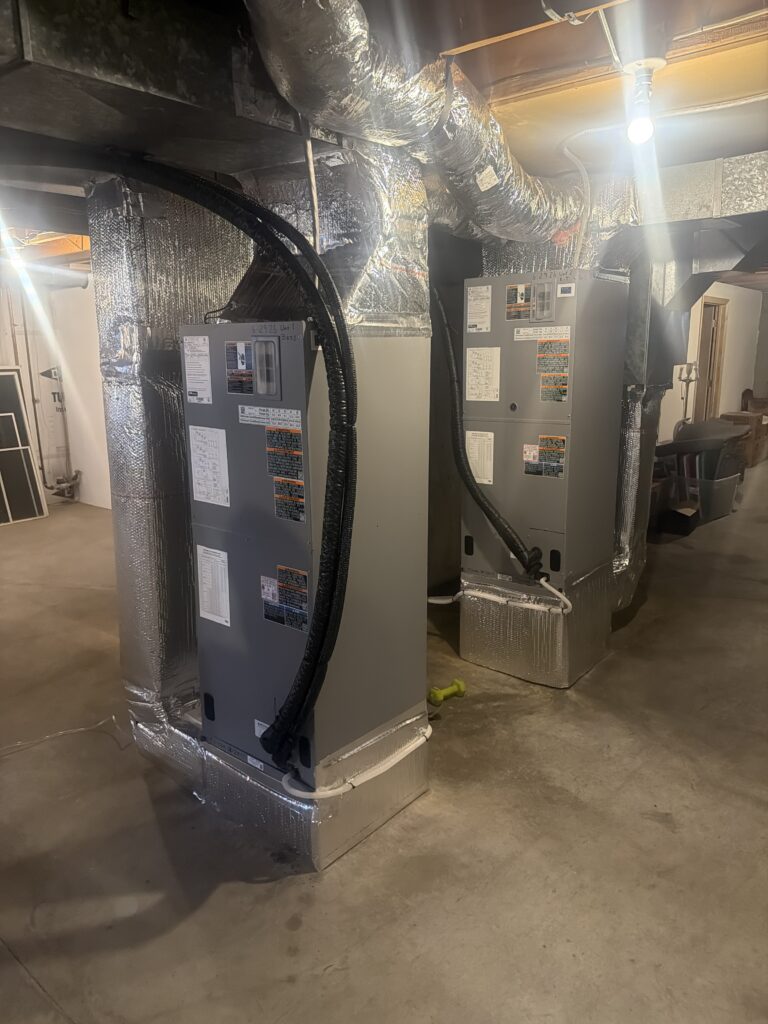
How we size and specify the system
Before we recommend anything, we run a load calculation on the house – a Manual J, not a guess based on square footage or what’s already installed. The existing furnace’s output tells us almost nothing useful; a lot of homes in this area are heated by equipment that was oversized from day one, and that oversizing is the single most common failure we find. An oversized furnace short-cycles, meaning it blasts heat, shuts off, and starts again before the house or the ductwork ever reaches a steady state. That means uneven temperatures room to room, more noise, more wear on the blower and heat exchanger, and a shorter equipment life despite spending more money upfront.
A proper quote accounts for your actual heat loss, the condition and sizing of your existing ductwork (static pressure matters here – undersized or leaky ducts choke even a well-matched furnace), your fuel source and tank or propane setup, and your venting. If someone hands you a number based on a five-minute walkthrough and the size of the unit you already have, that’s a warning sign, not a shortcut. We’ll also walk you through whether a smaller furnace paired with a heat pump makes more sense than full-size forced-air heat alone, since on oil or propane that hybrid approach often pencils out better over a winter than people expect.
What the work involves
A furnace replacement starts with disconnecting and removing the old unit, including the oil line or propane line, venting, and any electrical connections tied to it. We check the condition of the existing ductwork and modify it where airflow demands a change – a new furnace that’s correctly sized sometimes needs different duct transitions than the oversized unit it’s replacing. We set the new furnace, connect fuel and venting to current code (this matters more than people realize with older chimneys, which weren’t designed for the flue gas temperatures of modern high-efficiency equipment), wire the controls and thermostat, and commission the system – meaning we test it under real operating conditions, not just confirm it turns on. Condensate drainage, combustion air, and carbon monoxide safety checks are part of every install, not an upsell.
If your house is one of the ones with no ductwork, this section doesn’t apply to you at all, and that’s worth saying plainly rather than quoting you for duct work you don’t need. We’ll tell you straight if ductless is the better fit before we ever talk furnace models.
- Removing and disposing of the old furnace, along with any associated oil tank or gas line modifications
- Sizing and, where needed, modifying supply and return ductwork so static pressure matches the new equipment
- Installing proper combustion air and venting: direct vent PVC for a high-efficiency condensing furnace, or a lined chimney for a conventional one
- Setting up condensate drainage for high-efficiency furnaces, which produce acidic condensate that needs to go somewhere specific, not just the nearest floor drain
- Pulling permits and scheduling the required inspections
- Commissioning the system: verifying gas pressure or oil nozzle sizing, airflow, and temperature rise against manufacturer specs before we call the job done
What it costs
A furnace replacement in Granby typically runs between {PRICE_LOW} and {PRICE_HIGH}, and the spread comes down to a handful of specifics: the fuel type and whether existing oil or propane infrastructure can be reused versus needing work, the AFUE efficiency tier you choose, whether your existing ductwork needs modification or is in reasonable shape, venting changes required by an older chimney, and site access – a basement with a tight bulkhead costs more labor than a walk-out. If your panel or electrical service needs attention to support the new furnace’s blower and controls, that’s a separate scope we can handle directly since we hold the electrical licensing in-house, but we’ll flag it before it becomes a surprise on the invoice.
We don’t quote a number over the phone before seeing the house. Anyone who does is guessing, and a guess on a job this size usually turns into a change order.
- Whether it's a straight swap or a fuel conversion, oil to gas, oil to propane, or adding a heat pump into the mix as primary or backup heat
- Ductwork condition, and whether the existing supply and return can handle the new unit or need rework
- Venting type, direct vent versus relining an existing chimney
- Electrical service, since some high-efficiency furnaces and any accompanying heat pump equipment need panel capacity that older services don't have
- Access: basement height, oil tank removal, and how far the equipment has to travel from the truck
None of this replaces an actual site visit. Every house in Granby carries its own combination of fuel setup, duct condition, and chimney venting, and the only honest quote is one built from a look at your specific basement and your specific ductwork, not a phone estimate.
Rebates and incentives
Mass Save offers incentives that can apply to certain heating equipment and upgrades, and the rules and amounts change often enough that we won’t quote you a figure here – check masssave.com directly for current details, and see our Mass Save heat pump rebates page for how this generally works for heat pump projects. If you’re on the fence between a conventional furnace replacement and a heat pump, that’s exactly the conversation worth having with us before you buy – the incentive landscape is one more piece of information that can tip the decision, especially on a property heated by delivered fuel. [EXTERNAL LINK: masssave.com – current program details and eligibility]
Permits and Inspection
Furnace replacements in Massachusetts require a permit, and gas or oil-fired equipment gets inspected as part of that process – venting, combustion air, and clearances all get checked against current code, not against whatever was acceptable when the old unit went in. We pull the permit and schedule the inspection as a standard part of the job, not as an add-on. If your project also touches your electrical panel – a new furnace blower occasionally pushes an older panel past what it can reasonably handle – that work gets its own permit and inspection too, and we handle both in-house since the electrical licensing is ours, not a subcontractor’s.
Get a Quote
If your furnace is on its last winter, or you’re just tired of guessing whether oil, propane, or a heat pump makes more sense for your Granby house, call {PHONE}. You’ll talk to Drew, not a dispatcher reading from a script, and the first real step is a load calculation and a look at your ductwork, chimney, and fuel setup, not a sales pitch.
frequently asked questions
Is a heat pump really a better option than a furnace in Granby?
It depends on your house, but on delivered oil or propane the economics tend to favor a heat pump more than they would in a town with piped natural gas, since you're not competing against a cheap fuel. We'll run the numbers for your specific situation rather than giving a blanket answer.
My house has no ductwork. Can I still get a furnace?
Technically yes, but it means installing ductwork from scratch, which adds significant cost and disruption. For houses with radiators and no existing ducts, a ductless mini-split system is usually the more practical and less invasive option.
How long does a furnace replacement take?
A straightforward swap with existing ductwork and compatible venting typically takes one day. Jobs involving duct modifications, venting changes for an older chimney, or electrical panel work take longer, and we'll tell you a realistic timeline after seeing the house.
Do you work on propane furnaces, or only oil?
We install and service both oil-fired and propane furnaces, which covers the two most common fuel sources in Granby and the surrounding towns without gas distribution.
What size furnace do I need?
We won't answer that without a load calculation. The right size depends on your home's actual heat loss, not its square footage or the size of the furnace currently installed, which in a lot of older Granby homes was oversized to begin with.