
EV Charger Installation in South Hadley, MA
South Hadley is one of a handful of towns in our territory where home EV charging actually makes sense for a meaningful share of houses, and it comes down to parking. A charger needs a car that sits in the same spot for six to eight hours overnight, on property the owner controls. South Hadley has that in the post-war neighborhoods off Newton Street and out toward Granby Road, in the ranches and colonials with real driveways and attached garages. It does not have that in the same way in a lot of the housing packed in close to Mount Holyoke, where parking is on-street or shared and a dedicated 240 volt circuit has nowhere useful to land.
- Powers Air HVAC, based in Granby, MA
We install Level 2 chargers as in-house electrical work, not as a referral to someone else’s crew. Drew holds the electrical licensing this requires, and the same person who looks at your panel and your parking situation is the one who pulls the permit, runs the circuit, and signs off on the inspection. If a property doesn’t have the parking or the panel capacity to support it honestly, we’ll tell you that up front rather than sell you a charger that sits unused in a garage because the math never worked.
Where the Car Parks and What That Means
Before anything else, we look at where the car actually sits. An attached garage is the simplest case: short run from the panel, surface-mounted conduit, done in an afternoon in most cases. A detached garage or a parking spot at the far end of a long driveway is a different job entirely, because now you’re talking about a trench, possibly a sub-panel, and a lot more conductor. South Hadley’s older stock near the college complicates this further – a lot of those houses were carved into rental units or faculty housing decades ago, and the driveway or yard space that would host a charger may not even belong clearly to one unit.
If you’re a landlord with a two or three family near campus, the charger conversation is really a tenant and metering conversation first. Who pays for the electricity, whose panel feeds the circuit, and whether the parking is actually assigned to one unit all matter more than the charger itself. We’ll walk through that with you before quoting anything.
- Single-family home with a driveway or garage. The straightforward case. The main cost driver is distance from the panel to where the car sits, and whether the run is exposed in a garage or fished through finished walls.
- Small multi-family conversions. A lot of the older housing here was carved into two or three units over the decades, often still fed by one aging panel with circuits nobody has traced in thirty years.
- Larger apartment or condo buildings. Stacked meter banks, a house panel sized in a different era for hallway lighting and laundry, and a question that is rarely about the charger itself.
None of this is a sales pitch for every house in town. It’s the honest version of who this service is for, and it’s why we’d rather have this conversation on the phone before anyone drives out.
Level 2, and What Your Car Can Actually Take
The charger is not usually the bottleneck. Your car’s onboard charger is. Most EVs on the road today accept somewhere between 7.2 and 11.5 kW of AC power regardless of what the wall unit is rated for, so paying extra for a 19.2 kW charger on a car that tops out at 7.7 kW buys you nothing but a bigger box on the wall. Check your car’s actual onboard charger rating before you buy equipment, not the charger’s maximum output.
There are two ways we install these: hardwired, or on a NEMA 14-50 receptacle. Hardwired units run on a dedicated circuit sized for continuous duty – under the electrical code, a charging circuit has to be sized at 125% of the charger’s continuous load, which is why a 40 amp charger needs a 50 amp circuit. A 14-50 receptacle gives you flexibility to unplug and move the charger, or to use the outlet for something else, but it’s a connection point that has to be rated and installed correctly, and code treats it differently than a hardwired run because of that extra connection.
In real terms, a typical Level 2 setup adds somewhere around 20 to 30 miles of range per hour of charging, depending on the car and the circuit. That’s more than enough to fully charge most daily drivers overnight, which is really the whole point of a home charger – you’re not trying to replace a fast public charger, you’re trying to wake up with a full battery every morning.
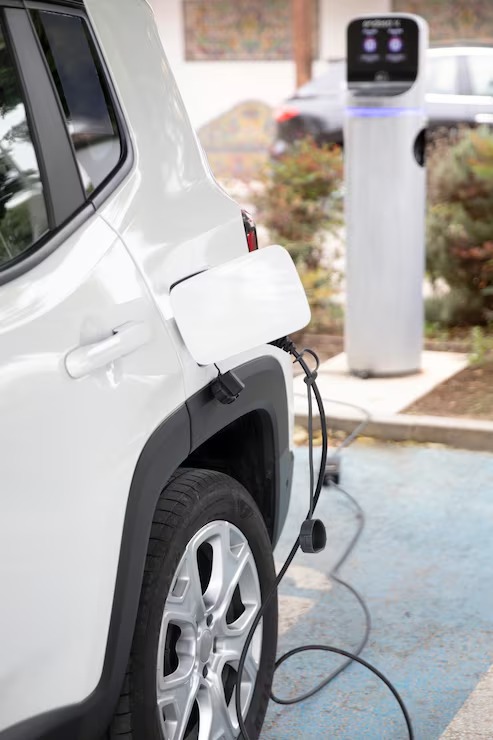
- Hardwired connection. No receptacle in the circuit at all. Typically the choice for higher-amperage installs, and there is no plug and cord sitting outdoors year after year to work loose or corrode.
- Plug-in on a NEMA 14-50 receptacle. The same style of receptacle used for a range or a welder. You can unplug the charger and take a portable unit with you, but code treats a cord-and-plug load differently than a hardwired one, and that changes some of the sizing and protection requirements.
Whether Your Panel Has Room
This is the question that decides whether your job is simple or whether it turns into a panel conversation. A Level 2 charger is a large continuous load, often 30 to 50 amps by itself, and if your panel is already carrying a heat pump, a heat pump water heater, an electric range, and whatever else has gone electric over the years, there may not be headroom left on paper even if the panel physically has open slots.
The way to answer this honestly is a load calculation, not a guess. In a lot of South Hadley houses, especially the newer construction further from the center, the answer comes back fine and the charger goes in without touching the panel at all. In the older converted housing near the college, where you sometimes find multiple meters feeding one structure or wiring that was never meant to carry today’s appliance load, the answer is more often no – at least not without help.
Where the load calculation comes back tight, a load management device is frequently the cheaper fix. It monitors what the house is drawing and backs off the charger’s output when other big loads kick in, rather than forcing a full service upgrade. If the panel genuinely can’t support it even with load management, that’s a different job and a different page – see our panel upgrade work in South Hadley and, if you’re weighing a heat pump install alongside the charger, how panel capacity affects heat pump installs too.
Whether Your Panel Has Room
We’d rather find this out with a calculation before we quote the charger than find it out halfway through the job, which is a conversation nobody enjoys having with a half-run conduit on the wall.
What the Work Involves
Once we know where the car parks and what the panel can support, the job itself is a defined scope: running a dedicated circuit from the panel to the charging location, mounting and connecting the charger or receptacle, and confirming everything is grounded, labeled, and tested correctly before we close anything up. Depending on the house, that run might be surface-mounted conduit in an unfinished garage, which is the simplest case, or it might mean fishing wire through finished walls or framing, which takes longer and costs more. Masonry walls, finished basements the run has to cross, and detached garages that need a trench all add time and material to the job. We won’t walk you through how to do any of this yourself – it’s service-level work involving a 240 volt circuit, and there’s no safe shortcut version of that instruction. That’s the whole reason it’s a licensed, permitted trade.
- A load calculation confirming the panel can carry the new circuit, or sizing a load management approach if it can't.
- Planning the run from the panel to the charger location, whether surface-run, fished through finished space, or trenched to a detached garage.
- Pulling the electrical permit before any work begins.
- Installing the dedicated circuit and charger or receptacle, sized and protected to code.
- Scheduling and passing the town inspection, which is what makes it code-compliant rather than just working.
What It Costs
A straightforward Level 2 install in an attached garage with an easy run from the panel typically lands around {PRICE_LOW}. Jobs that involve a longer run, finished walls that need to be opened and patched, a detached garage requiring a trench, or any panel work to free up capacity can run up toward {PRICE_HIGH} or beyond. We won’t quote a fixed number without seeing the panel and the run, because those two things move the price more than the charger itself does.
What moves the number, specifically: the distance between the panel and where the car actually parks, whether that run is open and accessible or buried in finished space, whether you’re dealing with masonry, whether a detached garage needs a trenched feed, and whether the panel needs any work to support the new load. The other thing that should always be in the number, and often isn’t in a cheap quote, is the permit and inspection. If a price seems low, ask directly whether it includes the permit – that’s usually the answer.
- Distance from the panel to where the car actually parks.
- Whether the run is surface-mounted in an open garage or has to be fished through finished walls and ceilings.
- Whether the wall is masonry, which changes how the run is fastened and routed.
- Whether a trench is needed to reach a detached garage.
- Whether the panel itself needs work, from a load management device up to a full upgrade.
- Whether the permit and inspection are included in the quote at all.
Utility and state incentive programs for home EV charging do exist and they change fairly often. We can help you understand what currently applies when we’re on site, but we won’t quote you a rebate number up front because none of them are guaranteed and most depend on details specific to your utility account.
Permits and Inspection
EV charger installation is permitted and inspected work in South Hadley, same as everywhere else in Massachusetts. We pull the permit, the work gets inspected, and you end up with a documented, code-compliant installation rather than something that passes a visual check and nothing else. This isn’t paperwork for its own sake – an uninspected 240 volt circuit behind a wall is exactly the kind of thing that turns into a problem at resale or, worse, a fire inspector’s finding after the fact. The quote that skips the permit is usually the one that looked cheapest, and it’s cheapest because that step is missing.
Get a Quote
If you’ve got off-street parking in South Hadley and you’re thinking about a home charger, the useful first step is a quick look at your panel and the route from it to where the car sits. That tells us whether this is a simple job or a panel conversation, and it’s the only way to give you a real number instead of a guess. Call {PHONE} and we’ll talk through what your car needs, what your panel can support, and what the job actually looks like at your address.
frequently asked questions
Can I just plug my EV into a regular outlet instead of installing a charger?
Yes, with the cable that comes with most EVs, but a standard 120 volt outlet only adds a few miles of range per hour. For most drivers that's too slow to be useful day to day, which is why Level 2 on a dedicated 240 volt circuit is the standard home setup.
Do I need a permit for a home EV charger in South Hadley?
Yes. It's permitted and inspected electrical work in every town we serve, including South Hadley. We handle the permit and the inspection as part of the job.
What size charger do I actually need?
Check your car's onboard charger rating first, not the wall unit's maximum output. A car that only accepts 7.7 kW won't charge any faster on a bigger charger, so matching the unit to your car saves money without costing you any range.
What if my panel doesn't have room for a charger?
A load calculation tells us for sure rather than guessing. Often a load management device solves it for less than a full panel upgrade. If the panel genuinely needs work, that's a separate, clearly scoped job – see our South Hadley panel upgrade page for what that involves.
Does Powers Air do the electrical work directly, or refer it out?
Direct, in-house. Drew holds the electrical licensing for this work and oversees the installation and inspection himself rather than handing it to a subcontractor or a separate electrical company.