
Heat Pump Installation in Granby, MA
Granby doesn’t have natural gas lines running past most of these houses, and a lot of the older farmhouses scattered along the back roads were built before anyone thought about ductwork at all. That combination, delivered fuel and no ducts, is exactly the situation where a heat pump makes the most financial and practical sense, and it’s also exactly why so many homeowners here still aren’t sure the equipment can handle a real Western Mass winter.
- Powers Air HVAC, based in Granby, MA
Heat Pump Installation in Granby
If you’re heating with oil or propane right now, you already know what a delivery feels like when the tank gets low in January. That’s the real comparison for a Granby homeowner, not some national average between electricity and gas. A cold-climate heat pump, sized correctly for your house, with a sensible backup heat plan for the coldest stretches, is a legitimate way to cut what you spend on fuel and still stay warm. It is not a gimmick and it is not a compromise if it’s done right. I’ve turned down jobs where someone wanted a system sized by square footage off a listing sheet, because that number tells you almost nothing about how a 1960s ranch on Granby Street actually holds heat compared to a drafty 1800s farmhouse off East State Street. The answer depends on the house, and that’s where the work actually starts.
The cold-climate question deserves a straight answer, not a brochure answer. Modern cold-climate heat pumps are rated and tested down to -5°F and below, and the good ones still deliver real heating capacity at 5°F, which covers the overwhelming majority of hours Granby sees in a typical winter. Capacity does fall off as the outdoor temperature drops, which is basic physics, not a defect. That’s why sizing and backup heat strategy matter more than the brand name on the unit.
What Granby Homes Are Working With
Granby is a small, rural town, somewhere around 6,300 people, and the housing stock reflects that. You’ve got original farmhouses from the 1800s and early 1900s on big lots, a run of post-war and 1960s-70s single family homes as the town filled in, and a scattering of newer construction further out. Lot sizes tend to be generous out here compared to the denser parts of the Valley, and most of what I see is owner-occupied, not rental stock, which changes the conversation because you’re the one living with the decision for the next fifteen or twenty years, not a landlord optimizing for turnover.
The fuel situation is the detail that actually drives the math. There’s no natural gas distribution to speak of in Granby, so the houses I go into are running on oil tanks in the basement, propane tanks in the side yard, or in some of the older farmhouses, a mix of an aging oil boiler and whatever supplemental heat someone’s added over the years. A good number of those homes, especially the older ones, were never ducted for forced air at all. They’ve got cast iron radiators or baseboard running off a boiler, which means a ducted heat pump retrofit would mean cutting into plaster and framing you’d rather not touch. That’s the case for ductless mini-splits made in plain terms: no ducts to fight, a line set run from an outdoor condenser to one or more indoor heads, and a system that handles both heating and cooling without touching your existing boiler piping.
How We Size and Specify the System
Before I quote anything, I run a load calculation, specifically a Manual J, room by room or zone by zone depending on the house. That accounts for your actual wall and ceiling insulation, window count and orientation, infiltration, and the layout of the space, not a rule of thumb per square foot. Skipping this step is the single biggest reason heat pump installs disappoint people.
Oversizing is the common failure, and it’s counterintuitive because people assume bigger means warmer. It doesn’t. An oversized heat pump short-cycles, turning on and off quickly instead of running long, steady cycles at low speed, which is where these systems are most efficient and most comfortable. Short cycling means worse dehumidification in summer, uneven temperatures in winter, more wear on the compressor, and a shorter equipment life. The system looks fine on paper and performs poorly in the house.
A legitimate quote should show you the load calculation, the equipment’s cold-climate performance data at the temperatures Granby actually sees, the backup heat plan if one is needed, and the line set length and routing. If someone hands you a number with none of that behind it, that’s a warning sign worth taking seriously, not a bargain.
What the Work Involves
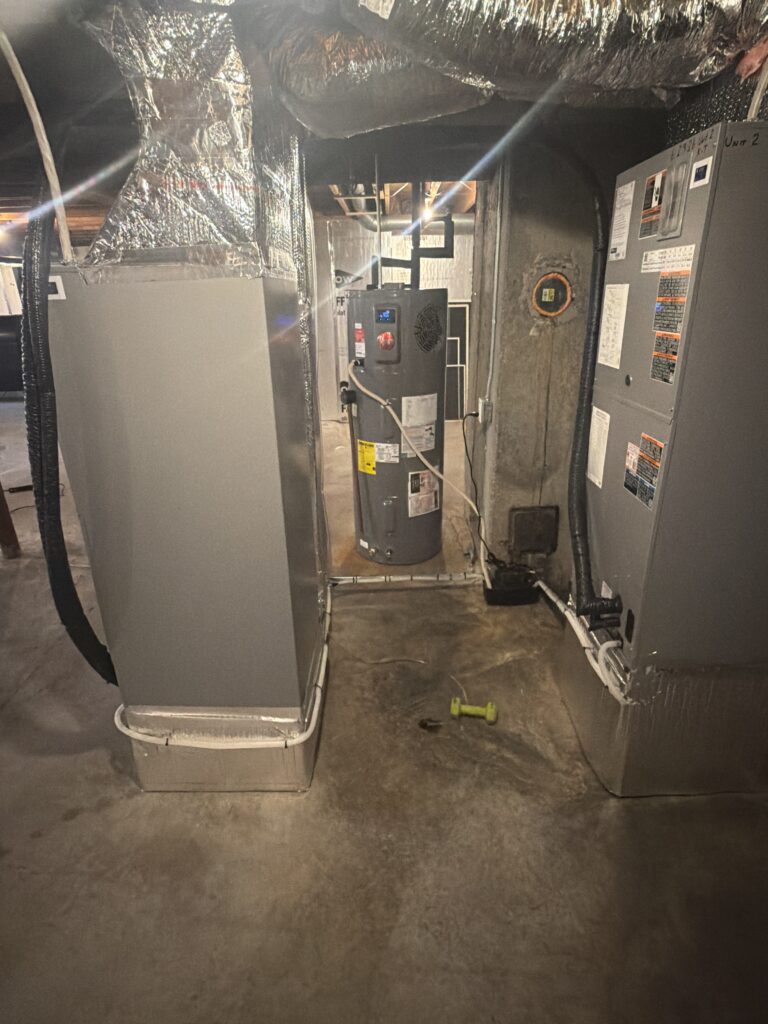
Every install starts with that load calculation and a walk-through of the house, basement to attic, looking at where line sets can run, where condensate needs to drain, and what your existing electrical panel can support. Mini-split line sets run from the outdoor condenser through a wall penetration to each indoor head, generally within the manufacturer’s rated length limits, and longer runs or significant elevation changes between indoor and outdoor units affect performance, so that gets accounted for up front rather than discovered mid-install.
If you’re going ducted, in a newer Granby home that already has forced air, static pressure in your existing ductwork matters just as much as the outdoor unit. Undersized or leaky ducts choke airflow and make even a correctly sized heat pump underperform. That gets checked, not assumed.
Electrical capacity is part of the same conversation. A heat pump is a dedicated circuit and sometimes a meaningful draw, and if your panel is already tight, that’s something to resolve before installation day, not after. Since Powers Air does panel work in-house, that’s one phone call instead of chasing down a separate electrician.
- A load calculation and walkthrough to confirm zone locations
- Mounting the outdoor condenser and indoor units
- Running refrigerant line sets within the manufacturer's length and elevation limits
- Setting up a proper condensate drain
- Dedicated electrical circuits, including a check on panel capacity
- Commissioning the system and a walkthrough of the controls
Backup heat is worth deciding deliberately rather than defaulting into. Some Granby homes keep the oil or propane system as backup for the coldest nights, which is a perfectly reasonable strategy and often the cheapest path if the boiler is in decent shape. Others go all-electric with strip heat or a cold-climate unit sized to handle the design temperature on its own. Which one makes sense depends on your house, your existing system’s condition, and what you’re trying to accomplish, whether that’s lowering fuel bills, adding air conditioning you don’t currently have, or getting off oil deliveries altogether.
What It Costs
A straightforward single-zone mini-split installation in Granby typically runs {PRICE_LOW} to {PRICE_HIGH}, and multi-zone or whole-house systems climb from there. What moves the number: how many zones and indoor heads you need, whether you’re using wall-mounted heads, ceiling cassettes, or ducted air handlers, how long the line set runs are and how much wall or siding work they require, whether your electrical panel has room for the new circuit or needs work first, and how accessible the install locations are. A one-zone retrofit on an attached garage wall is a different job than four zones across a rambling farmhouse with knob-and-tube wiring still in the walls. You’ll get a number that reflects your specific house, not a generic range stretched to fit.
Rebates and Incentives
Mass Save exists and it’s worth understanding before you commit to a system, since incentives and program rules do shift from year to year and change what makes financial sense. What applies to your specific house, equipment choice, and existing heating fuel is worth working through before you sign anything, and that’s a conversation we can have as part of quoting the job. For the current program details and eligibility, [EXTERNAL LINK: masssave.com, for up-to-date Mass Save heat pump program rules and eligibility] is the source to check directly, since figures change and a contractor’s website is the wrong place to find them.
Get a Quote
If you’re in Granby and thinking about a heat pump, whether it’s replacing an aging oil boiler, adding air conditioning to a house that’s never had it, or getting a quote that actually has a load calculation behind it instead of a guess, call Powers Air HVAC at {PHONE}. You’ll talk to Drew, not a dispatcher, and you’ll get a straight answer about whether a heat pump is the right call for your particular house before anyone talks about equipment.
frequently asked questions
Will a heat pump actually keep my Granby house warm in January?
A properly sized cold-climate heat pump will, for the overwhelming majority of the heating season. Capacity does decrease as outdoor temperature drops, which is why the load calculation and backup heat plan matter more than any single spec on a brochure. For the handful of the coldest nights, many homeowners keep existing oil or propane heat as backup rather than going all-electric.
Does it make sense to replace an oil system entirely, or keep it as backup?
It depends on the condition of your existing boiler, your tolerance for oil deliveries, and your budget. Some homeowners keep the oil system as a backup for design-temperature nights since it's often the cheaper path if the boiler is sound. Others go all-electric. There's a real answer for your specific house once we've run the numbers.
My house has no ductwork. Does that rule out a heat pump?
No, it's actually the more common scenario in Granby's older housing stock. Ductless mini-splits solve this directly: a line set runs from an outdoor condenser to one or more wall or ceiling-mounted indoor heads, with no ductwork required at all.
How much does Mass Save actually cover for a heat pump install?
That depends on current program rules, your household details, and the equipment specified, and the figures change over time. Check masssave.com directly for current numbers, and we can help you understand what applies to your specific house as part of quoting the job.
What should a real heat pump quote include?
A load calculation (Manual J) for your house, cold-climate performance data at temperatures Granby actually sees, a backup heat plan if one applies, and line set routing and length. A price with none of that behind it is a guess, not a quote.