
Central Air Conditioning Installation in Chicopee, MA
Chicopee has blocks of tight post-war ranches and capes with basement ductwork already run for a furnace, and it has triple-decker and duplex stock along the river where steam heat was the original system and central air was never part of the plan. Which category your house falls into decides almost everything about what a central AC install actually looks like here, and it is worth figuring out before anyone quotes you a number.
- Powers Air HVAC, based in Granby, MA
Central Air Conditioning Installation in Chicopee
Central air conditioning makes the most sense when a house already has ductwork, or when the layout and the budget both favor one outdoor condenser feeding a single air handler instead of multiple indoor heads. In a city the size of Chicopee, with its mix of post-war single families and older multi-unit buildings, that is a real split rather than a hypothetical one. We look at the house in front of us, not a one-size answer we give everyone.
If you’ve got a gas or oil furnace in the basement with a trunk line running to registers upstairs, adding or replacing a central AC system is usually the straightforward path: a matched coil on the furnace, a new or reused line set, and a condenser outside. If you don’t have ducts, we’ll tell you that plainly and talk through whether ductless makes more sense before we ever price out central air for a house that was never built for it.
- Ductwork already exists and is in decent condition
- A furnace or air handler is already in place and just needs a matching outdoor condenser
- One thermostat and one system serving the whole house is genuinely simpler than several ductless zones
- Whole-house humidity control matters as much as temperature does
What Chicopee homes are working with
Chicopee is the second largest market in our service territory, with roughly 55,600 people spread across a city that grew in distinct waves. The post-war neighborhoods off Memorial Drive and toward Fairview have smaller lots, single-family ranches and capes, many with a furnace and existing ductwork already doing the heating work. The older mill-era sections closer to the Chicopee Falls and Willimansett areas have a much higher share of two and three family properties, often steam or hot water heat, and a lot of those buildings never had a duct system installed at all. That split matters more here than in almost any other town we serve, because it means central air is a genuinely good fit for a large chunk of the housing stock and a poor fit for another large chunk.
Gas service is common in Chicopee’s denser sections but far from universal, and plenty of the mid-century housing stock runs on oil. A buyer here tends to be practical and price-aware, and a landlord buyer especially wants a straight answer on what it costs and how long it lasts, not a sales pitch. We quote it the way we’d want it quoted to us: here’s what your house needs, here’s why, here’s the number.
How we size and specify the system
Every central air quote we write starts with a load calculation, not a nameplate rating copied off the old unit. A Manual J looks at your square footage, insulation, window area and orientation, and tells us how many BTUs of cooling the house actually needs on a design day. Skipping that step and sizing off the old equipment or a rule of thumb is how houses end up with oversized systems that short-cycle, cool the air fast without pulling the humidity down, and wear out their compressors years early. Bigger is not better here. A correctly sized system runs longer cycles, dehumidifies properly, and is quieter and cheaper to operate than an oversized one that was sold on the promise of more capacity.
A real quote should show you the load calculation, the specific equipment model and its capacity, how the ductwork was evaluated for static pressure (undersized or leaky ducts choke even a well-matched system), and what’s included for line set, electrical, and startup. If someone hands you a flat number with no load calculation behind it and no explanation of why that tonnage was chosen, that’s a quote to be skeptical of. We’d rather lose the job than install the wrong size system in your house.
- Short cycles: it cools the air fast and shuts off before it's run long enough to pull humidity out, so the house ends up cold and clammy at the same time
- Wears out faster, because more starts and stops means more stress on the compressor
- Costs more to buy and more to run than a correctly sized system would
What the work involves
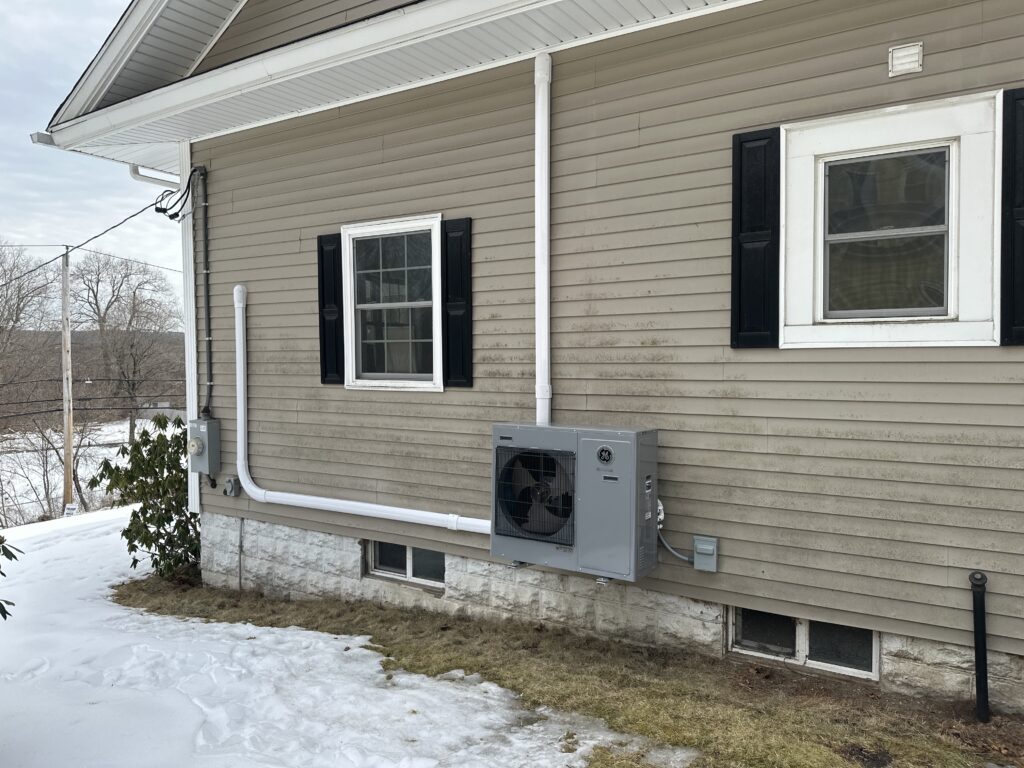
A straightforward add-on to existing ductwork means setting a new condenser on a pad outside, matching a coil to your furnace or air handler, running refrigerant line set between the two, and tying into the existing duct trunk. Where a house already has the ducts but they’re undersized or leaky, we’ll talk through whether to seal and improve what’s there or address the worst of it as part of the job, because a perfect condenser on bad ductwork still performs poorly.
For homes without existing ductwork, central air isn’t a clean fit, and that’s the honest answer rather than a reason to force new duct runs through finished ceilings and closets. We’ll lay out what that would actually involve and let you weigh it against ductless, which usually comes out ahead in both cost and disruption for a house that never had ducts to begin with.
Every job includes a condensate line run to a safe drain point, proper electrical disconnect and circuit sizing for the new condenser, and a full system startup with refrigerant charge verified against manufacturer specs, not just topped off and left.
Permits and inspection
Central air installation in Chicopee requires a permit and inspection, and that’s true whether you’re adding a new system to existing ductwork or replacing an old condenser and coil. We pull the permit, the inspector checks the electrical disconnect, refrigerant line work, and condensate handling, and you get a record that the job was done to code. It’s a small extra step that protects you if you ever sell the house or need warranty service down the line.
- The load calculation itself, not just a tonnage number pulled from it
- The SEER2 rating of the equipment proposed and what that means for the summer electric bill
- Ductwork condition, and whether sealing or modification is part of the job
- Electrical circuit requirements for the outdoor condenser
- What's covered under manufacturer parts warranty versus labor warranty
Electrical capacity and your panel
A new central air condenser adds load to your electrical panel, and in some of Chicopee’s older homes, particularly the mill-era multi-families, that panel is already stretched thin or still running fuses instead of breakers. We check capacity as part of every quote. If your panel needs an upgrade to safely support new cooling equipment, that’s electrical work we do in-house, fully licensed and permitted under {ELECTRICAL_LICENCE}, not farmed out to a third party you’ve never met.
Timeline and what to expect
A standard add-on install to existing ductwork typically runs one day for the equipment itself, start to finish, assuming line set runs and electrical are straightforward. Houses with panel upgrades, significant ductwork sealing, or access challenges in a multi-family building take longer, and we’ll tell you that up front rather than after we’ve started.
- A straight conversation about whether central air is still worth the disruption, or whether ductless is the better fit for that unit
- New duct runs through closets, dropped ceilings, or chases, placed to do the least damage to finished space
- Coordination on panel capacity if the building's electrical service can't support another circuit
What it costs
Central air installation in Chicopee generally runs between {PRICE_LOW} and {PRICE_HIGH} installed, and where you land in that range depends on a handful of real factors: whether your ductwork exists and is in good shape or needs sealing and modification, how far the line set has to run between condenser and coil, whether your electrical panel has room for the new load or needs an upgrade first, and how accessible the install locations are, especially in a triple-decker with tight basement or attic clearance. We don’t quote a number without seeing the house and running the load calculation, and we don’t pad the estimate with work your house doesn’t need.
Maintenance and system life
A properly sized and installed central air system, with annual filter changes and a coil cleaning every couple of years, should give you reliable cooling for a long service life. Oversized systems, by contrast, tend to fail early because they’re cycling on and off constantly instead of running steady, longer cycles the way they were designed to. Sizing it right the first time is the single biggest thing we control that affects how long your system lasts.
- Number of zones or separate systems needed
- Whether ductwork exists, needs sealing, or needs to be built new
- Line set length between the indoor and outdoor equipment
- Whether the electrical panel has capacity for another circuit or needs work first
- Access, a condenser pad on an open side yard costs less to install than one on a tight lot with a fence and a neighbor's driveway in the way
Rebates and incentives
Mass Save offers incentives that can apply to qualifying cooling and heat pump equipment, and the specifics change often enough that we won’t quote you a figure here. What we will do is help you work out what your specific house and equipment choice might qualify for, and point you to the current program details rather than guess. Check masssave.com [EXTERNAL LINK: Mass Save official program site for current incentive details] for the current offerings, and see our Mass Save heat pump rebates page if you’re also weighing a heat pump against central air for your situation.
Choosing a contractor you can trust
Central air installation involves real decisions about ductwork, equipment sizing, and electrical capacity that shape how your Chicopee home performs for years. It’s worth working with a contractor who explains those tradeoffs plainly instead of pushing the biggest unit available.
We’re licensed and insured to do this work in Massachusetts, and we’ll walk you through the reasoning behind our recommendation before anything gets installed. Ask questions, compare quotes, and pick the team that answers them clearly.
Get a Quote
No salesperson, no script. Whether it’s a two-family in Chicopee Falls with a cramped mechanical closet, an older ranch near Szot Park running on window units, or a home with ductwork that’s never been properly balanced, every quote starts the same way: a walkthrough, a real load calculation, and honest talk about what size and setup actually fits the house.
Call to schedule a visit, and we’ll put together a straightforward proposal for your Chicopee home.
frequently asked questions
Can I add central air to a Chicopee house that already has a furnace and ductwork?
In most cases, yes. If the ducts are a reasonable size and in decent shape, adding a matched coil to your existing furnace and a new outdoor condenser is usually the most cost-effective path to central air.
My house has no ductwork at all. Is central air still an option?
Technically yes, but running new ducts through a finished house, especially in the older mill-era multi-families common in Chicopee, is expensive and disruptive. We'll walk you through the real cost of that versus a ductless system before recommending either one.
How do you decide what size system my house needs?
We run a Manual J load calculation based on your square footage, insulation, windows and layout. It tells us the actual cooling load your house has on a hot day, rather than guessing off the old unit's rating or a rule of thumb.
Does a new AC condenser require electrical panel work?
Sometimes. Older panels, particularly in Chicopee's mill-era housing stock, are sometimes already at or near capacity. We check this during the quote, and if an upgrade is needed, it's electrical work we handle in-house, permitted and inspected.
How long does a central air installation take?
A straightforward add-on to existing ductwork typically takes about a day. Jobs involving panel upgrades, ductwork sealing, or difficult access in a multi-family building take longer, and we'll give you a realistic timeline before work starts.