
Central Air Conditioning Installation in Springfield, MA
Springfield’s housing stock ranges from turn-of-the-century triple-deckers with knob-and-tube wiring still buried in the walls to 1960s ranches in East Forest Park with ductwork already in place from an old gravity furnace conversion. Some of those houses have gas service from the mains running down the street. A lot of the outlying sections do not, and the decision about how to cool a house here depends more on what’s already in the walls than on what the neighbor two streets over installed.
- Powers Air HVAC, based in Granby, MA
Central Air Conditioning Installation in Springfield
Central air makes sense for a specific kind of house: one that already has ductwork, or one being built or gutted to the point where adding it is practical, and where the owner wants whole-house cooling off a single thermostat rather than zone-by-zone control. We install central AC in Springfield when that’s genuinely the right call, not because it’s the default answer. If the house has old gravity-furnace trunk lines in the basement or a newer forced-air furnace from a 1990s addition, there’s usually a path to tying in a cased coil and condenser without tearing the place apart.
What we won’t do is sell you a central system because it’s familiar, when a ductless setup would actually cost less to run and solve a comfort problem the ducts can’t fix. If your house already moves air well, central AC is often the straightforward, lower-labor option. We’ll tell you when that’s the case.
- Ductwork already exists and is in decent condition
- A furnace or air handler is already in place and just needs a matching outdoor condenser
- One thermostat and one system serving the whole house is genuinely simpler than several ductless zones
- Whole-house humidity control matters as much as temperature does
What Springfield homes are working with
Springfield is the biggest market in this territory by a wide margin, close to 156,000 people, and the housing reflects it. The dense neighborhoods near the city center and the triple-decker belt in Forest Park, Six Corners, and the McKnight district were mostly built before 1930, heated originally by coal-fired steam or hot water, and never ducted for anything. A good share of those buildings are owner-occupied two- and three-families where the owner lives in one unit and rents the others, which changes the calculus: a landlord weighing central air against ductless is usually thinking about per-unit metering and tenant turnover as much as comfort.
Move out toward Sixteen Acres, East Forest Park, and the areas bordering Wilbraham and Longmeadow, and you get a different housing type entirely: larger single-family lots, homes built mostly from the 1950s through the 1980s, many already running forced-air furnaces with ductwork sized for heating. Those are strong central AC candidates because the distribution system is already there. Gas service is reasonably common within the city itself, but plenty of Springfield-area homes, particularly older ones converted from coal to oil decades ago, still run on delivered oil or propane. That matters for the whole-house energy picture, even on a cooling-only project, because it affects what the HVAC system is paired with and what rebates might apply down the line.
How we size and specify the system
A central AC quote that doesn’t start with a load calculation is a quote you should question. We run a Manual J on the house, not a rule-of-thumb based on square footage, because square footage alone tells you almost nothing about how much heat a house actually gains. Insulation levels, window orientation and count, ceiling height, air leakage, and how many people and appliances are running inside all factor into the real number.
Oversizing is the most common mistake in this trade, and it’s usually sold as a feature: a bigger system cools the house faster, so it must be better. It isn’t. An oversized AC short-cycles, meaning it satisfies the thermostat and shuts off before it’s run long enough to actually pull humidity out of the air. You end up with a house that feels cold and clammy at the same time, a compressor that wears out faster from constant starts and stops, and higher electric bills for worse comfort. The right-sized system runs longer, steadier cycles and does the dehumidification job it’s supposed to do.
A quote worth signing should show the load calculation, the equipment’s rated capacity matched against it, the ductwork condition and whether static pressure was checked on existing trunk and branch lines, and what happens if the ducts can’t move enough air for the new equipment without modification. If none of that is on the page, you’re looking at a price, not a specification.
- Short cycles: it cools the air fast and shuts off before it's run long enough to pull humidity out, so the house ends up cold and clammy at the same time
- Wears out faster, because more starts and stops means more stress on the compressor
- Costs more to buy and more to run than a correctly sized system would
Existing ductwork versus new installation
If your Springfield home already has ductwork sized for a furnace, adding a cooling coil and an outdoor condenser is usually the most cost-effective path to central air. We check static pressure in the existing trunk lines before assuming they’ll handle the added airflow a cooling system needs, because undersized returns are a common problem in older forced-air retrofits and they choke performance no matter how good the equipment is.
Where there’s no ductwork at all, which describes a large share of Springfield’s older multifamily stock, running new trunk and branch lines through a house with plaster walls and low basement clearance gets expensive fast, and it’s often the point where ductless mini-splits become the more sensible option instead of forcing central air into a house that was never built for it.
Line sets, condensate, and outdoor unit placement
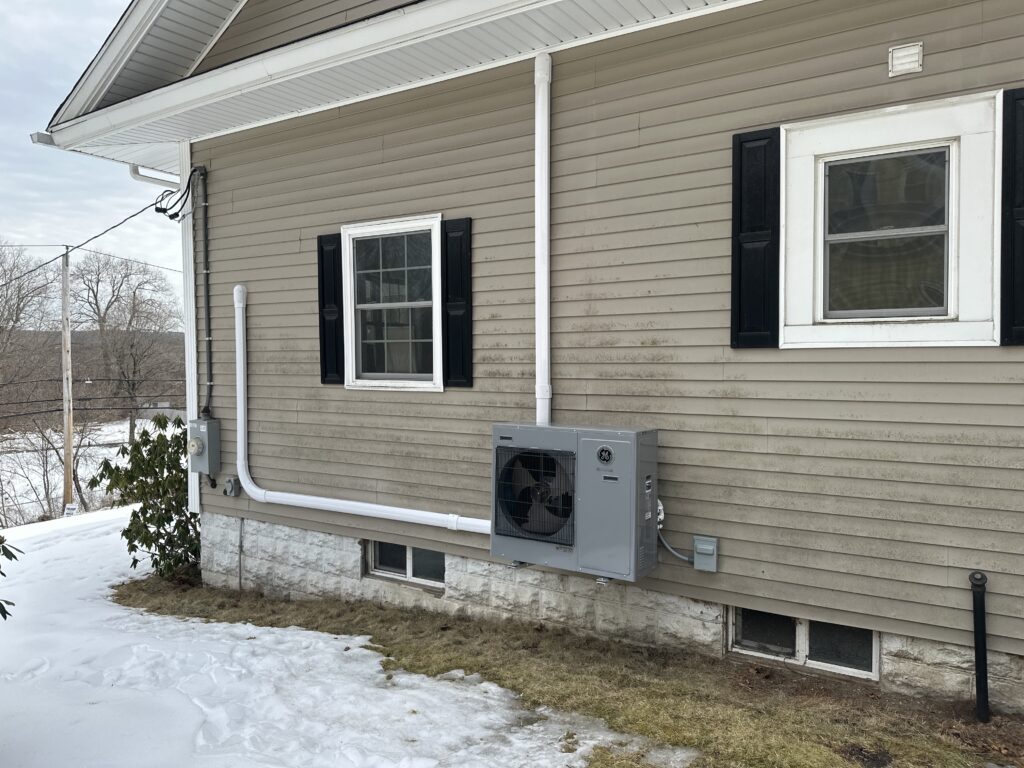
Even in a straightforward central AC job, the details matter. The refrigerant line set connecting the outdoor condenser to the indoor coil has length and elevation limits that affect performance if ignored. Condensate drainage needs a real slope and a secondary pan or float switch in a finished basement, since a backed-up drain line is one of the most common callback issues in this trade. Outdoor unit placement affects both efficiency and noise, especially on Springfield’s tighter city lots where the condenser might sit six feet from a bedroom window or a neighbor’s fence line.
- The load calculation itself, not just a tonnage number pulled from it
- The SEER2 rating of the equipment proposed and what that means for the summer electric bill
- Ductwork condition, and whether sealing or modification is part of the job
- Electrical circuit requirements for the outdoor condenser
- What's covered under manufacturer parts warranty versus labor warranty
Electrical capacity and panel considerations
A central air condenser draws a dedicated circuit, and on older Springfield homes still running a 60 or 100-amp panel, especially in the pre-war triple-decker stock, there’s often not enough headroom left once you account for a water heater, kitchen circuits, and whatever’s already drawing on that panel. We check this before quoting equipment, not after installation day when the breaker won’t hold. Powers Air performs panel upgrades and change-outs as licensed, permitted, inspected electrical work when a project calls for it, so if your central air install surfaces a capacity problem, it gets solved under one roof instead of a referral that stalls the job for weeks.
What the work involves
A typical central AC installation in an existing Springfield home runs over one to two days depending on ductwork condition and electrical scope. We set the outdoor condenser on a pad with proper clearance, run and insulate the line set, install or connect the indoor coil to the existing furnace plenum, tie in condensate drainage with a safety switch, and run the dedicated electrical circuit. Before we leave, we check refrigerant charge against manufacturer specs, verify airflow at the registers, and confirm the thermostat is communicating correctly with the system. Every job is pulled under permit and inspected, which is standard practice and also the thing that separates a quote that looks cheap from one that actually is cheap once you factor in a failed inspection or a redo.
- A straight conversation about whether central air is still worth the disruption, or whether ductless is the better fit for that unit
- New duct runs through closets, dropped ceilings, or chases, placed to do the least damage to finished space
- Coordination on panel capacity if the building's electrical service can't support another circuit
Working around occupied multifamily buildings
A meaningful share of Springfield’s housing is occupied multifamily, and installing central air in a triple-decker with tenants in two of the three units is a different logistics problem than a single-family job. We coordinate access, minimize the time any one unit is without power or water, and plan outdoor unit placement so it doesn’t end up blocking a shared driveway or a tenant’s only exterior door. Landlords evaluating this kind of project should ask any contractor how they handle occupied-unit scheduling before signing anything.
What it costs
Central air conditioning installation in Springfield generally runs between {PRICE_LOW} and {PRICE_HIGH} for a residential system, and the spread is wide because the variables are real. A single-zone system tying into existing, adequately sized ductwork sits at the low end. Add complexity, multiple zones, a line set run longer than standard, an electrical panel that needs upgrading to support the new circuit, or difficult access in a tight city lot or a finished basement, and the number climbs. We won’t quote a fixed price before seeing the house and running the load calculation, because anyone who does is guessing, and you end up paying for the gap between the guess and reality.
- Number of zones or separate systems needed
- Whether ductwork exists, needs sealing, or needs to be built new
- Line set length between the indoor and outdoor equipment
- Whether the electrical panel has capacity for another circuit or needs work first
- Access, a condenser pad on an open side yard costs less to install than one on a tight lot with a fence and a neighbor's driveway in the way
How financing and timing affect the project
Summer demand in Springfield means installation schedules fill up fast once the weather turns, and equipment lead times can stretch during peak season. Homeowners planning a replacement or new install get more scheduling flexibility, and sometimes better equipment availability, by scoping the job in spring before the heat arrives. We’ll give you a straight answer on current lead times when you call rather than a vague promise.
Rebates and incentives
Mass Save exists, it changes year to year, and it’s worth understanding before you finalize equipment choices, especially if you’re weighing central air against a heat pump system that might qualify for different incentives. We’re happy to walk through what a specific Springfield project might be eligible for, but the programme rules and dollar amounts shift often enough that we’re not going to quote figures here that could be outdated by the time you read them. Check masssave.com directly for current program details [EXTERNAL LINK: Mass Save official site for current rebate programs and eligibility], and see our page on heat pump rebates for how Mass Save treats electrified heating and cooling equipment specifically.
Get a Quote
Every quote starts with a walkthrough, not a guess over the phone. Springfield’s mix of older triple-deckers, postwar colonials, and newer builds all load differently, so before any numbers get written down, there’s a real look at the attic, the panel, and the duct runs already in place.
Call to set up a visit, or ask about financing if the timing matters more than the sticker price. Either way, you get a straight answer about what the house actually needs.
frequently asked questions
Can central air be added to a Springfield triple-decker that has no ductwork?
Technically yes, but running new ductwork through a balloon-framed triple-decker with plaster walls and low basement clearance is invasive and expensive. In most of these buildings, a ductless mini-split system delivers the same cooling result with far less construction work and lower long-term operating cost. We'll lay out both options honestly before you commit to either.
How long does a central AC installation take?
A straightforward tie-in to existing, adequately sized ductwork usually takes one day. Jobs that involve electrical panel work, ductwork modification for static pressure issues, or multi-zone setups can run two days. We'll give you a specific estimate once we've seen the house.
Does my existing furnace ductwork work for central air, or does it need to be redone?
Often it works, but not always. We check static pressure in the existing trunk and return lines before assuming they can handle the added airflow a cooling coil requires. Undersized returns are common in older forced-air retrofits and they limit performance regardless of how good the new equipment is.
Is central air a better choice than ductless mini-splits for my house?
It depends entirely on what's already in the walls. If you have functional ductwork sized reasonably well, central air is often the more straightforward and lower-labor option. If you don't have ductwork, or your existing ducts are undersized and routed through unconditioned space, ductless frequently wins on both installed cost and running efficiency. We size based on your house, not a default preference.
Will a new central air system require electrical panel work?
Sometimes. Many older Springfield homes, especially pre-war multifamily buildings, are still running 60 or 100-amp panels with little spare capacity. We check this during the initial assessment. If an upgrade is needed, Powers Air performs that work in-house as licensed, permitted, inspected electrical work rather than referring it out.