Furnace Installation and Replacement
- Powers Air HVAC, based in Granby, MA
What Furnace Installation and Replacement Involves
Furnace installation and replacement means putting in a new, correctly sized combustion furnace, oil, propane, or in the rare pockets of this territory that have it, natural gas, tied into either existing ductwork or newly designed ductwork. Replacement covers swapping out a failing or worn unit for a new one. Installation covers putting a furnace into a house that’s changing fuel type, adding a system, or building new.
A furnace works by burning fuel to heat a metal heat exchanger, then pushing air across that heat exchanger with a blower and out through your ducts. The parts that fail over time are predictable: the heat exchanger cracks or corrodes, the ignition or burner assembly wears out, the blower motor bearings go, or the whole thing just falls behind current efficiency standards enough that repairing it stops making sense.
Signs it’s time to have this conversation instead of scheduling another repair call:
- The furnace is into its second decade or more of service, especially if it's on its original heat exchanger
- You've had two or more repair calls in the last couple of heating seasons
- Fuel bills have crept up without a change in how the house is used
- Some rooms run cold no matter how the thermostat is set
- A technician has flagged a cracked heat exchanger or a carbon monoxide concern, which is a safety issue, not a maintenance one
- The unit is a low-efficiency model and you're staying on oil or propane long term
When It Is the Right Answer and When It Is Not
This is the part most contractors skip, because a furnace quote is a bigger ticket than a repair, and skipping this conversation is how homeowners end up with the wrong system paid off over ten years. Furnace replacement is the right call for a lot of the houses in this territory. It is not the right call for all of them.
Furnace replacement usually makes sense when:
- The house already has ductwork in reasonable shape and you're not looking to change how it's heated, just replace worn-out equipment
- You're staying on oil or propane by choice, or gas service already runs to the house
- The furnace is failing but the cooling side, or the ductwork feeding it, is fine and doesn't need to change
- You want fuel-fired backup heat paired with an existing or planned heat pump, rather than relying on electric strip heat for the coldest days
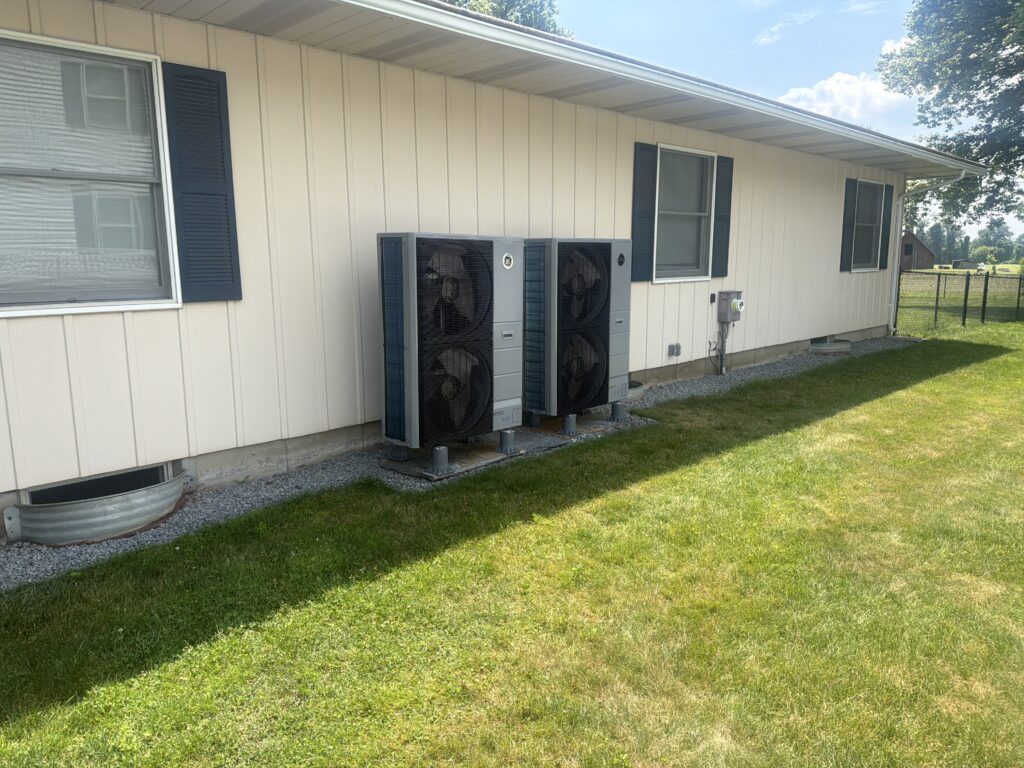
- The house has no ductwork at all, which describes a lot of the older housing stock in this area, especially homes built with steam or hot water radiators. Furnace replacement isn't really on the table there. That's a ductless conversation
- Delivered fuel cost is the actual complaint, not comfort or reliability. A large part of this territory has no natural gas distribution, so heating runs on delivered oil or propane. That changes the economics of a heat pump here in a way that doesn't apply in a gas town, and it's worth running the numbers before committing another decade to delivered fuel
- The ductwork itself is undersized, leaky, or poorly laid out. Dropping a new furnace onto bad ducts just means a new furnace fighting the same static pressure problem the old one had
- You're also thinking about adding cooling. In some of these houses, a heat pump that handles both heating and cooling through one system makes more sense than a furnace plus a separate air conditioner
How We Size and Specify
Furnace sizing goes wrong more often from oversizing than undersizing, and oversizing doesn’t make a house warmer. It makes it less comfortable. An oversized furnace heats the air fast, satisfies the thermostat, and shuts off, then repeats that cycle every few minutes instead of running a longer, steadier cycle. Short cycling wears out components faster, creates temperature swings between cycles, and in a lot of houses leaves some rooms noticeably colder than others because the system never runs long enough to push heat evenly through the ductwork.
A real load calculation, a Manual J, accounts for square footage, insulation levels, window count and orientation, ceiling height, air infiltration, and how the specific house holds or loses heat, not just its footprint on a listing sheet. That number, in Btu per hour, is what determines the furnace size, not the size of the unit currently in the basement.
Sizing also means checking the AFUE rating, annual fuel utilization efficiency, which tells you what percentage of the fuel burned actually turns into heat in your house versus going out the flue. It means deciding between single-stage, two-stage, and modulating furnaces, since a two-stage or modulating unit runs at lower output more of the time, which means steadier temperatures and less noise than a single-stage unit slamming on at full blast every cycle. And if the furnace is feeding existing ductwork rather than new, we check static pressure in that ductwork before assuming it can handle the new equipment. Ducts sized for an old furnace can choke a new one, and that shows up as noise, weak airflow to certain rooms, and a furnace that never performs the way its rating suggests it should.
Equipment and What Actually Differs Between Systems
- Oil furnaces need a tank, scheduled delivery, and typically a masonry or metal chimney for venting, and they tend to run in the mid-80s percent AFUE range for standard equipment
- Propane furnaces can be power-vented, meaning no chimney is required, and high-efficiency condensing models can reach into the mid-90s percent AFUE range, which matters more the longer you plan to stay on delivered fuel
- Natural gas furnaces exist in the pockets of this territory with distribution, but most of the towns we serve simply don't have a gas main to tie into, which is one of the two facts that shapes almost every heating decision here
- Single-stage furnaces are either fully on or fully off. Two-stage and modulating furnaces run at partial output most of the time, holding temperature steadier and running quieter
- Variable-speed blower motors adjust airflow more precisely than fixed-speed motors, which improves comfort and, in a lot of houses, lowers electrical draw over the heating season
- If a furnace replacement also means adding electrical load, a dedicated circuit, a disconnect, or the panel is already at capacity, that's electrical work Powers Air performs in house under {ELECTRICAL_LICENCE}, not something we hand off to a subcontractor and hope gets scheduled
What the Work Looks Like Start to Finish
You call, and we ask what the furnace is doing, how old it is, and what fuel it runs on, which tells us most of what we need before we ever step in the door.
Onsite, we run a real load calculation and look at the existing ductwork, venting, and fuel line, not just the furnace itself. We’ll walk you through what we find and what it means in plain terms before quoting anything, including whether a furnace is even the right call once we’ve seen the whole house.
If the job moves forward, we schedule the install. The old unit comes out, venting and any fuel line work is coordinated through our trusted subcontractor network where a licensed gas or oil fitter is required, and the new furnace goes in matched to the load calculation, not eyeballed against the old equipment. Electrical hookup, dedicated circuits, disconnects, and any panel work needed to support the new system, is handled by us directly, permitted and inspected the way it’s supposed to be. Once it’s running, we test airflow, temperature rise across the heat exchanger, and safety controls before calling the job finished, and we clean up after ourselves.
What it costs
- Fuel type and whether venting needs to change, such as moving from a chimney-vented oil furnace to a power-vented propane unit
- Efficiency tier, since a mid-efficiency and a high-efficiency condensing furnace are priced differently and perform differently over the life of the unit
- The condition of the existing ductwork, and whether it needs sealing, modification, or static pressure correction to support the new furnace
- Whether electrical work is needed to support the new equipment
- Removal and disposal of the old unit, and in some cases an old oil tank
Rebates and Incentives
Where We Work