
EV Charger Installation in Easthampton, MA
We install home EV chargers in Easthampton, but only where the house actually supports one. That sounds like an odd thing for a company to say about work it wants to sell, but it is the honest version of this job. A Level 2 charger needs a place where the car sits for hours on the owner’s own property, a garage, a driveway, a carport, something off the street. Where that exists, this is straightforward electrical work. Where it doesn’t, no charger installation fixes that, and we will tell you so rather than sell you a unit that ends up charging from an extension cord run out a window.
- Powers Air HVAC, based in Granby, MA
Drew Powers runs the electrical side of Powers Air the same way he runs the heating and cooling side: he is the one looking at your panel and your parking situation, not a salesperson quoting off a photo you texted in. Panel upgrades and EV charger installs are done in-house, under our own electrical licensing ({ELECTRICAL_LICENCE}), pulled and inspected the way Massachusetts requires. If a job needs more than a charger, we say so before you’ve spent money on the part that doesn’t solve the problem.
Where the Car Parks and What That Means
Easthampton is a mix that matters here. You’ve got single-family homes with driveways and detached garages spread through the hillier parts of town, and you’ve got converted mill buildings closer to the center with residential units fed by commercial-scale service equipment that was never built with EV charging in mind. The first type of property is usually a clean install. The second type is a different conversation entirely, because the electrical service feeding a mill unit often belongs to the building, not the apartment, and adding a 240 volt charging circuit means understanding who owns that capacity and what the building’s main service can actually support.
There’s also a renovation pattern worth naming. A lot of Easthampton homeowners are already in the middle of kitchen work, additions, or garage conversions when the EV charger question comes up. Electrical work done while walls are already open, during a planned renovation, is a far better and cheaper conversation than the same work done after the fact with finished drywall in the way. If you’re already renovating, this is the moment to ask about the charger circuit, even if the car is a year off.
- Single-family home with a driveway or garage. The straightforward case. The main cost driver is distance from the panel to where the car sits, and whether the run is exposed in a garage or fished through finished walls.
- Small multi-family conversions. A lot of the older housing here was carved into two or three units over the decades, often still fed by one aging panel with circuits nobody has traced in thirty years.
- Larger apartment or condo buildings. Stacked meter banks, a house panel sized in a different era for hallway lighting and laundry, and a question that is rarely about the charger itself.
None of this is a sales pitch for urgency. If your parking situation or your panel doesn’t support a charger right now, we’d rather tell you what it would take to get there than install something that technically works but leaves you unhappy with how long it takes to charge or how much of your panel it eats.
Level 2, and What Your Car Can Actually Take
A Level 2 charger runs on 240 volts, the same type of circuit as an electric dryer or range, and it’s what makes home charging practical: a Level 1 cord plugged into a standard outlet might add 3 to 5 miles of range per hour, while Level 2 typically adds somewhere between 20 and 40 miles per hour depending on the vehicle. But the charger isn’t the only limit in that equation, and it’s often not the real one.
Every EV has an onboard charger that caps how much power the car will actually accept, regardless of what the wall unit can deliver. A lot of chargers on the market are rated up to 48 or even 80 amps, but if your car’s onboard charger tops out around 32 amps or 7.7 kW, a bigger unit buys you nothing. It’s worth knowing your car’s actual acceptance rate before you spend money on a charger sized for a vehicle you don’t own. We’ll ask what you drive, or plan to drive, before we recommend hardware.
The circuit itself matters too. Continuous loads like EV charging are rated at 80% of the circuit’s breaker size under the National Electrical Code, so a 50 amp circuit is good for 40 amps of continuous charging, not the full 50. Hardwired installations and plug-in units on a NEMA 14-50 receptacle are both legitimate, but code treats them a little differently, and which one makes sense depends on the charger you’ve chosen, the distance from the panel, and whether you might want to move or replace the unit later. A hardwired connection is typically more permanent and slightly more efficient; a 14-50 receptacle gives you flexibility to swap chargers or even run other 240 volt equipment off the same outlet when the car isn’t there.
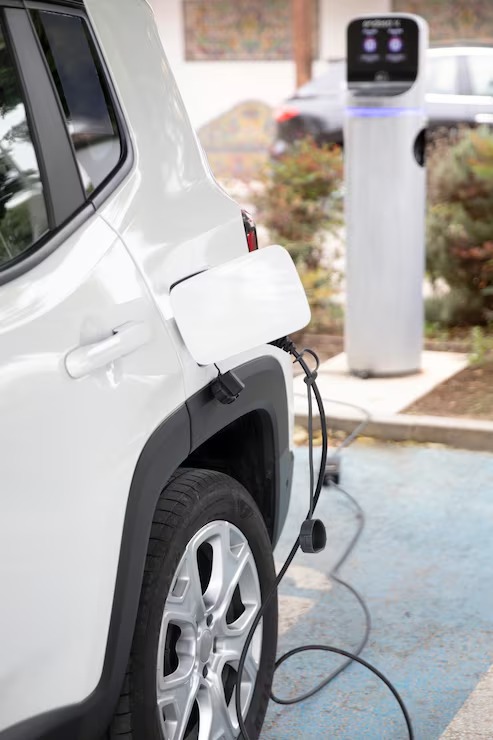
- Hardwired connection. No receptacle in the circuit at all. Typically the choice for higher-amperage installs, and there is no plug and cord sitting outdoors year after year to work loose or corrode.
- Plug-in on a NEMA 14-50 receptacle. The same style of receptacle used for a range or a welder. You can unplug the charger and take a portable unit with you, but code treats a cord-and-plug load differently than a hardwired one, and that changes some of the sizing and protection requirements.
None of this is complicated once someone walks you through it, but it’s exactly the kind of detail that gets skipped when a charger shows up as a line item on a bigger renovation bid. We’d rather spend ten minutes on your vehicle’s spec sheet than sell you capacity you’ll never use.
Whether Your Panel Has Room
This is the question that decides whether your job is a simple one or whether it becomes a panel conversation. An EV charger is one of the largest continuous electrical loads most homes ever add, and if your panel is already carrying a heat pump, a heat pump water heater, an electric range, and maybe an electric dryer, there may not be headroom left for a 40 or 50 amp charging circuit without doing the math first.
That math is a load calculation, and it’s the only honest way to answer the question. Good news first: in a lot of Easthampton homes, especially ones with reasonably modern 200 amp service, the answer comes back yes, no panel work required. When it doesn’t, the next step usually isn’t a full panel replacement. A load management device, which actively monitors total household draw and backs off the charger’s output when other large loads kick on, is frequently a fraction of the cost of a service upgrade and solves the capacity problem without touching your main panel. We size that option before we ever propose a bigger job.
If the load calculation does point to a genuine capacity shortfall, that’s a real and sometimes necessary step, and we handle it directly. You can read more about what that work involves on our Easthampton panel upgrade page, and if the driver is a heat pump system layered on top of everything else, our heat pump panel upgrade page walks through that specific scenario.
What the Work Involves
Once we know where the car parks and what your panel can support, the job itself follows a predictable sequence: confirming the charger location, running a dedicated circuit from the panel to that point, terminating the circuit at the charger (hardwired or into a NEMA 14-50 receptacle), and testing the installation before it’s ever used. The physical run matters a lot for cost and complexity. A charger mounted on a garage wall a few feet from the panel is a short, usually surface-mounted job. A charger on the far side of a detached garage, or one that has to be fished through finished living space to reach an exterior wall, is a longer and more involved run. Masonry walls, finished basements, and trenching to a detached structure all add time and materials.
We won’t walk you through how to land the conductors or make the terminations yourself here, because there isn’t a responsible, hedged version of that instruction. Service and branch circuit work at this voltage is exactly the kind of job where a mistake doesn’t show up as a minor inconvenience. What you should know as the homeowner is what’s happening and why, not how to do it, and that’s what we walk you through on site.
- A load calculation confirming the panel can carry the new circuit, or sizing a load management approach if it can't.
- Planning the run from the panel to the charger location, whether surface-run, fished through finished space, or trenched to a detached garage.
- Pulling the electrical permit before any work begins.
- Installing the dedicated circuit and charger or receptacle, sized and protected to code.
- Scheduling and passing the town inspection, which is what makes it code-compliant rather than just working.
What It Costs
A straightforward Level 2 install in Easthampton, panel already has room, short run from the panel to a garage wall, typically lands around {PRICE_LOW} to {PRICE_HIGH}. What moves that number: the physical distance between your panel and where the car parks, whether that run is surface-mounted or has to be fished through finished walls and ceilings, whether you’re dealing with masonry, whether a trench to a detached garage is involved, and whether the panel itself needs any work before the new circuit can land. Permit and inspection fees should be built into any quote you get. If a bid looks noticeably cheaper than others you’ve collected, ask directly whether the permit is included, because that’s the line item that tends to disappear from the lowest number on the table.
- Distance from the panel to where the car actually parks.
- Whether the run is surface-mounted in an open garage or has to be fished through finished walls and ceilings.
- Whether the wall is masonry, which changes how the run is fastened and routed.
- Whether a trench is needed to reach a detached garage.
- Whether the panel itself needs work, from a load management device up to a full upgrade.
- Whether the permit and inspection are included in the quote at all.
Utility and state incentive programs for home EV charging do exist and they change fairly often. We’re happy to help you understand what currently applies to your situation, but we won’t quote a dollar figure or promise an eligibility outcome we don’t control.
Permits and Inspection
EV charger circuits are permitted electrical work in Easthampton and everywhere else in our service area, no exceptions. That means a permit application, an inspection of the completed work by the local electrical inspector, and a signed-off result on file with the town. [EXTERNAL LINK: Massachusetts Electrical Code (527 CMR 12.00), the state-adopted NEC amendments governing residential wiring, including EV charging circuits] Skipping that step is one of the easiest ways a contractor shaves a number down, and it’s also the step that protects you if there’s ever a fire, an insurance claim, or a future sale where a buyer’s inspector asks who pulled the permit. We pull it every time, as a matter of how the work gets done, not as an upsell.
Get a Quote
If you’ve got off-street parking in Easthampton and you’re thinking about a home charger, the useful first step is a quick look at your panel and your parking situation together, since one usually determines the other. Call {PHONE} and you’ll talk to Drew, not a scheduler reading from a script. For the general cost picture across our whole territory, our EV charger installation cost page breaks down what drives price regardless of town. And if you want the fuller view of how we approach this work everywhere we serve it, start at our EV charger installation hub.
frequently asked questions
Can I install a Level 2 charger if I only have street parking?
Not really, and we'll say so upfront. A home charger depends on the car sitting on your own property for hours at a time. Without a driveway, garage, or dedicated off-street space, there's nowhere to run the circuit that makes sense, which is part of why this service is built around towns and properties with that kind of parking.
Do I need a bigger electrical panel to add an EV charger?
Sometimes, but less often than people assume. A load calculation tells us whether your existing panel has room for the new circuit. Many Easthampton homes with modern 200 amp service have enough headroom already. When they don't, a load management device is often a cheaper fix than a full panel upgrade.
What's the difference between hardwired and plug-in chargers?
A hardwired unit connects directly to the circuit with no receptacle in between, while a plug-in unit uses a NEMA 14-50 outlet, the same style used for some ranges and RV hookups. Both are code-compliant when installed correctly, but they're treated a little differently under electrical code and the right choice depends on your specific charger and setup.
Is a bigger charger always better?
No. Your car's onboard charger caps how much power it will accept no matter how large the wall unit is rated. A driver whose vehicle tops out around 7.7 kW gains nothing from a 19.2 kW charger. We check your vehicle's specs before recommending equipment so you're not paying for capacity you can't use.
Is a permit actually required for a home EV charger in Easthampton?
Yes. This is permitted electrical work requiring inspection by the local electrical inspector, the same as any other circuit added to your panel. If a quote doesn't mention a permit, ask directly, because that's often the step a lower bid is quietly skipping.