
EV Charger Installation in Belchertown, MA
Belchertown has the kind of housing stock that actually makes sense for a home EV charger: single family lots with driveways, attached garages, and enough distance from the street that the car sits in one spot every night. That is not true everywhere in this territory, and it is worth saying plainly because it is the whole reason this page exists for Belchertown at all.
- Powers Air HVAC, based in Granby, MA
A Level 2 charger only makes sense when a vehicle parks somewhere on the owner’s own property long enough to charge unattended, usually overnight. Powers Air installs these as licensed electrical work, permitted and inspected the way Massachusetts requires, not as a side gig bolted onto an HVAC call.
Where the Car Parks and What That Means
Belchertown’s 1990s and 2000s subdivisions, the ones off Federal Street, North Washington Street, and the newer construction toward the Quabbin side of town, are built on larger lots with attached two-car garages and 200 amp electrical service as a matter of course. For that housing, a charger install is usually a short, clean run from the panel to the garage wall with no drama and no panel upgrade attached to it.
The older center-village homes near South Main Street and the town common are a different story. Smaller lots, detached garages or no garage at all, and electrical service that was sized for a house with a furnace and a few window units, not a heat pump and a car charger. If that describes your house, the parking situation and the panel question both need a real look before anyone quotes you a number.
- Single-family home with a driveway or garage. The straightforward case. The main cost driver is distance from the panel to where the car sits, and whether the run is exposed in a garage or fished through finished walls.
- Small multi-family conversions. A lot of the older housing here was carved into two or three units over the decades, often still fed by one aging panel with circuits nobody has traced in thirty years.
- Larger apartment or condo buildings. Stacked meter banks, a house panel sized in a different era for hallway lighting and laundry, and a question that is rarely about the charger itself.
We will tell you up front if your property is not a good candidate for a home charger. If the car can’t park somewhere on your own property for hours at a stretch, no amount of electrical work fixes that, and we would rather say so than sell you equipment that won’t get used the way it’s designed to be used.
Level 2, and What Your Car Can Actually Take
Every EV has an onboard charger that converts the AC power coming out of the wall into DC power the battery can accept, and that onboard charger has a hard ceiling. A lot of homeowners buy a 48 amp or 80 amp charging unit assuming more is always better, then find out their car only accepts 32 amps or 7.7 kW no matter what’s feeding it. The charger isn’t the bottleneck in that case. The car is.
Before you buy anything, know your vehicle’s maximum AC charging rate. That number, paired with a realistic look at your panel’s available capacity, tells you what circuit size actually makes sense. A circuit sized well beyond what the car can use doesn’t charge it faster, it just costs more to install.
There’s also a decision between hardwired connections and a NEMA 14-50 receptacle. A hardwired unit is wired directly into the circuit with no plug, and the electrical code allows it to run at a higher continuous load percentage of the breaker rating. A plug-in unit on a 14-50 receptacle gives you flexibility to swap chargers or vehicles later, but the code derates it more conservatively. Neither is wrong, but they’re not interchangeable choices, and the right one depends on what you’re driving and whether you expect to change that.
As a rough sense of real-world results, a Level 2 circuit in the 30 to 40 amp range typically adds somewhere around 20 to 30 miles of range per hour of charging, enough to take most daily driving from empty to full overnight. Higher-output circuits help if you’re charging multiple vehicles or driving well beyond a typical commute, not for the average Belchertown household.
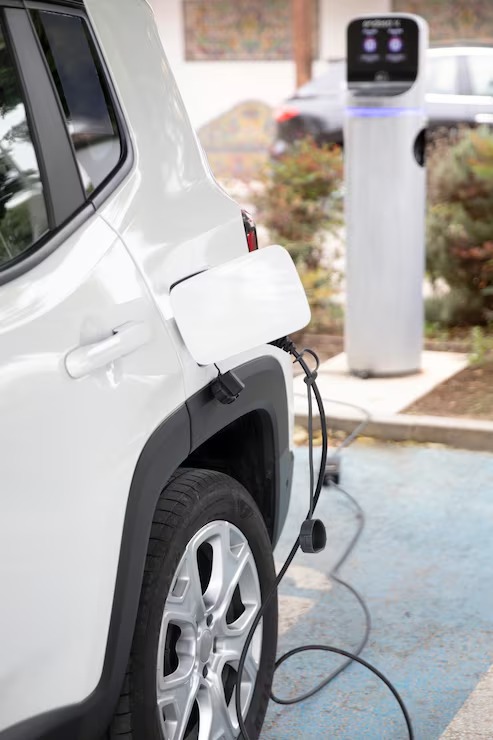
- Hardwired connection. No receptacle in the circuit at all. Typically the choice for higher-amperage installs, and there is no plug and cord sitting outdoors year after year to work loose or corrode.
- Plug-in on a NEMA 14-50 receptacle. The same style of receptacle used for a range or a welder. You can unplug the charger and take a portable unit with you, but code treats a cord-and-plug load differently than a hardwired one, and that changes some of the sizing and protection requirements.
Whether Your Panel Has Room
An EV charger is a large continuous load, and Massachusetts electrical code treats continuous loads conservatively on purpose. If your house already has a heat pump, a heat pump water heater, an electric range, or electric dryer running off the same panel, there may not be as much headroom as you’d guess just by counting open breaker slots.
The only honest way to answer this is a load calculation, which looks at your home’s actual electrical demand against what the panel and service are rated to carry. More often than not in Belchertown’s newer housing stock, the answer comes back fine and no panel work is needed. In the older housing, or in any home that’s already added a heat pump system, the answer isn’t always yes.
If the calculation comes back tight, a load management device that intelligently shares capacity between the charger and the rest of the house is frequently a cheaper fix than a full service upgrade. It’s worth exploring before assuming you need a bigger panel. If a panel upgrade genuinely is the answer, we handle that too, in-house, as the same licensed electrical scope. See our Belchertown panel upgrade page and, if you’re weighing a charger alongside a heat pump install, our heat pump panel upgrade page for how the two loads interact.
What the Work Involves
A charger install starts with the load calculation and a look at where the car actually parks relative to the panel. From there it’s a dedicated 240 volt circuit run from the panel to the charging location, sized and protected according to code, terminating either in a hardwired connection or a NEMA 14-50 receptacle depending on what you’ve chosen. The run itself might be a straightforward surface-mounted conduit in an unfinished garage, or it might mean fishing wire through finished walls, through a basement ceiling, or out to a detached structure, and each of those changes the labor involved. We don’t walk you through how to land conductors in a panel or make up a 240 volt circuit yourself, because there isn’t a safe simplified version of that explanation. That part is licensed, permitted work, and it stays that way.
What It Costs
Most Level 2 charger installs in Belchertown run between {PRICE_LOW} and {PRICE_HIGH}, and the spread comes down to a handful of real variables: how far the panel is from where the car parks, whether that run is surface-mounted in an open garage or has to be fished through finished living space, whether you’re cutting into masonry, whether a trench out to a detached garage is involved, and whether the panel itself needs any work before the circuit can be added. Permit and inspection fees should be built into the number you’re quoted. If a quote looks noticeably cheaper than the others, ask whether the permit is actually included, because skipping it is the easiest way to shave a number down, and it’s the part that protects you if anything’s ever wrong with the work.
- A load calculation confirming the panel can carry the new circuit, or sizing a load management approach if it can't.
- Planning the run from the panel to the charger location, whether surface-run, fished through finished space, or trenched to a detached garage.
- Pulling the electrical permit before any work begins.
- Installing the dedicated circuit and charger or receptacle, sized and protected to code.
- Scheduling and passing the town inspection, which is what makes it code-compliant rather than just working.
What It Costs
Utility and state incentive programs for home EV chargers exist and they change often enough that we won’t quote figures here, but we can walk through what currently applies once we know your situation.
- Distance from the panel to where the car actually parks.
- Whether the run is surface-mounted in an open garage or has to be fished through finished walls and ceilings.
- Whether the wall is masonry, which changes how the run is fastened and routed.
- Whether a trench is needed to reach a detached garage.
- Whether the panel itself needs work, from a load management device up to a full upgrade.
- Whether the permit and inspection are included in the quote at all.
Permits and Inspection
Every charger install we do in Belchertown and across the towns we serve is pulled under permit and signed off by inspection, because that’s what Massachusetts requires for this class of electrical work and because it’s the step that confirms the circuit was sized and installed correctly. This isn’t optional add-on paperwork. It’s part of the job, and it’s part of every quote we give.
Get a Quote
If you’re in Belchertown and thinking about a home charger, start with the panel question and the parking question, both of which we can usually answer in one visit. Call {PHONE} or reach out through the site, and we’ll look at your actual house rather than quoting off a phone call. For the general service area and what we cover beyond EV chargers, see our EV charger installation overview, and if you want a wider sense of real cost ranges across the territory, our EV charger cost guide covers that. You can also see the rest of what we do for Belchertown homeowners on our Belchertown service page.
For the code basis behind circuit sizing and continuous load ratings, see the [EXTERNAL LINK: Massachusetts Electrical Code as adopted, for the continuous load and circuit sizing rules governing EV charging equipment].
Ready When You Are
Belchertown homes vary widely in panel age and garage layout, so there’s no one-size answer until someone’s actually looked at yours. A short conversation about your vehicle, your parking setup, and your electrical service tells us whether this is a straightforward install or needs a panel upgrade first.
Reach out and we’ll figure out the right path together, no guesswork required.
frequently asked questions
Can I install a Level 2 charger myself and just have you inspect it?
No. Running a 240 volt circuit and terminating it correctly at the panel and at the charger is licensed electrical work, and we perform the full install start to finish, not a sign-off on someone else's wiring.
Does every house in Belchertown need a panel upgrade for a charger?
No. Much of the 1990s and 2000s housing stock here already has 200 amp service and handles a charger circuit with no panel work at all. Older center-village homes are more likely to need a load calculation before we know either way.
What size charger do I actually need?
Start with what your car's onboard charger can accept, not with the biggest unit on the shelf. A charger rated beyond your vehicle's maximum AC input doesn't charge it any faster.
Hardwired or a NEMA 14-50 plug, which is better?
Hardwired units allow a higher continuous load percentage under code and tend to be the cleaner choice for a permanent single-vehicle setup. A 14-50 receptacle gives you flexibility to change chargers or vehicles later. The right choice depends on your situation, not a universal rule.
Do you handle the permit and inspection?
Yes. Every charger install is pulled under permit and inspected, and that cost is part of the quote, not an extra step you have to arrange separately.