
Air Conditioning Repair in Belchertown, MA
Air Conditioning Repair in Belchertown
A good share of the colonials and split-levels built through Belchertown’s growth years in the 1990s and 2000s are reaching the point where the original condenser isn’t limping along anymore, it’s just dead. Pair that with the parts of town that never got a natural gas main, where the AC runs off the same electrical service as an oil or propane furnace instead of a gas one, and a compressor failure in July turns into an actual problem, not a minor inconvenience.
If your system quit this afternoon, you don’t need a quote queued up for next week. Call {PHONE} and you’ll get Drew, not a scheduler reading a script, and he’ll tell you honestly whether it’s a same-day fix or something bigger.
- Powers Air HVAC, based in Granby, MA
What Belchertown homes are working with
Most of the service calls here come from two very different housing stocks. The bigger one is the newer construction, colonials and raised ranches on half-acre-plus lots built from the late 1980s through the 2000s, most of them on forced air with a propane or oil furnace and a matched outdoor condenser added at the same time. Those systems are now twenty to thirty years old. When the compressor fails on a unit that age, repairing it often means paying real money for a part on a system that was never efficient to begin with, on a refrigerant that’s increasingly hard to source. That’s the house where the conversation usually shifts from repair to replacement, and it’s worth having that conversation honestly instead of just swapping the failed part and seeing you again in two summers.
The other stock is the older housing closer to the town center, built well before central air was standard, heated by steam or hot water radiators with no ductwork anywhere in the house. Those homeowners usually aren’t calling about a repair at all, they’re calling because a window unit finally gave out and they want something that actually cools the whole house. For that stock the fix generally isn’t fixing anything, it’s adding a ductless system sized to the rooms that actually need it. Belchertown doesn’t have uniform building stock the way a mill city does, so the right answer changes block by block, and that’s exactly why a phone call beats a web form.
- No cold air, or air that is barely cooler than the room
- Ice forming on the outdoor unit or the line set
- Short cycling, where the system turns on and off every few minutes instead of running a full cycle
- A breaker that trips repeatedly when the AC starts
- Water pooling near an indoor unit, or a stain on the ceiling below one
- A system that has gotten noticeably louder, especially on startup
What Belchertown homes are working with
Before Drew recommends a repair, a replacement, or a ductless add-on, he does a load calculation on the actual house, not a guess based on square footage. Insulation, window count and orientation, ceiling height, how many people live there, all of it feeds into what the equipment actually needs to do. A furnace guy eyeballing the old unit and quoting the same tonnage back is how houses end up with systems that are too big, and an oversized AC is a less comfortable AC. It cools the air fast, shuts off before it pulls the humidity out, and you get a cold, clammy house that cycles on and off all day while the compressor wears out early from short-cycling.
A real quote tells you the calculated load, the equipment’s rated capacity at that load, where the line set runs, what the electrical service needs to look like, and what happens to performance on the hottest days of the year. If a bid shows up with a price and a brand name and nothing behind it explaining why that size was chosen, that’s the quote to be skeptical of.
How we size and specify the system
Most AC repair calls start the same way: the system runs but doesn’t cool, or it doesn’t run at all. That split matters. A unit that runs warm is usually low on refrigerant from a leak, a failing capacitor that’s starving the compressor, or a frozen evaporator coil from restricted airflow, often a filter nobody’s changed in a year. A unit that won’t start at all is more often electrical, a failed contactor, a tripped breaker, or on older homes a service panel that’s undersized for the load it’s being asked to carry. Drew diagnoses it on site, explains what’s actually wrong in plain terms, and gives you the repair cost before touching anything.
On the older center-village houses with no ductwork, there often isn’t a repair to make because there’s no central system to repair, the fix is adding ductless capacity to the rooms that need it. On the newer forced-air houses, condensate drainage and static pressure in the existing ductwork get checked too, because a compressor that’s working fine can still leave you uncomfortable if the duct system restricting it was never right in the first place.
- The load calculation behind the recommendation, not just a model number
- Equipment capacity at your actual design temperature, not just at the 47°F rating
- What the electrical service needs to support it, and whether the panel has room
- Line set length and routing, and what that does to performance
- What backup or auxiliary heat looks like, if the system also handles heating
What it costs
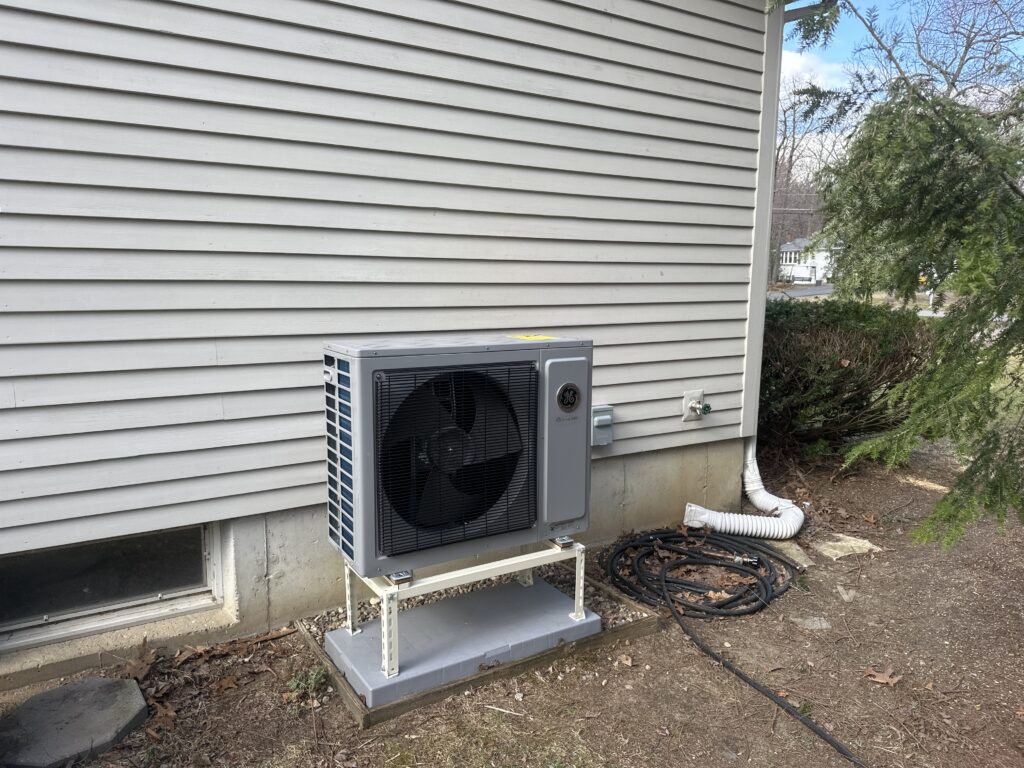
A straightforward repair, capacitor, contactor, a refrigerant leak fix and recharge, typically runs toward the lower end of what you’d expect for a service call plus parts. A full replacement is a wider range, generally {PRICE_LOW} to {PRICE_HIGH} depending on tonnage, whether it’s a straight swap or the ductwork needs correction, how far the line set has to run, and whether the electrical panel has room for the new equipment or needs upgrading first. Access matters too, a condenser tucked against a foundation wall with a tight crawlspace above costs more labor than one with a clean basement run. Nobody gets a real number without Drew seeing the house.
What the work involves
Massachusetts runs the Mass Save program through the utility sponsors, and depending on the equipment and the household it can meaningfully change the economics of a central air replacement or a ductless add-on, especially when it’s paired with a heat pump instead of straight AC. The rules and the incentive amounts change often enough that repeating a number here would be wrong the day after we posted it. What’s worth doing is figuring out what actually applies to your house before you commit to equipment, and that’s part of the conversation when Drew comes out. Start with masssave.com [EXTERNAL LINK: Mass Save program site, for current rebate rules] for the current program details, and see our Mass Save heat pump rebates page for how it generally works.
- Checking refrigerant charge and finding the source of a leak, rather than just topping it off
- Testing the capacitor, contactor, and other electrical components that fail from heat and age
- Inspecting the condenser coil and airflow, since a restricted coil is one of the most common reasons a system runs constantly without cooling
- Checking the condensate line and pan, since a clogged line is a common cause of water damage around indoor units
- Reviewing thermostat wiring and settings, which is sometimes the actual issue behind what looks like an equipment failure
Get a quote
If the air is warm, the system won’t start, or you’re staring down a twenty-five-year-old condenser that just gave out, call {PHONE}. You’ll talk to Drew, he’ll ask what the system is doing, and he’ll tell you honestly whether it’s a quick fix or time to talk about something new.
What it costs
- Number of zones or indoor units involved
- Whether the issue is electrical, mechanical, or refrigerant-related
- Access to the outdoor unit and any indoor equipment
- Age and condition of the system, including whether parts are still available
- Whether the underlying issue points to an electrical service or panel limitation
Rebates and incentives
Get a Quote
frequently asked questions
My air conditioner is running but blowing warm air. What's wrong?
Most often it's a refrigerant leak, a failing capacitor that's weakening the compressor, or a frozen evaporator coil caused by restricted airflow, frequently just a dirty filter. Drew can usually tell which within a few minutes on site.
Is it worth repairing a 20 to 25 year old AC unit?
Depends on what failed and what it costs. A capacitor or contactor is almost always worth fixing. A failed compressor on equipment that age usually isn't, both because of the repair cost and because the efficiency gap to current equipment is significant. Drew will tell you which situation you're in before recommending anything.
Can you add central air to a house that only has radiators and no ductwork?
Not central air in the traditional sense, since there's no ductwork to run it through and retrofitting duct chases into a plaster-and-radiator house is usually impractical. A ductless mini-split system does the same job without needing ducts, and it's the more common answer for Belchertown's older center-village housing.
Does having oil or propane heat instead of gas change the AC repair or replacement?
Not the repair itself, but it changes the bigger picture decision. In homes without a gas main, a heat pump that provides both cooling and a meaningful share of winter heat competes directly against the cost of delivered fuel, which makes the economics of replacing an old AC with a heat pump system worth a real look rather than just swapping in another straight AC unit.
How fast can you get to a no-cool call in July?
Same-day in most cases. Call {PHONE} and describe what the system is doing and Drew will give you a realistic window, not a dispatcher's guess.