
Electrical Panel Upgrades and Change-Outs in Amherst, MA
Electrical panel upgrades in Amherst
- Powers Air HVAC, based in Granby, MA
A panel is rarely the first thing a homeowner calls about. It becomes the thing that decides whether the heat pump, the water heater, or the charger install is even possible, because none of it fits behind a service already carrying everything it can hold. Powers Air treats the panel as its own job with its own honest answer. This is licensed electrical work performed in-house, under Massachusetts electrical license, start to finish. Sometimes the answer is a full change-out. Just as often it is a subpanel, a smarter appliance choice, or nothing at all, and that answer only comes from opening the panel and doing the math, not guessing off a square footage number.
What Amherst homes have for service today
The build era decides most of what is already on a panel before anyone touches it. A lot of the older single-family stock here was wired for 60 amp service originally, bumped up to 100 amps at some point in the decades since, and never touched again even as ranges, central air, and now heat pumps and chargers got added to the list. Newer construction and recent renovations more often carry 150 or 200 amp service, but plenty of the housing in between is running right at the edge of what its panel was ever rated for.
Multifamily changes the picture again. A triple-decker or a converted house with three or four units typically has a bank of meters feeding one or more house panels, and every addition or unit split along the way tends to have added a subpanel rather than reworked the original service. Overhead drops are still common on the older streets, underground service is more typical in newer developments, and whether the owner lives on site or manages from a distance changes what question actually gets asked. An owner-occupant wants to know what their own house can carry. A landlord wants to know whether the building can take on more load, for a charger or a new unit, without a full re-service of the property.
How we work out what the house actually needs
The starting point is a load calculation done under the Massachusetts Electrical Code, counting what is actually connected to the house, not a guess based on square footage or a number pulled off the panel label. Heating equipment, water heater, range, dryer, air conditioning, and any charger installed or planned all get added up against what the existing service can deliver.
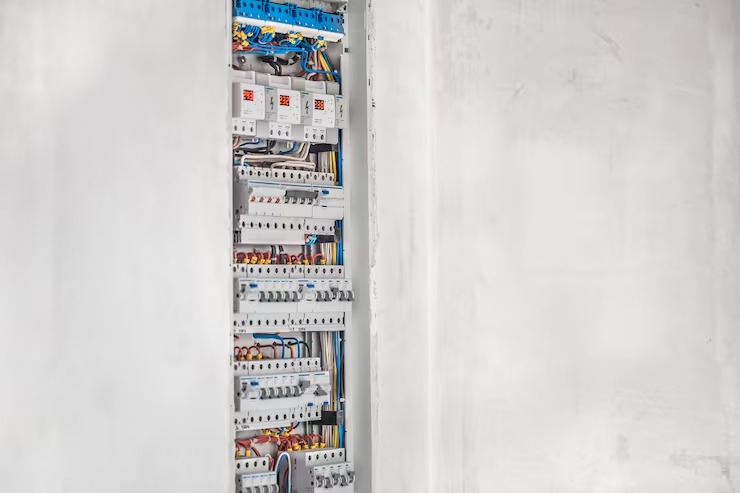
That calculation usually turns up two separate problems. One is service capacity, how much total load the wire from the meter can carry. The other is breaker spaces, whether there is physical room in the panel for another circuit. A panel can be short on spaces while the service has capacity to spare, and there a change-out is the wrong answer. A real quote spells out both numbers, documents the condition of the panel and meter equipment, and includes the permit as a line item. A quote written without anyone opening the panel first is not a lower price. It is a guess.
When you do not need a new panel
- A better-matched appliance. A heat pump water heater or a mini-split system sized correctly for the actual load draws less than a straight replacement sized off habit, and sometimes that difference is what keeps the existing panel adequate.
- A load management device. These devices let two loads, an EV charger and an electric dryer for example, share the same available capacity by stepping one down when the other is running, instead of requiring enough headroom for both to run flat out at once.
- A subpanel. When the real problem is breaker spaces rather than total service capacity, adding a subpanel solves it for a fraction of what a full change-out costs, without touching the main service at all.
What the work involves
A change-out starts with the utility scheduling a disconnect, because the service conductors ahead of the main breaker stay live until the utility drops the connection at the meter. Once power is down, the existing panel, meter socket, and mast are assessed for what has to be replaced alongside the panel itself. A new panel is sized and rated to the load the calculation actually identified, not to whatever is standard on the truck that day. Every circuit gets reconnected and labeled correctly, the new setup is inspected by the town’s wiring inspector, and the utility restores service once that inspection is signed off. None of this is something a homeowner should attempt to follow along with. It is licensed work for a reason.
What it costs
- The size of service going in. Jumping from 100 to 200 amps costs less than sizing up further for a multifamily building.
- Overhead versus underground service. Underground runs cost more because they involve trenching.
- Whether the meter socket and mast also need replacing, which is common on older services.
- How far the panel is from the meter, since a longer conductor run adds cost.
- The utility's disconnect scheduling, which is outside our control and can add time even to a straightforward job.
- Whether the work is done alongside other equipment, such as a heat pump or an EV charger, which can share some labor.
Permits and Inspection
Get a Quote
If a heat pump, a water heater, or a charger has you looking at the panel for the first time in years, start with the load calculation. Call Powers Air at 413-339-3194, and we will tell you honestly whether the panel needs to change or whether something smaller solves it.
frequently asked questions
Do I need a new panel just to add an EV charger?
How long does a panel change-out take?
Will I be without power during the work?
What is a load calculation, and do I actually need one?
I own a multifamily building. Can I add capacity without re-servicing the whole thing?
Often, yes. Depending on how the meter bank and house panels are configured, a subpanel or a load management device can add capacity to one unit without touching every meter in the building.