
Central Air Conditioning Installation in South Hadley, MA
Walk through the Village Commons area of South Hadley and you’ll find homes built before anyone thought about central cooling at all, then drive a few minutes out toward Newton Street or the roads feeding into Mount Holyoke College and you’ll hit post-war ranches and colonials where ductwork was part of the original build. Both exist here in real numbers, and which one you own changes the whole conversation about central air.
- Powers Air HVAC, based in Granby, MA
Central Air Conditioning Installation in South Hadley
Central air conditioning makes sense for a specific kind of house: one that already has ductwork, or one being built or renovated with ducts in the plan, and one where a homeowner wants a single thermostat running one system rather than multiple indoor heads. We install central AC in South Hadley as a straightforward, correctly sized addition to existing duct systems, and we’re just as quick to tell you when ductless makes more sense for your particular house. That second part matters more than most contractors let on.
- Ductwork already exists and is in decent condition
- A furnace or air handler is already in place and just needs a matching outdoor condenser
- One thermostat and one system serving the whole house is genuinely simpler than several ductless zones
- Whole-house humidity control matters as much as temperature does
What South Hadley homes are working with
A good chunk of South Hadley’s housing stock predates central cooling entirely, particularly the neighborhoods close to the college and the older sections near the Village Commons, where gravity hot water or steam heat was original equipment and ductwork was never part of the house. Further out, in the ranch and colonial neighborhoods built from the 1950s through the 1970s, forced hot air heating is common, which means the ductwork already exists and adding central air is a matter of a condenser, a coil, and connecting into what’s there. Natural gas service reaches some of South Hadley but plenty of homes, especially outside the main village corridor, still run on delivered oil or propane for heat. That matters for the cooling conversation because it changes the baseline cost of comfort and makes heat pump options worth a second look even on a page about conventional AC.
The other variable in this town is who’s making the decision. South Hadley has a meaningful rental and faculty-housing market tied to the college, and landlords buy differently than owner-occupiers. A landlord wants reliability, a reasonable install cost, and equipment that won’t need a service call every July. An owner-occupier planning to stay fifteen years cares more about efficiency and long-term operating cost. We size and quote both the same way, with a load calculation, but we’ll talk through which priorities actually matter for your situation before we recommend equipment.
How we size and specify the system
Every central air quote we write starts with a Manual J load calculation, not a guess based on square footage or what the last contractor installed. The load calculation accounts for your home’s insulation, window area and orientation, ceiling height, and air leakage, and it tells us the actual tonnage your house needs to cool, not the nearest round number.
Oversizing is the most common mistake we see in older AC systems around South Hadley, and it’s almost always framed as a feature rather than a problem. A bigger unit cools the space fast, satisfies the thermostat, and shuts off before it’s run long enough to actually pull humidity out of the air. The result is a house that feels cold and clammy at the same time, a compressor that short-cycles on hot days, and a system that wears out faster than one sized correctly in the first place. Right-sized equipment runs longer, quieter cycles and does a better job of both temperature and humidity control.
If you get a quote for central air that doesn’t reference a load calculation, that’s worth noticing. A number pulled from a one-page estimate sheet based on square footage alone isn’t sizing, it’s a guess with a price tag on it. Our quotes include the calculated load, the equipment’s rated capacity at your design conditions, and what’s involved in the ductwork and electrical connection, so you know exactly what you’re paying for and why.
- Short cycles: it cools the air fast and shuts off before it's run long enough to pull humidity out, so the house ends up cold and clammy at the same time
- Wears out faster, because more starts and stops means more stress on the compressor
- Costs more to buy and more to run than a correctly sized system would
Ductwork condition comes first
Before we talk equipment, we look at the ducts already in the house. Undersized or leaky ductwork is the single biggest reason a correctly sized air conditioner underperforms. Static pressure that’s too high because of narrow trunk lines or crushed flex duct means the blower works harder and delivers less air than the system was designed for, regardless of how good the condenser is. If your existing ductwork needs sealing, resizing, or additional returns, we build that into the project instead of installing a new condenser onto a duct system that was never going to support it.
Electrical capacity and panel considerations
Central air adds a meaningful electrical load, and older South Hadley homes with 100-amp service or an aging panel sometimes don’t have the headroom for a new condenser circuit without changes. We check the panel as part of the quote. If it needs work, Powers Air handles electrical panel upgrades and change-outs ourselves, permitted and inspected, under our own electrical licensing ({ELECTRICAL_LICENCE}). That’s not a referral to someone else’s subcontractor, it’s part of the same job with one point of accountability.
- The load calculation itself, not just a tonnage number pulled from it
- The SEER2 rating of the equipment proposed and what that means for the summer electric bill
- Ductwork condition, and whether sealing or modification is part of the job
- Electrical circuit requirements for the outdoor condenser
- What's covered under manufacturer parts warranty versus labor warranty
Condensate and outdoor unit placement
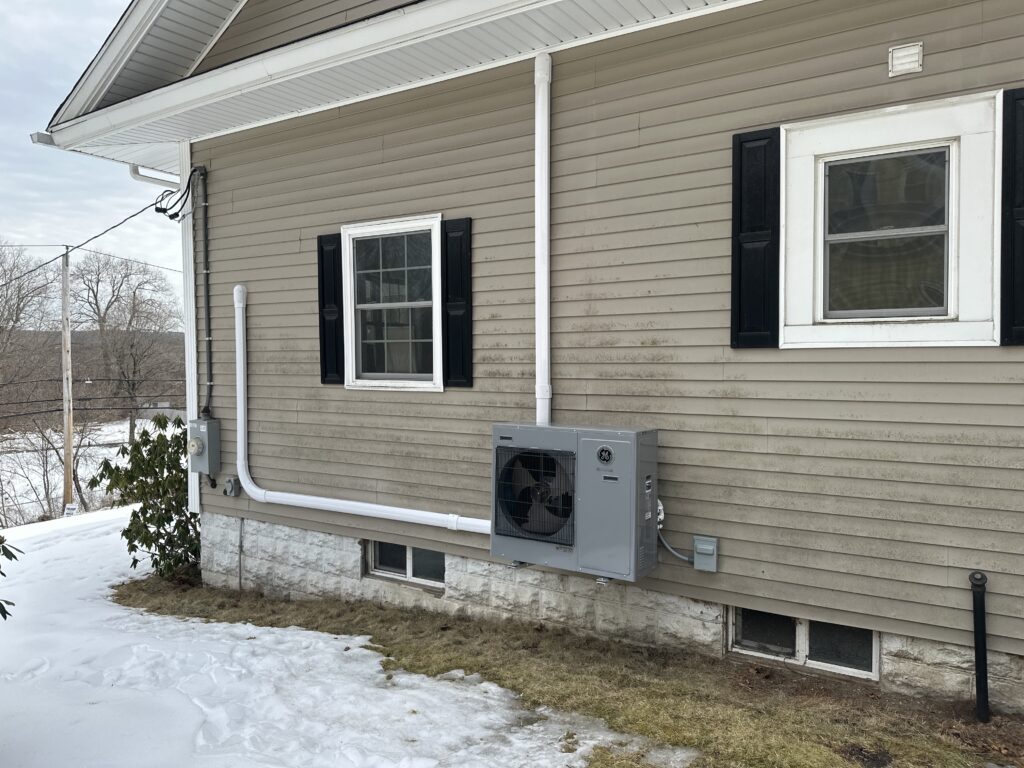
Where the condenser sits and how the condensate drains matters more than people expect. We look at grading, proximity to bedroom windows for noise, and whether a condensate pump is needed if gravity drainage isn’t available. These are small details on paper but they’re the difference between a system that’s quiet and trouble-free and one that generates complaints every summer.
What the work involves
A typical central air installation in a South Hadley home with existing ductwork runs one to two days. We set the outdoor condenser on a pad with proper clearance, install or connect the indoor evaporator coil to the existing air handler or furnace, run refrigerant line sets between the two, wire the new electrical circuit, and set up condensate drainage. If ductwork needs sealing or modification to handle the added airflow, that happens before we charge the system. Every install gets a final check of refrigerant charge, airflow, and system performance against the load calculation we started with, not just a check that the thermostat turns the unit on.
- A straight conversation about whether central air is still worth the disruption, or whether ductless is the better fit for that unit
- New duct runs through closets, dropped ceilings, or chases, placed to do the least damage to finished space
- Coordination on panel capacity if the building's electrical service can't support another circuit
Permits and inspection
Central air installation in Massachusetts requires permitting, and any electrical work tied to the install, whether it’s a new circuit or a full panel upgrade, gets inspected. We pull the permits and schedule inspections as part of the job. It adds a step but it’s the difference between work that’s documented and insured against problems later and work that technically doesn’t exist on paper if something goes wrong.
What it costs
Central air conditioning installation in South Hadley generally runs between {PRICE_LOW} and {PRICE_HIGH}, and where a given project lands in that range depends on a handful of real factors. A single-zone system connecting into existing, well-sized ductwork costs less than a project that needs duct sealing, resizing, or added returns. Line set length between the condenser and the air handler affects both material and labor. Electrical capacity is a big variable too: if your panel has room for the new circuit, that’s straightforward, but if it needs an upgrade, that’s additional work done right rather than skipped. Access also matters, since a condenser location with easy equipment access and a simple line set run costs less to execute than one requiring extensive routing through finished space. We walk through all of this during the quote so the number reflects your house, not a generic estimate.
- Number of zones or separate systems needed
- Whether ductwork exists, needs sealing, or needs to be built new
- Line set length between the indoor and outdoor equipment
- Whether the electrical panel has capacity for another circuit or needs work first
- Access, a condenser pad on an open side yard costs less to install than one on a tight lot with a fence and a neighbor's driveway in the way
What a real quote includes
A quote worth trusting shows the load calculation, the specific equipment model and its rated capacity, the scope of any ductwork or electrical work, and a clear line between what’s included and what’s an allowance. If a quote is a single number with no backup, ask what it’s based on. You’re entitled to know before you sign anything.
Rebates and incentives
Mass Save offers incentives for qualifying HVAC equipment, and the specifics change often enough that we’d rather help you check current eligibility for your project than quote you a number that might be outdated by the time you read this. Whether a given central air system qualifies depends on efficiency ratings, your utility, and program rules at the time of install. [EXTERNAL LINK: masssave.com, for current program details and eligibility] has the current details, and our Mass Save rebates page walks through how the program generally works. We’ll help you figure out what applies to your specific house as part of the quote process.
Ready to Move Forward in South Hadley
Once you’ve got a feel for what your South Hadley home needs, the next step is getting someone out to look at it in person. No two houses on the same street end up with identical setups, so a walkthrough matters more than a phone estimate ever could.
We’ll check your existing ductwork, electrical panel, and where the outdoor unit makes sense, then put together a quote that reflects your actual house, not a generic package.
frequently asked questions
Does my South Hadley home need ductwork added for central air, or do most houses already have it?
It depends on the age and heating type of the house. Homes with existing forced hot air heat, common in the ranch and colonial neighborhoods built from the 1950s on, already have ductwork that a central air system can use. Older homes near the Village Commons and college with steam or hot water radiators typically have no ducts at all, and adding them is a significant project. We evaluate your ductwork condition before recommending central air over a ductless alternative.
Is central air conditioning better than a ductless heat pump for my house?
It depends on what you have and what you want. If your house already has good ductwork and you want one system running from a single thermostat, central air is often the simpler and more cost-effective choice. If you have no ductwork, or you want heating and cooling from one system, a ductless heat pump may make more sense. We size and quote based on your actual house rather than defaulting to one or the other.
Will my electrical panel need an upgrade for central air?
Sometimes. Central air adds a dedicated circuit, and older panels with limited capacity, particularly common in South Hadley's pre-1960s housing, may not have room. We check this as part of every quote, and if a panel upgrade is needed, we handle it ourselves as licensed in-house electrical work, permitted and inspected.
How long does a central air installation take?
A straightforward install connecting into existing, properly sized ductwork typically takes one to two days. If ductwork needs sealing or modification, or if electrical panel work is required, the timeline extends accordingly. We'll give you a specific estimate once we've assessed your house.
Are Mass Save rebates available for central air conditioning?
Mass Save does offer incentives for certain qualifying HVAC equipment, though the specifics depend on the equipment, your utility, and current program rules, which change over time. We're not going to quote you a dollar figure that might not hold up by install day, but we'll help you check what applies to your specific project.