
Furnace Installation and Replacement in Ludlow, MA
Ludlow has a lot of houses built when a forced-air furnace and ductwork were standard, but central air conditioning was not. If your basement has a furnace plenum running to registers upstairs and no cooling coil sitting on top of it, you are living in one of the most common mechanical setups in this town, and it is also one of the easiest to fix right the first time.
- Powers Air HVAC, based in Granby, MA
Furnace Installation and Replacement in Ludlow
When a furnace fails in Ludlow, it is usually not a surprise. The unit is fifteen to twenty-five years old, the heat exchanger is starting to rattle or short-cycle, and somebody has already told you the repair cost does not make sense anymore. Powers Air installs and replaces furnaces across Ludlow as straightforward work, but we treat the decision part of it seriously: what size furnace the house actually needs, whether the existing ductwork can handle it, and whether this is the moment to add central air while the system is open. Drew handles the sizing and the install himself, with subcontractors brought in only for the plumbing side of a gas or oil conversion when that applies.
What Ludlow homes are working with
Ludlum’s housing stock splits roughly into three eras: the mill-adjacent streets with older post-war capes and colonials, the larger mid-century ranch and split-level neighborhoods that make up most of the town, and the newer construction on the outer edges toward Wilbraham and the Chicopee River side. The mid-century homes are the ones we see most for furnace replacement, because that is when forced-air heat with ductwork became the default here, often paired with a fuel oil tank in the basement rather than gas. Ludlow does have natural gas service along a good portion of its main corridors, which puts it in a different position than towns running entirely on delivered fuel, but plenty of side streets and the newer subdivisions on the edges are still oil or propane.
That mix matters for what we recommend. A homeowner on gas with existing ductwork and a furnace at end of life has a genuinely different cost equation than a homeowner on oil in a 1970s ranch with the same layout. Ludlum is also a strong owner-occupier town, more so than some of its neighbors, which means the person making the furnace decision is usually the person who will live with the result for the next fifteen years, not a landlord optimizing for the lowest bid. That changes the conversation. We spend more time here on what the house needs long-term, including whether adding a cooling coil now saves a second mobilization later.
How we size and specify the system
Every furnace we put in starts with a load calculation, not a nameplate match to whatever is already down there. A Manual J calculation looks at the house itself: square footage, insulation levels, window area and orientation, air leakage, and the Ludlow design temperature for winter. It tells us how much heat the house actually loses on the coldest night of the year, which is the number that should drive equipment selection, not a contractor’s habit or a distributor’s inventory.
Oversizing is the most common mistake in this trade, and it happens because a bigger furnace feels like a safer bet. In practice an oversized furnace short-cycles, meaning it fires, satisfies the thermostat fast, and shuts off before it has run long enough to heat evenly or wring real efficiency out of the fuel it burned. That shows up as rooms that never feel right, a furnace that cycles on and off audibly all night, and a cabinet and heat exchanger that wear out faster from the stress of constant starts. Right-sized equipment runs longer, steadier cycles and actually costs less to operate.
A legitimate quote for furnace replacement should show you the load calculation or at least reference the numbers behind it, specify the furnace model and its AFUE rating, note the duct modifications if any are needed, and price permits and disposal of the old unit separately so you can see what you are paying for. If a quote is just a number on a sticky note with no sizing behind it, that is worth asking about before you sign anything.
What the work involves
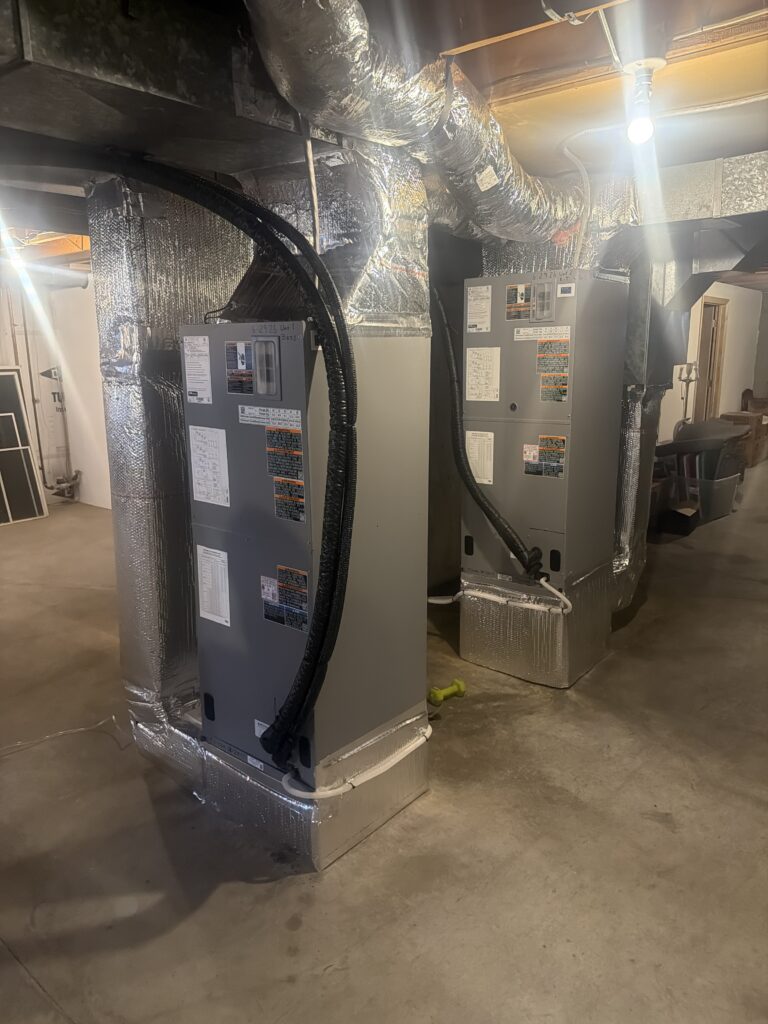
A furnace replacement in an existing Ludlow home is usually a one-day job if the ductwork is staying as-is. We disconnect and remove the old unit, inspect the existing supply and return ductwork for static pressure problems (undersized returns are common in older installs and choke airflow no matter how good the furnace is), set the new furnace, and connect gas or oil supply, venting, and the electrical and control wiring. If the house is on oil, we coordinate the fuel line and tank connection; if it is gas, we verify the gas line sizing can support the new unit’s input rate. Condensate drainage gets run properly on high-efficiency models rather than left to gravity and hope. Once it is running we commission it: checking temperature rise against the manufacturer’s spec, verifying gas pressure or oil nozzle sizing, and confirming the thermostat and any zoning controls are talking to the equipment correctly.
If you are also adding central air, that work happens alongside the furnace swap since the indoor coil sits directly on top of the furnace plenum and the line set runs from there to an outdoor condenser. Doing both at once saves a second round of opening up the ductwork later.
- Removing and disposing of the old furnace, along with any associated oil tank or gas line modifications
- Sizing and, where needed, modifying supply and return ductwork so static pressure matches the new equipment
- Installing proper combustion air and venting: direct vent PVC for a high-efficiency condensing furnace, or a lined chimney for a conventional one
- Setting up condensate drainage for high-efficiency furnaces, which produce acidic condensate that needs to go somewhere specific, not just the nearest floor drain
- Pulling permits and scheduling the required inspections
- Commissioning the system: verifying gas pressure or oil nozzle sizing, airflow, and temperature rise against manufacturer specs before we call the job done
What it costs
Furnace installation and replacement in Ludlow typically runs {PRICE_LOW} to {PRICE_HIGH}, and the spread comes down to a handful of real variables: the furnace’s AFUE efficiency tier, whether the existing ductwork needs modification or just reconnection, whether you are converting fuel types (oil to gas is a bigger job than a straight gas-to-gas swap), venting changes required by a high-efficiency unit, and access (a furnace in a tight crawlspace costs more labor than one in an open basement, which describes most of the mid-century Ludlow housing stock). Adding central air conditioning at the same time changes the number too, since you are adding a coil, a line set, and an outdoor unit to the scope. We give you a specific number after we have seen the house and done the load calculation, not before.
- Whether it's a straight swap or a fuel conversion, oil to gas, oil to propane, or adding a heat pump into the mix as primary or backup heat
- Ductwork condition, and whether the existing supply and return can handle the new unit or need rework
- Venting type, direct vent versus relining an existing chimney
- Electrical service, since some high-efficiency furnaces and any accompanying heat pump equipment need panel capacity that older services don't have
- Access: basement height, oil tank removal, and how far the equipment has to travel from the truck
None of this replaces a conversation about what your specific house needs. A furnace that is right for a ranch on Munsing Street is not automatically right for a colonial off East Street with a finished basement and a different return layout.
Rebates and incentives
Mass Save offers incentives that can apply to qualifying heating equipment and efficiency upgrades, and the program is worth understanding before you finalize a furnace decision, especially if you are weighing a furnace replacement against a heat pump conversion. The specifics of what qualifies and what the incentive amounts are change over time, so rather than quote a figure here that may be outdated by the time you read it, we will go over what currently applies to your situation when we scope the job. You can also review current program details directly. [EXTERNAL LINK: masssave.com program details] For a side-by-side look at how heat pump incentives compare to furnace replacement, see our Mass Save heat pump rebates page.
Permits and Inspection
Furnace replacement in Ludlow requires a permit, and gas or oil-fired equipment gets inspected as part of that process. This is not optional paperwork we skip to save you money. A cheap quote that does not include permit cost is usually a quote that is not pulling one, and that leaves you holding an uninspected combustion appliance in your own basement, which matters for safety and for insurance and resale down the line. We handle the permit and inspection scheduling as part of the job.
frequently asked questions
How long does a furnace last before it needs replacing in a Ludlow home?
Most furnaces run fifteen to twenty years, depending on maintenance and how hard the house asks it to work. Mid-century Ludlow homes with original ductwork often see furnaces replaced in that window as heat exchangers start to fatigue or efficiency drops off noticeably.
Can I replace just the furnace without touching my ductwork?
Often yes, if the existing ducts were sized reasonably and are not showing airflow problems. We check static pressure and return sizing before assuming the ductwork is fine, since undersized returns are a common issue in older Ludlow installs that a new furnace alone will not fix.
Is it worth adding central air when I replace my furnace?
If your house already has ductwork and no cooling, as a lot of Ludlow housing does, replacing the furnace is the natural time to add a coil and condenser. You avoid a second mobilization and a second round of opening up the system later.
Does Ludlow have natural gas, or is it mostly oil and propane?
It's mixed. Ludlow has gas service along a good portion of its main corridors, but plenty of side streets and newer subdivisions on the edges still run on delivered oil or propane. We confirm which applies to your address before specifying equipment.
What's included in a furnace installation quote from Powers Air?
A load calculation or the numbers behind it, the specific furnace model and AFUE rating, any duct modifications needed, and permit and disposal costs shown separately so you can see exactly what you're paying for.