
Central Air Conditioning Installation in Ludlow, MA
A lot of Ludlow’s housing went up in the two decades after the war, with forced hot air furnaces already sitting in the basement and a duct trunk running straight down the middle of the house. There is no cooling attached to any of it, which makes this one of the more straightforward central AC retrofit situations we run into in this part of the state.
- Powers Air HVAC, based in Granby, MA
Central Air Conditioning Installation in Ludlow
Powers Air installs central air conditioning in Ludlow homes that already have ductwork and heat, and the house just never got cooling added on. That is a different job than starting from scratch, and it is usually a better one, because the expensive part of a central AC system, the duct network, is already in the walls and floors.
Drew runs the job himself or oversees it directly, from the first look at your ductwork and electrical panel through to the final charge and test of the system. You are not getting handed off between an estimator, a crew, and a service department. The person who sizes the job is the person who stands behind it.
- Ductwork already exists and is in decent condition
- A furnace or air handler is already in place and just needs a matching outdoor condenser
- One thermostat and one system serving the whole house is genuinely simpler than several ductless zones
- Whole-house humidity control matters as much as temperature does
What Ludlow homes are working with
Ludlow’s housing stock is dominated by mid-century and post-war single-family homes, many of them originally built with oil heat before some switched to propane or, closer to the center and along the main corridors, natural gas. That mix matters for cooling decisions because a house already running forced hot air through ductwork is set up to accept central AC cleanly. The furnace’s existing blower and trunk lines do most of the work; we are adding a coil, a condenser outside, and the refrigerant piping between them.
There is also a real stretch of newer construction on the edges of town, where houses were built with central air already roughed in, and those jobs usually come down to replacing undersized or failing original equipment rather than a true retrofit. Across both groups, Ludlow’s owner-occupier rate is high, which means most of the calls we get are from people planning to live with the decision for a long time, not landlords looking for the cheapest box that fits. That changes how we talk about equipment selection, and it is part of why we start with a load calculation instead of a square-footage guess.
How we size and specify the system
We do not quote tonnage off the size of the house. We run a Manual J load calculation that accounts for insulation levels, window area and orientation, ceiling height, air leakage, and the layout and condition of your existing ductwork. Two houses of the same square footage in Ludlow can need meaningfully different capacity depending on when they were built and how they have been updated since.
Oversizing is the single most common mistake in this trade, and it happens because bigger sounds safer to install and easier to sell. An oversized system cools the air fast and then shuts off, which means it never runs long enough to pull humidity out of the house. You end up with a cold, damp, clammy feeling instead of real comfort, and the compressor takes more wear from constant short cycling. A correctly sized system runs longer, steadier cycles and actually dehumidifies while it cools.
- Short cycles: it cools the air fast and shuts off before it's run long enough to pull humidity out, so the house ends up cold and clammy at the same time
- Wears out faster, because more starts and stops means more stress on the compressor
- Costs more to buy and more to run than a correctly sized system would
What a real quote includes
A legitimate quote for central air tells you the calculated load in tons or BTUs, the specific equipment model and SEER2 rating being proposed, whether your existing ductwork can handle the airflow or needs modification, and what electrical work is required for the new circuit. If a quote is just a price and a brand name with no load calculation behind it, that is a sign the contractor is guessing, and you are the one who lives with the guess.
Static pressure and your existing ducts
Before we connect a new coil to your existing trunk and branch lines, we check static pressure and duct condition. Ductwork sized for a smaller or older furnace blower can choke airflow on a new system, which shows up later as weak cooling at the far bedrooms or a system that runs constantly without catching up. If modification is needed, we say so up front rather than installing around a known problem.
- The load calculation itself, not just a tonnage number pulled from it
- The SEER2 rating of the equipment proposed and what that means for the summer electric bill
- Ductwork condition, and whether sealing or modification is part of the job
- Electrical circuit requirements for the outdoor condenser
- What's covered under manufacturer parts warranty versus labor warranty
Electrical capacity for the new unit
A central AC condenser needs its own dedicated circuit and disconnect, and in some older Ludlow homes the panel is already at or near capacity before that new load gets added. We check this as part of the initial visit, not as a surprise mid-install. When a panel upgrade is the right call, we do that work ourselves under our own electrical licensing ({ELECTRICAL_LICENCE}), permitted and inspected, rather than pointing you toward someone else and hoping it gets scheduled.
What the work involves
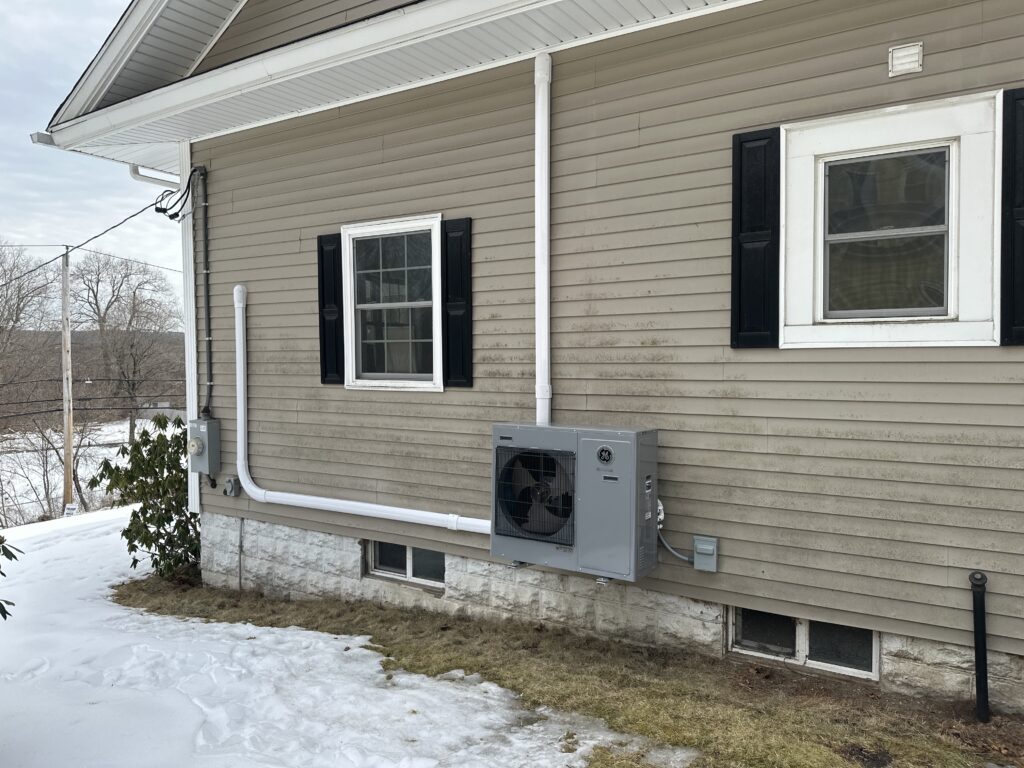
For a house with existing, adequate ductwork, the job generally covers setting the outdoor condenser on a pad with proper clearance, installing the evaporator coil in the plenum above or beside the furnace, running refrigerant line set between the two, adding a condensate drain with a safety switch, wiring the new circuit back to the panel, and then evacuating, charging, and commissioning the system with actual pressure and temperature readings, not a guess based on how the air feels at the supply register.
If ductwork needs rework, that gets scoped and priced as its own line item before we start, so there is no mid-job surprise. We also check that your thermostat and controls match the new equipment, since a mismatched or oversimplified thermostat can undercut a correctly sized system’s performance.
- A straight conversation about whether central air is still worth the disruption, or whether ductless is the better fit for that unit
- New duct runs through closets, dropped ceilings, or chases, placed to do the least damage to finished space
- Coordination on panel capacity if the building's electrical service can't support another circuit
Timeline and disruption
Most straightforward add-on installations in Ludlow are a one to two day job with one crew. We try to schedule around weather, since running line set and setting an outdoor unit in a Massachusetts summer downpour is not how anyone wants to spend a Tuesday. Indoor work is dust-contained around the furnace area, and we walk the system with you at the end so you understand the thermostat and know what normal operation sounds and feels like.
What it costs
Central AC installation on an existing forced-air system in Ludlow generally runs {PRICE_LOW} to {PRICE_HIGH}, and where you land in that range depends on a handful of real variables: the tonnage the load calculation calls for, whether your existing ductwork needs modification or just a connection point, how far the line set has to run between the condenser pad and the coil location, whether your electrical panel has room for the new circuit or needs upgrading, and how accessible the attic, basement, or crawlspace is for the crew. We walk through all of that on the initial visit so the number you get is tied to your actual house, not a generic average.
- Number of zones or separate systems needed
- Whether ductwork exists, needs sealing, or needs to be built new
- Line set length between the indoor and outdoor equipment
- Whether the electrical panel has capacity for another circuit or needs work first
- Access, a condenser pad on an open side yard costs less to install than one on a tight lot with a fence and a neighbor's driveway in the way
Financing and timing the project
Central air is not an emergency repair, which gives you room to plan it around your budget and schedule it before peak summer demand rather than during the first heat wave when everyone else is calling too. Pairing it with a furnace replacement or an electrical panel upgrade, when either is already on the horizon, can sometimes reduce the overall disruption of having work done twice.
Rebates and incentives
Mass Save offers incentives that can apply to certain HVAC upgrades, and the program’s rules and amounts change often enough that we will not quote you a figure here. What we can do is look at your specific house and equipment plan and tell you honestly what is worth checking into and what is not. You can review current program details directly at masssave.com [EXTERNAL LINK: official Mass Save program site for current incentive details], and our Mass Save rebates page covers how the program generally works for heating and cooling equipment.
Get a Quote
If you are in Ludlow and ready to talk about adding central air to a house that already has the ductwork sitting there unused, call Powers Air at {PHONE}. You will get a load calculation, a straight answer about what your ductwork and electrical panel can support, and a quote that explains exactly what you are paying for.
frequently asked questions
Can central air be added to a house that already has forced hot air heat?
In most cases, yes, and it is usually the most cost-effective cooling path for Ludlow's mid-century and post-war housing stock. If the furnace and supply ducts are reasonably sized and laid out, we add a coil, a condenser, and the refrigerant lines rather than rebuilding the duct system. If the existing ductwork is undersized or leaky, that gets addressed as part of the job, not ignored.
What size system does my house need?
We will not tell you that until we have run a load calculation. Square footage alone does not determine capacity. Insulation, window orientation, ceiling height, air leakage, and how the ductwork is laid out all factor into it. A 1,800 square foot house in Ludlow built in 1958 and a 1,800 square foot house built in 2005 can need noticeably different tonnage.
Will my gas or oil furnace still work alongside central AC?
Yes. Central air conditioning uses the furnace's existing blower and ductwork to move cooled air, but the cooling and heating systems operate independently. Adding AC does not change how your furnace heats the house in winter, whether it runs on oil, propane, or gas.
How long does a central AC installation take?
A straightforward add-on to existing ductwork is often a one to two day job. If we need to rework ductwork, upgrade electrical capacity, or if access to the attic or basement is tight, it can run longer. We will tell you which situation you are in before we start, not after.
Do you handle the electrical work if my panel needs an upgrade for the new condenser?
Yes. Panel work and circuit additions are done in-house under our own electrical licensing, not farmed out to a third party we hope shows up. It is permitted and inspected work, which matters more than it sounds like it should.