
Heating and cooling in Palmer
Palmer doesn’t really think of itself as one town. Ask someone where they live and you’ll get Three Rivers, Thorndike, Bondsville, or Palmer proper, not just “Palmer.” Each village grew up around its own mill and its own cluster of triple-deckers and worker housing, and that history still shows up in the heating systems we find when we go into these basements. We’re based in Granby, a few miles down the road, and Palmer is one of the towns we’re in regularly.
- Powers Air HVAC, based in Granby, MA
Heating and cooling in Palmer
The village pattern matters for HVAC more than people expect. Natural gas service doesn’t reach every street here, especially out in Thorndike and parts of Bondsville, so plenty of homes are still running on delivered oil or propane for heat. That changes the math on a heat pump conversion in a way it wouldn’t in a town with gas on every block – when your alternative is $4-plus propane or oil by the gallon, a cold-climate heat pump isn’t a lifestyle upgrade, it’s usually a real reduction in what you spend to stay warm.
Then there’s Route 20, which runs through town as a genuine working commercial strip – auto shops, restaurants, small retail, light industrial space. That’s a different kind of HVAC work entirely: packaged rooftop units, commercial refrigeration tie-ins, ventilation sized for occupancy rather than square footage. We handle both sides of Palmer, the houses and the storefronts, and the conversation is different for each one.
The homes we work on here
Most of what we see in Three Rivers and Bondsville dates back to the mill era – early 1900s two- and three-family housing, originally built with gravity hot water or steam heat and no provision for air conditioning at all. If that system is still the original boiler, it’s probably oversized for the house as it exists today (insulation and windows have improved even if the boiler hasn’t), and it’s got zero cooling capacity. These are classic ductless candidates – there’s no ductwork to retrofit into, and running one isn’t cheap or always possible given plaster walls and tight stairwells, so a multi-zone mini-split system handling two or three rooms per outdoor condenser is usually the more sensible path than trying to force central air into a house that was never built for it.
Palmer center and the newer pockets toward the Wilbraham line have more ranch and split-level construction from the 1950s through 1970s, often with real ductwork already in place from an oil furnace or electric baseboard setup. Those systems are reaching the age where the furnace heat exchanger or the AC condenser is on its way out, and the question becomes whether to replace like-for-like or convert to a heat pump that can use the existing ducts. That decision comes down to duct sizing – older ductwork was sometimes sized for a furnace blower, not a heat pump’s airflow needs, and we check static pressure before promising a homeowner their existing ducts will work without modification.
Out toward the rural edges of town you’ll also find larger homes on well and septic with delivered fuel heat and no central air ever installed. Those are often good candidates for a cold-climate heat pump as primary heat with the existing oil or propane system kept as backup for the handful of single-digit nights each winter, which is a setup that makes a lot of sense here given how often that backup actually gets used.
- Center-of-town and older residential streets: colonial and early 20th-century homes, often with steam or hot water radiators and no ductwork anywhere in the house. This is where ductless mini-splits do their best work, because there's no duct system to fight and no reason to build one.
- Converted multifamily and rental housing: older single-family homes divided into two, three, or more units, frequently with a mix of heating types installed at different points as the building changed hands. Zoning heat and cooling unit by unit is the practical fix, and it's also what lets an owner bill or manage each unit independently.
- Postwar capes and ranches on the outskirts: more likely to have basic ductwork already in place, sized for a furnace and central air rather than a heat pump. Static pressure and duct sizing matter here before we talk about equipment.
- Newer construction near campus and the town's edges: usually has gas service and existing ductwork, which opens up more straightforward heat pump or hybrid options.
Services we provide in Palmer
We do the full range of residential and commercial heating and cooling work in Palmer, plus the electrical work that increasingly goes along with it.
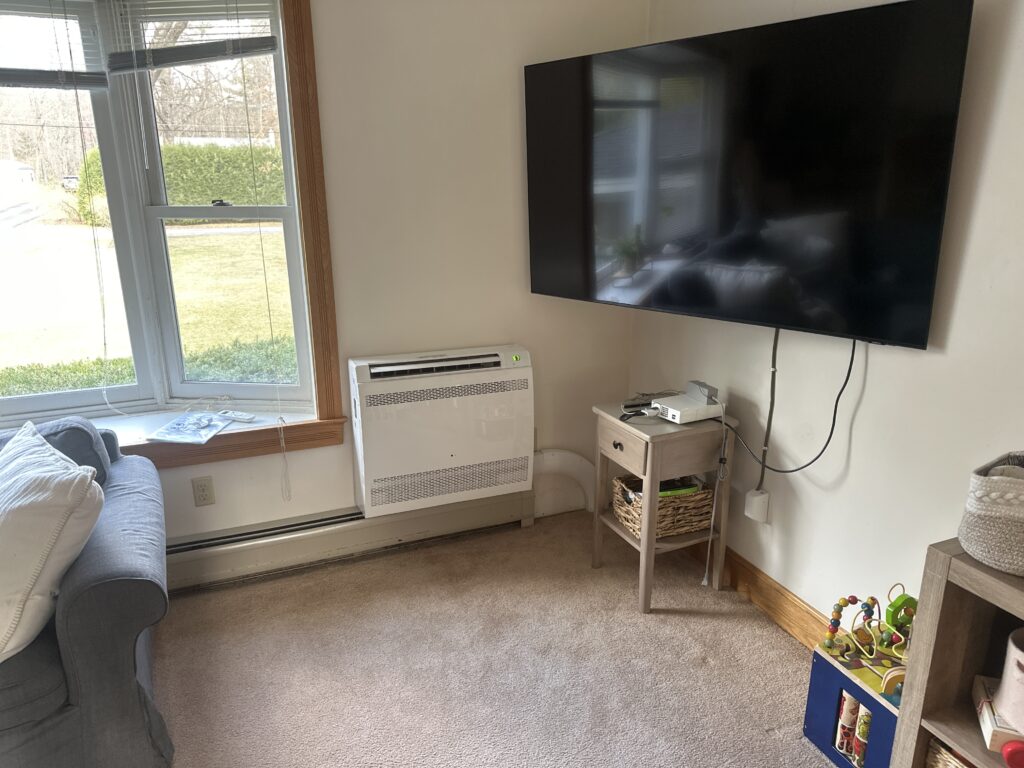
- Ductless mini-splits for the triple-deckers and older village homes where ductwork was never an option – this is where we spend a lot of our time in Three Rivers and Bondsville.
- Heat pumps, ducted or ductless, sized against an actual Manual J load calculation for the house, not a rule of thumb based on square footage.
- Central air conditioning for the ranches and colonials around Palmer center that have ductwork but never had cooling added.
- Furnace repair and replacement, including propane and oil-fired equipment common on the outskirts of town where gas isn’t run.
- Ductwork and ventilation work for the homes with existing duct systems that need sizing corrections before a new furnace or heat pump goes in.
- Electrical panel upgrades for Palmer homes – see our Palmer panel upgrade page for the details on when this is needed.
- EV charger installation for Palmer homeowners with suitable off-street parking – details on our Palmer EV charger page.
The electrical work exists because of a pattern we keep running into: a cold-climate heat pump, a heat pump water heater, and an EV charger are all large electrical loads, and an older Palmer home’s 100-amp panel often can’t take all three without a real upgrade. Drew holds the electrical licensing to do that work in-house, permitted and inspected, rather than handing you off to someone else mid-project.
Services we provide in Palmer
The honest pitch in Palmer isn’t environmental, it’s financial. When your heating alternative is delivered oil or propane, a cold-climate heat pump with a good HSPF2 rating is competing against some of the most expensive heating fuel there is, not against cheap piped-in gas. That’s a real argument for conversion, not a sales line.
It’s also worth being straight about limits. A heat pump’s output drops as the outdoor temperature drops, and on the coldest nights of a Palmer winter, a system without backup heat can struggle to keep up on its own. That’s why we size for the house’s actual load and talk through whether the existing oil or propane system stays in place as backup, or whether electric resistance backup makes more sense for a smaller load. There’s also the Mass Save program, which offers rebates for heat pump installations – the specifics of what you qualify for depend on your situation, and we’re glad to help you work through what applies to your house.
- Ductless mini-splits — our specialty, and the right fit for most of Palmer's older, unducted housing. Zone by zone, no ductwork required, and well suited to a building that's been carved into separate units.
- Whole-home heat pumps — cold-climate rated systems sized to the house with a proper load calculation, not a rule of thumb, with a clear plan for backup heat on the coldest days.
- Central air conditioning — new installs and replacements for homes that already have ductwork in place.
- Furnace service and replacement — for the homes here that are staying on ducted heat, sized correctly rather than swapped like-for-like.
- Ductwork and ventilation — sizing, repair, and improvements where existing ductwork is undersized or leaking, which shows up often in the postwar housing stock here.
- Electrical panel upgrades and change-outs — permitted and inspected work performed in-house under {ELECTRICAL_LICENCE}, not referred out.
How we work
Drew runs Powers Air directly – he’s the one who comes out to look at your house, sizes the system, and is either on the job or overseeing it, not a salesperson handing you off to a crew you’ve never met. He works with a small network of trusted electrical and plumbing subcontractors for the pieces outside core HVAC, but the person quoting the job is the person accountable for it. If a system isn’t right for your house, he’ll tell you that instead of selling it to you.
Why homeowners here are looking at heat pumps
If you’re in Three Rivers, Thorndike, Bondsville, Palmer center, or anywhere in between, call {PHONE} to talk through what your house actually needs. No call center, no scripted sales visit – just a straight conversation about your options.
How we work
- We start with a real assessment of the house, not a guess: build era, existing heat source, ductwork if there is any, and a proper load calculation.
- We give you a straight recommendation, including telling you when a system isn't the right fit for your house, even if that means turning down the job.
- Installation is done by Drew and a small, trusted crew, with plumbing handled by subcontractors we've worked with directly. Electrical work is performed in-house, permitted and inspected.
- You get one point of contact from the first call through the install, not a rotating cast of technicians.
Get a Quote
frequently asked questions
Does Palmer have natural gas service everywhere?
No. Gas service is inconsistent across Palmer's villages – parts of Palmer center have it, while sections of Thorndike and Bondsville run on delivered oil or propane. That's a big factor in whether a heat pump conversion saves you money.
Can a mini-split work in an old Three Rivers triple-decker?
Yes, and it's often the better option. These buildings typically have no ductwork and limited structural room to add any, so a multi-zone ductless system handling individual rooms or floors is usually more practical and less invasive than trying to retrofit ducts.
Will my electrical panel handle a heat pump and an EV charger?
It depends on the panel's current amperage and what else is already drawing from it. Many older Palmer homes have 100-amp service that needs an upgrade to support a heat pump, a heat pump water heater, and a car charger together. We evaluate the panel as part of any heat pump or charger quote.
Do you work on commercial buildings along Route 20?
Yes. We handle commercial HVAC including rooftop units and ventilation sizing for the retail and light industrial space along the Route 20 corridor, not just residential systems.
Is Powers Air actually based near Palmer?
Yes. We're based in Granby, a short drive from Palmer, and we're in town regularly for both residential and commercial work.