
Heating and cooling in Amherst
- Powers Air HVAC, based in Granby, MA
The homes we work on here
- Center-of-town and older residential streets: colonial and early 20th-century homes, often with steam or hot water radiators and no ductwork anywhere in the house. This is where ductless mini-splits do their best work, because there's no duct system to fight and no reason to build one.
- Converted multifamily and rental housing: older single-family homes divided into two, three, or more units, frequently with a mix of heating types installed at different points as the building changed hands. Zoning heat and cooling unit by unit is the practical fix, and it's also what lets an owner bill or manage each unit independently.
- Postwar capes and ranches on the outskirts: more likely to have basic ductwork already in place, sized for a furnace and central air rather than a heat pump. Static pressure and duct sizing matter here before we talk about equipment.
- Newer construction near campus and the town's edges: usually has gas service and existing ductwork, which opens up more straightforward heat pump or hybrid options.
Services we provide in Amherst
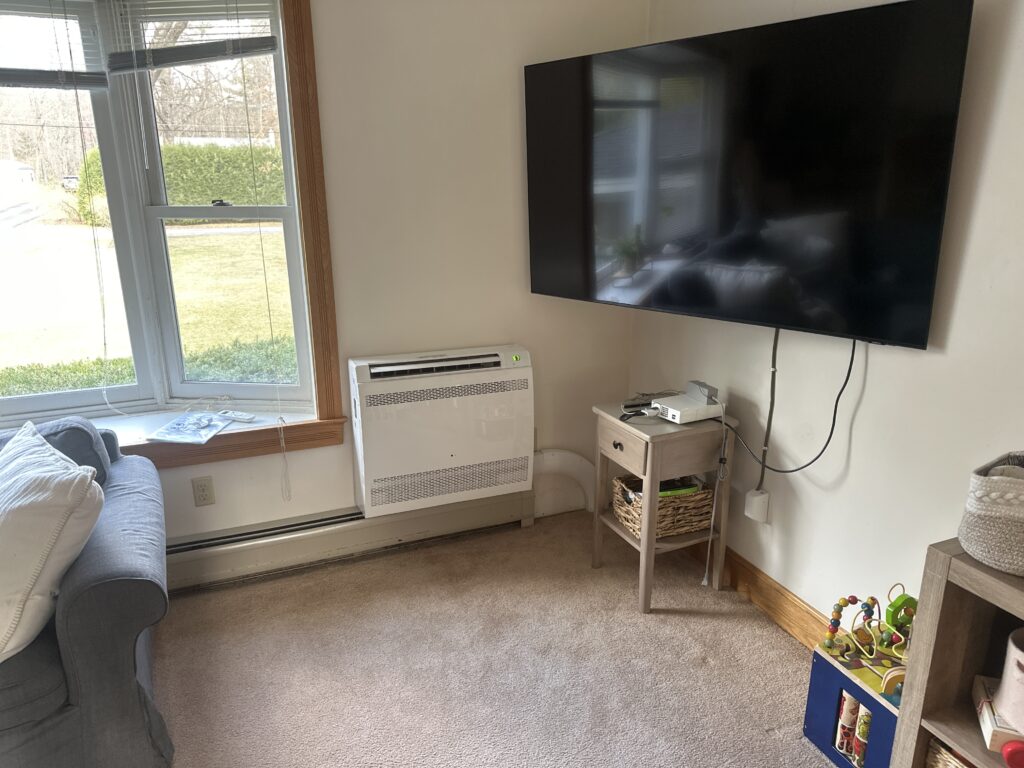
- Ductless mini-splits — our specialty, and the right fit for most of Amherst's older, unducted housing. Zone by zone, no ductwork required, and well suited to a building that's been carved into separate units.
- Whole-home heat pumps — cold-climate rated systems sized to the house with a proper load calculation, not a rule of thumb, with a clear plan for backup heat on the coldest days.
- Central air conditioning — new installs and replacements for homes that already have ductwork in place.
- Furnace service and replacement — for the homes here that are staying on ducted heat, sized correctly rather than swapped like-for-like.
- Ductwork and ventilation — sizing, repair, and improvements where existing ductwork is undersized or leaking, which shows up often in the postwar housing stock here.
- Electrical panel upgrades and change-outs — permitted and inspected work performed in-house under {ELECTRICAL_LICENCE}, not referred out.
Why homeowners here are looking at heat pumps
Two things about this part of Massachusetts shape almost every heat pump conversation we have, and Amherst is no exception.
First, a lot of this territory has no natural gas distribution at all. Homes run on delivered oil or propane, and that changes the economics of a heat pump in a way that doesn’t apply in a gas town. When the honest comparison is heat pump against oil or propane rather than heat pump against cheap gas, the math tends to favor the heat pump, and that’s the real argument here, not a sales line.
Second, a great deal of the older housing in this area, Amherst included, has no ductwork at all. Steam and hot water radiators were the standard for decades, and retrofitting a full duct system into a house like that is expensive and disruptive. Ductless is the answer to that problem, not a premium upgrade layered on top of it.
Beyond the economics, the technology itself has changed. Cold-climate heat pumps carry real HSPF2 ratings and documented capacity down to sub-zero temperatures, which is a different conversation than the heat pumps homeowners may remember from ten or fifteen years ago. We size every system with a Manual J load calculation rather than rough square footage, because oversizing a system doesn’t make a house more comfortable, it makes it less comfortable and shortens the equipment’s life through short-cycling. We also talk plainly about backup heat: when it kicks in, what it costs to run, and whether the house needs it at all given its insulation and exposure.
Mass Save is part of this conversation for a lot of Amherst homeowners, and it’s worth understanding before you commit to equipment. Rather than quote numbers that change or promise a rebate we don’t control, we’ll help you work out what actually applies to your project and your address.
How we work
- We start with a real assessment of the house, not a guess: build era, existing heat source, ductwork if there is any, and a proper load calculation.
- We give you a straight recommendation, including telling you when a system isn't the right fit for your house, even if that means turning down the job.
- Installation is done by Drew and a small, trusted crew, with plumbing handled by subcontractors we've worked with directly. Electrical work is performed in-house, permitted and inspected.
- You get one point of contact from the first call through the install, not a rotating cast of technicians.