
Heating and cooling in Easthampton
Easthampton has done something a lot of old mill towns haven’t managed: it kept its brick and its character while actually renovating the housing stock instead of letting it sit. Mill buildings along the canals have been converted into condos and loft apartments, Victorians near Main Street are getting rewired and re-insulated, and the arts-district energy has brought in a wave of owners who ask good questions about efficiency before they ask about price. That makes Easthampton one of the more interesting towns in our territory to work in, and one where the heat pump conversation tends to go further than it does elsewhere.
Powers Air HVAC is based in Granby, a short drive from Easthampton, and we work here regularly on heating, cooling, ductwork, and now electrical panel and EV charger work as well. Drew Powers runs the company himself with a small crew and a network of trusted subcontractors for plumbing. If you call about a job in Easthampton, you’re talking to the person who will size the system, not a call center reading from a script.
- Powers Air HVAC, based in Granby, MA
Heating and cooling in Easthampton
Easthampton sits in that part of Western Mass where fuel delivery still shapes a lot of heating decisions. Plenty of homes here, especially outside the immediate downtown grid, run on delivered oil or propane rather than natural gas. That changes the math on a heat pump conversion in a way it wouldn’t in a gas-served suburb closer to Boston. When the alternative is a fuel truck instead of a pipeline, a cold-climate heat pump isn’t a lifestyle upgrade, it’s often the cheaper way to heat the house, and that argument holds up even with New England winters in the equation.
Cooling matters here too. A lot of the older housing, especially the mill conversions and the pre-war single-families near downtown, was never built with air conditioning in mind, and window units only do so much in a third-floor unit with south-facing glass. We size cooling the same way we size heating: based on the actual building, not a rule of thumb.
The homes we work on here
Easthampton’s housing splits into a few clear categories, and each one tells us something different before we’ve even walked the basement.
The mill conversions along the canals and in the arts district are often open-concept, well-insulated by renovation, but short on anywhere to run ductwork. These are some of the best ductless mini-split candidates we see anywhere in our territory, because the unit owners have already stripped out old systems and are starting closer to a blank slate, and they tend to be receptive to a system that doesn’t require chasing chases through exposed brick.
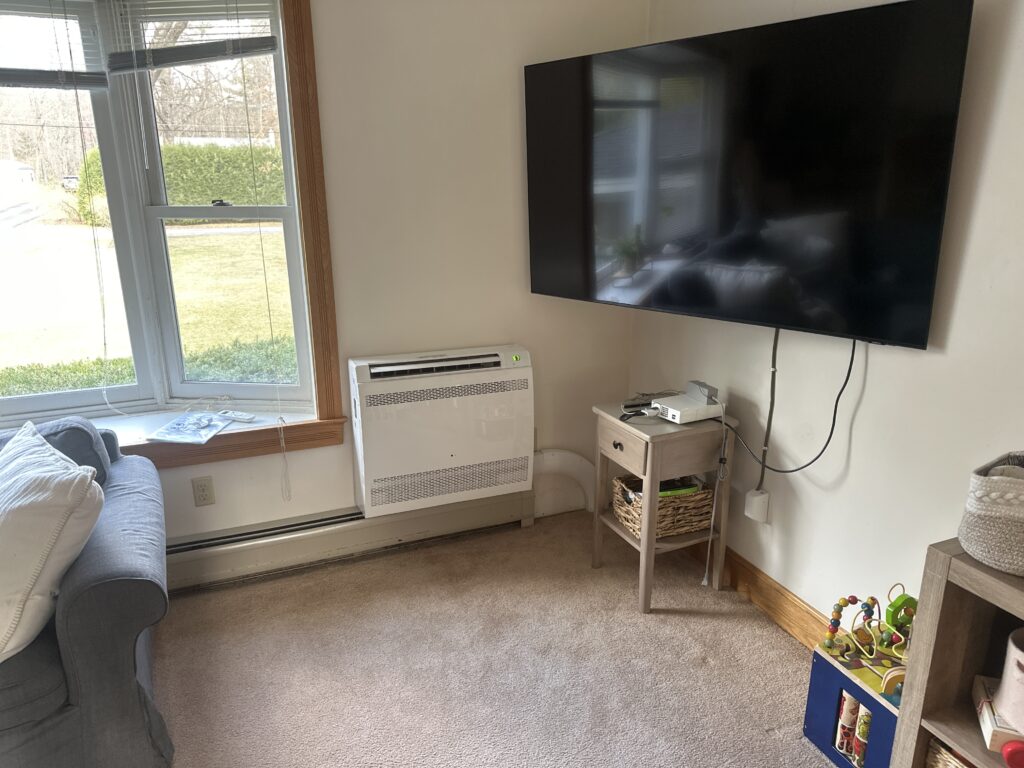
Then there’s the Victorian and early-1900s housing stock closer to downtown and up toward the Mount Tom side of town. A lot of these homes still have steam or hot water radiators and no ductwork at all. For these, central air was never really an option without a major retrofit, which is exactly why ductless has become the default answer for cooling, and increasingly for heating too, once the oil tank starts looking expensive.
Out toward the more suburban edges of Easthampton, you get a mix of 1960s-80s ranches and colonials, some with existing ductwork from an older forced-air furnace. These are the homes where we’re more likely to be talking about a ducted heat pump or a hybrid system that keeps the furnace as backup, because the duct infrastructure is already there and ripping it out to go ductless rarely makes sense.
Common failure points we see on service calls here: oil furnaces in the 20-30 year range starting to short-cycle or leak at the heat exchanger, old central AC condensers losing refrigerant through degraded line sets, and electrical panels in the older homes that were never sized for anything beyond the original wiring, let alone a heat pump and a car charger.
- Center-of-town and older residential streets: colonial and early 20th-century homes, often with steam or hot water radiators and no ductwork anywhere in the house. This is where ductless mini-splits do their best work, because there's no duct system to fight and no reason to build one.
- Converted multifamily and rental housing: older single-family homes divided into two, three, or more units, frequently with a mix of heating types installed at different points as the building changed hands. Zoning heat and cooling unit by unit is the practical fix, and it's also what lets an owner bill or manage each unit independently.
- Postwar capes and ranches on the outskirts: more likely to have basic ductwork already in place, sized for a furnace and central air rather than a heat pump. Static pressure and duct sizing matter here before we talk about equipment.
- Newer construction near campus and the town's edges: usually has gas service and existing ductwork, which opens up more straightforward heat pump or hybrid options.
Services we provide in Easthampton
We cover the full range of heating, cooling and now electrical work in Easthampton:
- Ductless mini-splits – our core specialty here, especially for the mill conversions and radiator-heated homes with no existing ductwork.
- Heat pump installation – cold-climate systems sized against a real Manual J load calculation, not a square-footage guess.
- Central air conditioning – for the homes with ductwork already in place, including replacements where static pressure or duct sizing is limiting performance.
- Furnace installation and repair – oil and propane-fired systems, including backup heat setups paired with a heat pump.
- Ductwork and ventilation – new duct runs, repairs to existing systems, and ventilation work for tighter, newly-renovated homes.
- Electrical panel upgrades and change-outs – permitted, inspected work performed by us under {ELECTRICAL_LICENCE}, not referred out to a separate electrician.
- EV charger installation – Easthampton is one of the towns where we handle this directly, from circuit sizing to the install itself.
The electrical side exists because of what the heating and cooling side is doing to home electrical loads. A cold-climate heat pump, a heat pump water heater, and an EV charger are each a serious draw on their own, and in a lot of Easthampton’s older panels, that conversation ends somewhere around ‘the panel needs to be upgraded before any of this gets installed.’ Having that work done in-house instead of coordinated through a third party means one less handoff and one less place for a job to stall.
Services we provide in Easthampton
Easthampton’s arts and renovation culture isn’t just a nice detail, it actually changes the sales conversation. Owners who’ve already put real money into insulation, windows, or a full gut renovation tend to understand efficiency arguments faster than someone who hasn’t touched the building envelope in forty years. They ask about HSPF2 ratings, they want to know what the unit actually does at ten degrees below zero, and they want straight answers about backup heat rather than a brochure.
The honest version of that answer: a good cold-climate heat pump, properly sized, will carry the bulk of an Easthampton winter on its own. Capacity does drop as outdoor temperature falls, which is why we talk about backup or auxiliary heat up front rather than after the system is in the ground. For homes still on oil or propane, the economics usually favor the heat pump even accounting for that backup. For homes that already have decent ductwork and a newer furnace, a hybrid setup that lets the heat pump do most of the work and the furnace cover the coldest stretches is often the more practical first step.
Mass Save is part of this conversation for a lot of Easthampton homeowners, and it’s worth understanding what the program covers before you commit to a system. We’re glad to walk through what might apply to your specific situation and help you figure out where to look, without promising a number we don’t control.
- Ductless mini-splits — our specialty, and the right fit for most of Easthampton's older, unducted housing. Zone by zone, no ductwork required, and well suited to a building that's been carved into separate units.
- Whole-home heat pumps — cold-climate rated systems sized to the house with a proper load calculation, not a rule of thumb, with a clear plan for backup heat on the coldest days.
- Central air conditioning — new installs and replacements for homes that already have ductwork in place.
- Furnace service and replacement — for the homes here that are staying on ducted heat, sized correctly rather than swapped like-for-like.
- Ductwork and ventilation — sizing, repair, and improvements where existing ductwork is undersized or leaking, which shows up often in the postwar housing stock here.
- Electrical panel upgrades and change-outs — permitted and inspected work performed in-house under {ELECTRICAL_LICENCE}, not referred out.
How we work
We don’t send a salesman to measure your house and a different crew to install the system. Drew comes out, walks the house, runs the numbers, and tells you what he’d actually do if it were his own place. If a system someone else quoted is wrong for the house, we’ll say so, even if that means a smaller job or no job at all.
For heating and cooling work, that means a real load calculation instead of a sizing guess, a conversation about where line sets and condensate will run before the quote, and straight talk about what backup heat looks like if you’re going ductless or heat-pump-primary. For electrical work, that means the panel change-out or charger install is permitted and inspected the way it’s supposed to be, because the cheap quote that skips that step is cheap for a reason.
Why homeowners here are looking at heat pumps
If you’re weighing a heat pump against another oil delivery season, trying to figure out if your panel can handle an EV charger, or just want someone to look at a system that isn’t performing the way it should, call {PHONE}. We’ll talk through the house and the options honestly, and if it’s not a fit, we’ll tell you that too.
How we work
- We start with a real assessment of the house, not a guess: build era, existing heat source, ductwork if there is any, and a proper load calculation.
- We give you a straight recommendation, including telling you when a system isn't the right fit for your house, even if that means turning down the job.
- Installation is done by Drew and a small, trusted crew, with plumbing handled by subcontractors we've worked with directly. Electrical work is performed in-house, permitted and inspected.
- You get one point of contact from the first call through the install, not a rotating cast of technicians.
Get a Quote
frequently asked questions
Do you serve all of Easthampton, including the mill district conversions?
Yes. We work regularly in the mill building conversions, the downtown Victorian housing stock, and the more suburban neighborhoods toward the edges of town.
Is Easthampton on natural gas or do homes run on delivered fuel?
It's mixed. Plenty of Easthampton homes, particularly outside the downtown core, run on delivered oil or propane rather than gas, which changes the economics of a heat pump conversion compared to a gas-served town.
Can you install a heat pump in a home with steam or hot water radiators and no ductwork?
Yes, that's one of the most common situations we handle in Easthampton. A ductless mini-split system doesn't need existing ductwork, which makes it a practical fit for older radiator-heated homes.
Do you do electrical panel upgrades in Easthampton, or just refer that out?
We perform panel upgrades and change-outs ourselves as licensed in-house work under {ELECTRICAL_LICENCE}, not as a referral to a separate electrician. The work is permitted and inspected.
Is Easthampton one of the towns where you install EV chargers?
Yes, Easthampton is one of the towns where we offer EV charger installation directly, alongside panel work when a charger requires more electrical capacity than the existing panel can support.
How far is Easthampton from your base in Granby?
We're based in Granby and Easthampton is a regular part of our service area. We also cover Springfield and the surrounding towns from the same base.