
Heating and cooling in Granby
Granby is a small town, about 6,300 people spread across farmland, back roads, and large lots, and it’s where Powers Air HVAC is actually based. Not a service territory on a map, not a coverage zone drawn in from somewhere else. This is home. When you call about a system here, you’re usually talking to the same person who will be in your basement or your attic looking at the equipment.
Granby doesn’t have much in the way of natural gas distribution. Most houses out here run on delivered oil or propane, and that one fact changes the whole heat pump conversation. A homeowner paying for oil deliveries or propane fill-ups has a much stronger economic case for switching some or all of their heating load to a heat pump than someone on cheap piped gas in a city neighborhood. That’s not a sales pitch, it’s just how the fuel math works, and it’s the reason heat pumps come up in almost every conversation I have with Granby homeowners.
- Powers Air HVAC, based in Granby, MA
The homes we work on here
Granby’s housing stock is a mix. You’ve got old farmhouses, some with additions bolted on over the decades, post-war capes and ranches, and newer single-family builds on big rural lots. The age and layout of the house tells me most of what I need to know before I even get there.
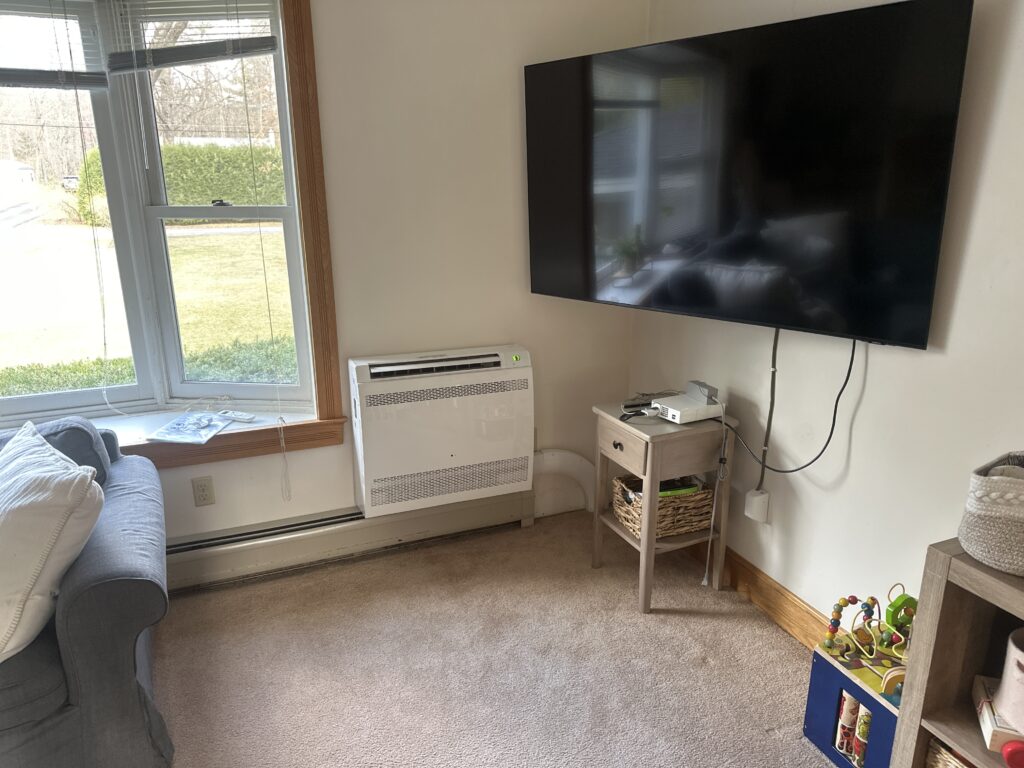
A lot of the older farmhouses were never built with ductwork. They were heated with oil-fired boilers and cast iron radiators, or later converted to hot water baseboard. If that’s your house, running ductwork through plaster walls and tight stud bays to install central air or a conventional heat pump doesn’t make sense. Ductless mini-splits are built for exactly this situation: one outdoor condenser, a few indoor heads placed where you actually spend time, and no demolition.
The post-war and newer homes more often have ductwork already in place, usually sized for a furnace or an oil-fired air handler. Here the questions change. Is the existing ductwork sized to handle the static pressure a heat pump air handler needs, or is it going to restrict airflow and cost you capacity? Does the system need a Manual J load calculation to confirm what size equipment the house actually needs, instead of what the last contractor guessed? Oversizing is common out here and it’s the single biggest reason people complain about a heat pump short cycling or a house that never feels quite right.
Fuel source matters just as much as ductwork. If you’re on delivered oil or propane, your break-even point for a cold-climate heat pump is usually faster and more favorable than it would be in a gas-served part of the state. If you’re already running baseboard hot water off an oil boiler, a heat pump can take over most of the season’s heating and let the boiler sit as backup for the coldest stretches. That’s often the most sensible way to do it, rather than ripping out a perfectly functional boiler.
What fails and when: in older farmhouses it’s usually the original boiler or an aging oil tank, plus electrical panels that were never sized for anything beyond lights and a well pump. In the postwar housing it’s often an undersized or failing central air condenser, or ductwork that was patched together over the years and is now leaking air into an attic or crawlspace. Knowing which failure mode you’re dealing with before recommending anything is the job.
The homes we work on here
We handle both residential and commercial work in Granby, and because Granby is home base, this is where you’ll find the full range of what we do.
- Ductless mini-splits are the right call for the farmhouses and older homes here with no ductwork. See our ductless mini-split installation page for how sizing and head placement actually work.
- Heat pumps, ducted and ductless, cold-climate rated units that keep delivering heat well below freezing, with a real conversation about backup heat for the coldest nights. Details on our heat pump installation page.
- Central air conditioning for homes that already have ductwork, including right-sizing a new condenser to the ductwork that’s already there. Covered on our central AC page.
- Furnaces for homes that want to stay with forced air heat, with honest advice on when a heat pump can do the job instead or alongside it. More on our furnace installation page.
- Ductwork and ventilation work, from sealing and resizing existing duct runs to fresh air ventilation for tighter, newer construction. See our ductwork and ventilation page.
- Electrical panel upgrades and change-outs, performed in-house under {ELECTRICAL_LICENCE}, not farmed out to someone else. A cold-climate heat pump, a heat pump water heater, and an EV charger are all large electrical loads, and in a lot of Granby’s older homes the panel simply wasn’t built to carry them. That’s why panel work is now part of what we do directly. Details on our panel upgrade page.
- EV charger installation, also licensed in-house work, for homeowners here who have the driveway or garage space for a Level 2 charger. See our EV charger installation page.
We also work with a small group of trusted plumbing and electrical subcontractors when a job calls for scope outside HVAC and outside the electrical licensing itself, so the whole project stays coordinated instead of getting split across three companies who’ve never spoken to each other.
- Center-of-town and older residential streets: colonial and early 20th-century homes, often with steam or hot water radiators and no ductwork anywhere in the house. This is where ductless mini-splits do their best work, because there's no duct system to fight and no reason to build one.
- Converted multifamily and rental housing: older single-family homes divided into two, three, or more units, frequently with a mix of heating types installed at different points as the building changed hands. Zoning heat and cooling unit by unit is the practical fix, and it's also what lets an owner bill or manage each unit independently.
- Postwar capes and ranches on the outskirts: more likely to have basic ductwork already in place, sized for a furnace and central air rather than a heat pump. Static pressure and duct sizing matter here before we talk about equipment.
- Newer construction near campus and the town's edges: usually has gas service and existing ductwork, which opens up more straightforward heat pump or hybrid options.
Why homeowners here are looking at heat pumps
The pattern in Granby is pretty consistent. Someone is tired of watching the oil truck pull in every few weeks, or they’re on propane and the per-gallon cost has them rethinking everything. They’ve heard heat pumps work in cold climates now, and they want to know if that’s actually true for their house, not in general.
It is true, with real caveats. A good cold-climate heat pump, rated and tested for sub-zero performance with a decent HSPF2 number, will keep producing meaningful heat well below zero degrees. Capacity does drop off as the temperature drops, which is why backup heat matters. For some houses that backup is the existing oil or propane system kept in place and working alongside the heat pump. For others it’s electric resistance heat built into the air handler. Which one makes sense depends on the house, the existing equipment, and what the homeowner wants to keep as a safety net.
Mass Save is part of this conversation too, in general terms. The program exists, it’s worth understanding, and the rebates and incentives can meaningfully change the cost of a project depending on your situation. We’re glad to help you work out what might apply to your home, but we’re not going to tell you a dollar figure before we know your specifics, and we’re not going to pretend we hand out the rebate ourselves. The utility sponsors run that program, not us.
What we will tell you plainly is the sizing matters more than the brand. An oversized heat pump short cycles, struggles with humidity, and never settles into the steady, even output that makes these systems comfortable in the first place. A correctly sized system, based on an actual load calculation for your house rather than a guess based on square footage, is what makes the difference between a heat pump you love and one you regret.
Services we provide in Granby
- Ductless mini-splits — our specialty, and the right fit for most of Granby's older, unducted housing. Zone by zone, no ductwork required, and well suited to a building that's been carved into separate units.
- Whole-home heat pumps — cold-climate rated systems sized to the house with a proper load calculation, not a rule of thumb, with a clear plan for backup heat on the coldest days.
- Central air conditioning — new installs and replacements for homes that already have ductwork in place.
- Furnace service and replacement — for the homes here that are staying on ducted heat, sized correctly rather than swapped like-for-like.
- Ductwork and ventilation — sizing, repair, and improvements where existing ductwork is undersized or leaking, which shows up often in the postwar housing stock here.
- Electrical panel upgrades and change-outs — permitted and inspected work performed in-house under {ELECTRICAL_LICENCE}, not referred out.
Why homeowners here are looking at heat pumps
How we work
- We start with a real assessment of the house, not a guess: build era, existing heat source, ductwork if there is any, and a proper load calculation.
- We give you a straight recommendation, including telling you when a system isn't the right fit for your house, even if that means turning down the job.
- Installation is done by Drew and a small, trusted crew, with plumbing handled by subcontractors we've worked with directly. Electrical work is performed in-house, permitted and inspected.
- You get one point of contact from the first call through the install, not a rotating cast of technicians.
Get a Quote
frequently asked questions
Is Powers Air HVAC actually based in Granby, or just serving it from somewhere else?
We're based in Granby. This is home, not a territory we drive into. Drew Powers runs the company out of Granby and that's where most jobs start and end.
Does a heat pump make sense if my house runs on oil or propane?
Often more sense than it would in a gas-served area. Delivered fuel costs per unit of heat are generally higher than piped natural gas, so a cold-climate heat pump taking over a large share of your heating load tends to pay back faster here than it would in a gas town.
My farmhouse has radiators and no ductwork. What are my options?
Ductless mini-splits are usually the straightforward answer. No need to open walls or install ductwork, just an outdoor unit and indoor heads placed where you spend time, often alongside your existing radiators as backup heat for the coldest days.
Do you do electrical work, or do you just refer it out?
We perform panel upgrades, change-outs, and EV charger installation ourselves, in-house, under {ELECTRICAL_LICENCE}. It's licensed, permitted, and inspected work, not a referral to someone else.
Will Mass Save cover my heat pump installation?
The Mass Save program exists and can reduce project costs depending on your situation, but we're not going to quote you a number without knowing your home and equipment. We can walk through what might apply once we've looked at your specific case.
How do I know what size heat pump my house actually needs?
A proper Manual J load calculation, not a square-footage guess. Oversizing is common and it's usually what makes a heat pump feel inconsistent or run constantly. We size to the house, not to a rule of thumb.