
Heating and cooling in Holyoke
Holyoke is a brick-and-steam city. Canal-era mills, triple-deckers stacked three units deep, and a downtown built before anyone was thinking about central air. That housing stock changes what good HVAC work looks like here compared to a newer suburb, and it’s why a lot of the calls we get from Holyoke start with “the radiators work fine, but we need something for summer” or “the system in this building is older than I am.” Powers Air is based in Granby, a short drive down Route 202/33, and Holyoke is one of the towns we work in regularly.
- Powers Air HVAC, based in Granby, MA
Heating and cooling in Holyoke
Holyoke runs on a mix that you don’t see everywhere in Western Mass. A good chunk of the city has gas service through Holyoke Gas and Electric, which is unusual for this part of the state since HG&E is a municipal utility and not an investor-owned company. That matters for two reasons. One, gas-heated buildings here have a different cost comparison for heat pumps than homes on delivered oil or propane out in the hill towns. Two, HG&E runs its own incentive and rebate programs, separate from the investor-owned-utility structure that funds most Mass Save heat pump rebates elsewhere in the state. If you’ve read rebate numbers online that reference Mass Save and you’re inside Holyoke city limits, don’t assume they apply to you without checking. We’ll walk through what’s actually available for your address rather than quoting you a generic figure.
Outside the gas footprint, plenty of Holyoke’s outer neighborhoods and the surrounding triple-decker blocks still run on oil delivery, and those households are the ones where a heat pump conversation tends to pay for itself fastest, especially paired with keeping the oil boiler as backup for the coldest stretches.
The homes we work on here
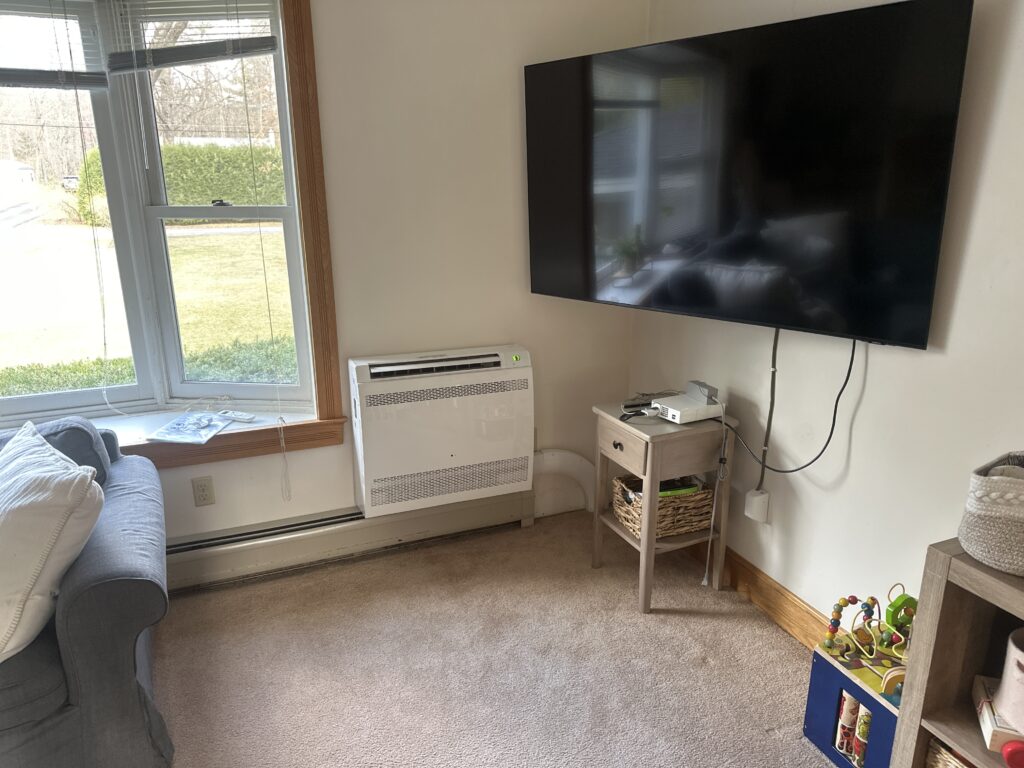
Most of what we see in Holyoke falls into a few categories. There’s the nineteenth and early-twentieth-century triple-decker, three units stacked with steam or hot water radiators on a single boiler, zero ductwork, and plaster walls that make running anything through a wall cavity a real conversation rather than an afternoon job. For these, ductless mini-splits are usually the only system that makes sense for cooling, and often the cleanest way to add heating capacity without touching the existing steam system at all. One outdoor condenser can feed two, three, or four indoor heads, one per room that actually needs conditioning, and the line sets run through small core-drilled holes instead of a chase.
Then there’s the old mill-adjacent housing and converted commercial space downtown, brick exterior walls, high ceilings, and sometimes surprisingly good bones for a ducted system if there’s already a chase or a drop ceiling to hide trunk lines in. These buildings get a proper Manual J load calculation before we size anything, because a high-ceilinged brick unit doesn’t load the same way a stick-built ranch does, and oversizing the equipment here is an expensive way to end up with a room that short-cycles and never quite dehumidifies.
We also see a fair amount of Holyoke’s postwar single-family stock on the outskirts toward South Hadley and the Westfield line, split-level and cape-style houses with forced hot air already in place, which simplifies a central AC add-on or a full heat pump conversion since the ductwork is already there, assuming it’s sized correctly for the static pressure a modern variable-speed system needs. We check that before we quote, not after installation.
Common failure points in Holyoke’s older building stock: boilers nearing end of life that still heat fine but are inefficient enough that pairing them with a heat pump for shoulder seasons saves real money, undersized electrical panels that can’t take a heat pump water heater or an EV charger without an upgrade, and window AC units that are being asked to do a job they were never built for in a 90-degree week with high humidity off the river.
- Center-of-town and older residential streets: colonial and early 20th-century homes, often with steam or hot water radiators and no ductwork anywhere in the house. This is where ductless mini-splits do their best work, because there's no duct system to fight and no reason to build one.
- Converted multifamily and rental housing: older single-family homes divided into two, three, or more units, frequently with a mix of heating types installed at different points as the building changed hands. Zoning heat and cooling unit by unit is the practical fix, and it's also what lets an owner bill or manage each unit independently.
- Postwar capes and ranches on the outskirts: more likely to have basic ductwork already in place, sized for a furnace and central air rather than a heat pump. Static pressure and duct sizing matter here before we talk about equipment.
- Newer construction near campus and the town's edges: usually has gas service and existing ductwork, which opens up more straightforward heat pump or hybrid options.
Services we provide in Holyoke
- Ductless mini-split installation – our most common Holyoke job by far, built for triple-deckers, condo conversions, and any unit with steam or hot water heat and no ducts.
- Heat pump installation, ducted or ductless, sized with a real load calculation and a cold-climate rating that matches what a Pioneer Valley winter actually does to capacity.
- Central air conditioning for homes that already have ductwork, often paired with a furnace swap if the air handler is past its service life.
- Furnace installation and replacement for the gas and oil-fired forced-air homes on the outer edges of the city.
- Ductwork and ventilation, including fixing undersized or leaky trunk lines in older forced-air systems before we ever add new equipment on top of them.
- Electrical panel upgrades and change-outs, done as licensed in-house work under {ELECTRICAL_LICENCE}, fully permitted and inspected. A cold-climate heat pump, a heat pump water heater, and an EV charger are all substantial electrical loads, and in a lot of Holyoke’s older triple-deckers the panel is the thing that actually decides what you can install, not the equipment itself.
- EV charger installation, available in Holyoke along with the panel work, same licensing, same permitting and inspection standard.
We don’t run a separate electrical crew that gets dispatched after the fact. It’s the same conversation, the same visit in most cases, and the same person standing in your basement looking at your panel and your HVAC load together.
Services we provide in Holyoke
Two different arguments show up depending on which part of Holyoke you’re in. If you’re on delivered oil or propane out past the gas footprint, the math is straightforward: a cold-climate heat pump with good HSPF2 numbers can cut your heating cost noticeably against current delivered-fuel prices, and you get cooling in the same equipment you’re already paying for. If you’re on HG&E gas, the case is less about raw cost and more about adding air conditioning to a building that’s never had it, getting rid of window units, and having a single system that handles both seasons in a triple-decker unit where there’s no room for ductwork anyway.
Either way, the honest answer about cold weather matters. A cold-climate heat pump keeps delivering real heating capacity well below zero, but capacity does taper as it gets colder, and we size and discuss backup heat specifically so you know what kicks in and when, rather than finding out the hard way in February. If keeping your boiler as backup heat makes more sense than running the heat pump’s electric strip at the coldest points, we’ll say so.
- Ductless mini-splits — our specialty, and the right fit for most of Holyoke's older, unducted housing. Zone by zone, no ductwork required, and well suited to a building that's been carved into separate units.
- Whole-home heat pumps — cold-climate rated systems sized to the house with a proper load calculation, not a rule of thumb, with a clear plan for backup heat on the coldest days.
- Central air conditioning — new installs and replacements for homes that already have ductwork in place.
- Furnace service and replacement — for the homes here that are staying on ducted heat, sized correctly rather than swapped like-for-like.
- Ductwork and ventilation — sizing, repair, and improvements where existing ductwork is undersized or leaking, which shows up often in the postwar housing stock here.
- Electrical panel upgrades and change-outs — permitted and inspected work performed in-house under {ELECTRICAL_LICENCE}, not referred out.
How we work
Drew runs Powers Air directly. He used to run a bigger outfit, ten to twenty employees, and went back to a smaller model on purpose, because the thing that was getting lost at that size was exactly the thing homeowners are paying for: the person doing the sizing is the person doing the install. There’s no salesperson on commission steering you toward the bigger unit, no dispatcher who’s never seen your panel. Plumbing work on a job gets handled by trusted subcontractors we’ve worked with directly. Electrical work, including panel upgrades and EV chargers, is done in-house under {ELECTRICAL_LICENCE}, permitted and inspected, which matters in a city with as much older electrical infrastructure as Holyoke has.
Why homeowners here are looking at heat pumps
Call {PHONE} or send us the basics on your building, address, current heat source, gas or delivered fuel, and whether you’ve got ductwork. We’ll tell you what makes sense before we ever quote equipment, and if the answer is that your money is better spent fixing a duct problem or your existing boiler is fine for another few winters, that’s what we’ll tell you.
How we work
- We start with a real assessment of the house, not a guess: build era, existing heat source, ductwork if there is any, and a proper load calculation.
- We give you a straight recommendation, including telling you when a system isn't the right fit for your house, even if that means turning down the job.
- Installation is done by Drew and a small, trusted crew, with plumbing handled by subcontractors we've worked with directly. Electrical work is performed in-house, permitted and inspected.
- You get one point of contact from the first call through the install, not a rotating cast of technicians.
Get a Quote
frequently asked questions
Does Holyoke Gas and Electric offer heat pump rebates like Mass Save?
HG&E is a municipal utility, not one of the investor-owned utilities that fund most Mass Save rebates, so its incentive programs are structured separately. If you're inside Holyoke's HG&E service territory, don't assume a Mass Save rebate figure you've seen elsewhere applies to you. We'll help you work out what's actually available for your specific address before you commit to equipment.
Can you put a heat pump into a triple-decker with no ductwork?
Yes, that's the most common job we do in Holyoke. A multi-zone ductless system lets one outdoor unit feed several indoor heads, one per room or unit, run through small core-drilled wall penetrations rather than a full duct chase. It's usually the cleanest and least invasive path to both heating and cooling in a building with existing steam or hot water heat.
What happens to heat pump capacity when it's below zero in Holyoke?
A cold-climate rated heat pump keeps producing meaningful heat well below zero, but output does taper as temperatures drop. We size systems and plan backup heat, whether that's keeping an existing boiler as backup or using electric resistance strips, so you know exactly what's covering the coldest nights before you're relying on it.
Do I need an electrical panel upgrade before I can get a heat pump or EV charger?
Sometimes, especially in Holyoke's older triple-deckers where the original panel wasn't sized for modern electric loads. A cold-climate heat pump, a heat pump water heater, and an EV charger are all significant draws, and we check your panel's capacity as part of the HVAC conversation, not as an afterthought. Panel upgrades are performed as licensed, permitted, and inspected work under {ELECTRICAL_LICENCE}.
Is my brick mill-building space different to size for HVAC than a regular house?
Yes. High ceilings, brick exterior walls, and large glazed storefronts in converted commercial and mill spaces load very differently than a standard stick-built house. We run a Manual J load calculation specific to the space rather than sizing off square footage alone, since oversizing in these buildings tends to cause short-cycling and poor humidity control rather than better comfort.
Do you serve Springfield as well?
Yes, we take jobs in Springfield as part of our regular service area out of Granby. It's a bit further out than our closest towns, so scheduling may work a little differently, but the same sizing and installation standards apply.