
Heating and cooling in Springfield
Springfield is the biggest city we serve, and it’s not close. At roughly 155,900 people it’s by far the largest market in our coverage area, and it’s also the most varied housing stock we deal with anywhere – dense triple-deckers in the older neighborhoods, solid single-family streets in the outer wards, and a commercial and institutional base that smaller towns around here just don’t have. We’re based about 13 miles away in Granby, which means Springfield isn’t a job we swing by on the way to somewhere else. It’s a market we actively work in, with real jobs completed in real Springfield houses, not a town we added to a service list because it has a big population number.
- Powers Air HVAC, based in Granby, MA
Heating and cooling in Springfield
Springfield splits into two very different heating worlds, and which one your house falls into changes the entire conversation about what to install. Parts of the city have natural gas service, which keeps a gas furnace or boiler in the running on fuel cost alone. But plenty of houses here, especially as you move toward the city’s edges and into some of the older sections, are still on delivered oil or propane. When that’s the case, the math on a heat pump looks completely different than it does in a gas-served neighborhood three streets over – and that’s before you even get into cooling, which oil and propane systems don’t provide at all.
We look at fuel type, how the existing system is distributing heat, and what the house actually needs before we recommend anything. A lot of Springfield homes could use a serious second look at what they’re paying to stay warm.
The homes we work on here
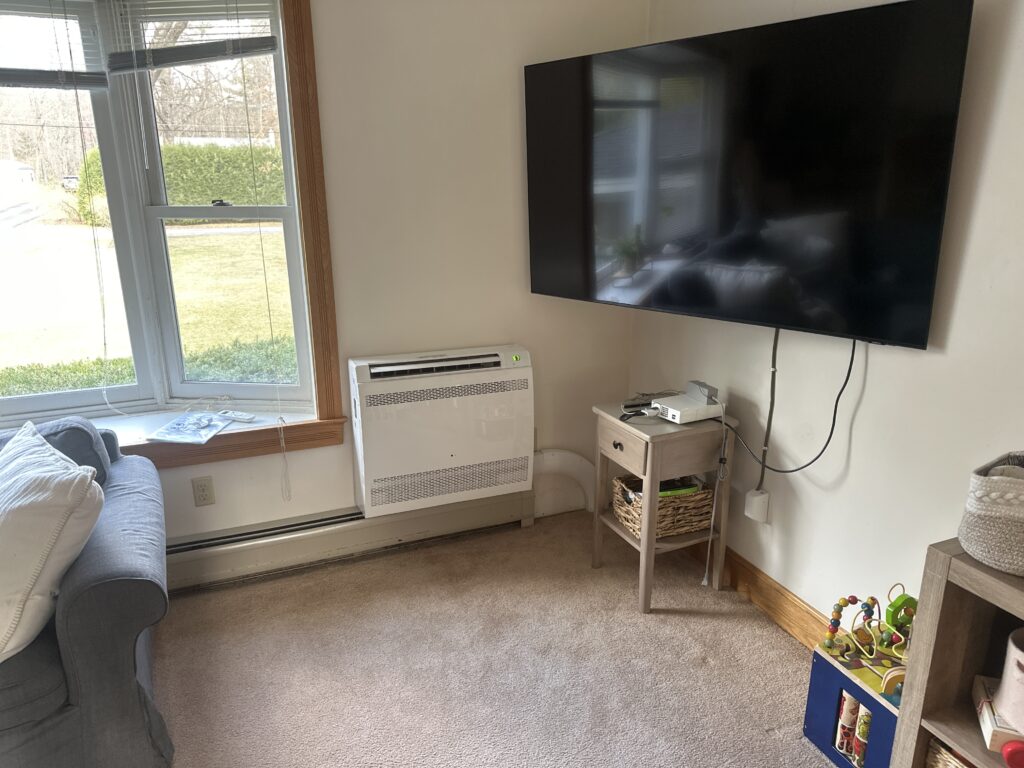
Springfield’s building stock tells you a lot before we even walk in the door. The triple-deckers and older multifamily buildings in neighborhoods like the McKnight, Six Corners, and parts of Forest Park were built long before anyone was running ductwork – they were heated with steam or hot water radiators, and a huge number of them still are. No ducts means a forced-air furnace retrofit is a demolition project nobody wants, and it’s exactly why ductless mini-splits exist. One or two outdoor condensers, a handful of wall-mounted or ceiling cassette indoor heads, and you’ve added cooling and supplemental or full heat to a building that was never going to accept a duct system without tearing out plaster and framing in chases.
The single-family stock out toward Sixteen Acres, East Forest Park, and the Indian Orchard side of the city is a different animal – more of it has some ductwork already, often undersized or leaky from decades of patchwork repairs, which shows up as a static pressure problem the moment you try to push a modern high-efficiency system through it. We check that before we size anything, because a system that looks right on paper but chokes on bad ductwork will short-cycle, run loud, and fail early.
On the commercial and institutional side – and Springfield has more of this than anywhere else we work – we see aging rooftop units, commercial boilers nearing the end of their service life, and ventilation systems that were sized for a building’s original use and never revisited. Those jobs usually start with a conversation about what the space actually does now, not what the mechanical drawings said forty years ago.
- Center-of-town and older residential streets: colonial and early 20th-century homes, often with steam or hot water radiators and no ductwork anywhere in the house. This is where ductless mini-splits do their best work, because there's no duct system to fight and no reason to build one.
- Converted multifamily and rental housing: older single-family homes divided into two, three, or more units, frequently with a mix of heating types installed at different points as the building changed hands. Zoning heat and cooling unit by unit is the practical fix, and it's also what lets an owner bill or manage each unit independently.
- Postwar capes and ranches on the outskirts: more likely to have basic ductwork already in place, sized for a furnace and central air rather than a heat pump. Static pressure and duct sizing matter here before we talk about equipment.
- Newer construction near campus and the town's edges: usually has gas service and existing ductwork, which opens up more straightforward heat pump or hybrid options.
Services we provide in Springfield
We do licensed electrical work in Springfield alongside heating and cooling, and here’s why that pairing matters: a cold-climate heat pump, a heat pump water heater, and an EV charger are all large electrical loads, and sooner or later that conversation lands on the panel. If the panel can’t support what you’re trying to add, the HVAC plan and the electrical plan are the same plan. We’d rather have that conversation up front than have a homeowner find out the hard way after the equipment is already on order.
- Ductless mini-split installation – the right call for the no-duct housing stock in the older neighborhoods, and often the most cost-effective cooling and heating upgrade for a triple-decker unit or an addition without existing ducts.
- Heat pump installation – cold-climate rated systems sized with an actual load calculation, not a rule of thumb, for homes on oil or propane looking to cut fuel costs or add cooling.
- Central air conditioning – for homes with existing ductwork where central AC still makes sense, installed with attention to the duct system that’s already there, not just the condenser outside.
- Furnace installation and replacement – for Springfield’s gas-served neighborhoods where a furnace is still the right call, sized to the house instead of matched to whatever was there before.
- Ductwork and ventilation – repair, replacement, and new duct runs for the single-family stock where existing ductwork is undersized, leaky, or simply in the wrong places.
- Electrical panel upgrades and change-outs – permitted, inspected panel work for homes where the existing service can’t support modern heating, cooling, and charging loads.
- EV charger installation – licensed in-house installation for Springfield homeowners adding a home charger, done as part of the same electrical capacity conversation as panel upgrades.
Services we provide in Springfield
In Springfield’s gas neighborhoods, the heat pump conversation is mostly about adding efficient cooling and maybe trimming shoulder-season heating costs. But in the sections of the city still running on delivered oil or propane, it’s a different conversation entirely – you’re comparing a fuel you buy by the tank to one you draw from a wall outlet, and that changes the payback math in the heat pump’s favor in a way gas-town comparisons never quite do.
The honest caveat, every time: a modern cold-climate heat pump holds real capacity well below zero, but it still loses some output as temperatures drop, and we size backup or auxiliary heat into the plan rather than pretending it isn’t needed. We look at the manufacturer’s HSPF2 and capacity-at-temperature data for the specific unit, not a marketing brochure number, and we size against a Manual J load calculation for your house, not the square footage on your tax bill. Mass Save rebates are part of the picture for a lot of Springfield homeowners weighing this decision, and the program is worth understanding before you commit to anything – we’re happy to walk through what applies to your situation and help you figure out where your project actually lands.
- Ductless mini-splits — our specialty, and the right fit for most of Springfield's older, unducted housing. Zone by zone, no ductwork required, and well suited to a building that's been carved into separate units.
- Whole-home heat pumps — cold-climate rated systems sized to the house with a proper load calculation, not a rule of thumb, with a clear plan for backup heat on the coldest days.
- Central air conditioning — new installs and replacements for homes that already have ductwork in place.
- Furnace service and replacement — for the homes here that are staying on ducted heat, sized correctly rather than swapped like-for-like.
- Ductwork and ventilation — sizing, repair, and improvements where existing ductwork is undersized or leaking, which shows up often in the postwar housing stock here.
- Electrical panel upgrades and change-outs — permitted and inspected work performed in-house under {ELECTRICAL_LICENCE}, not referred out.
How we work
Powers Air HVAC is based in Granby, Massachusetts, and it’s owner-operated – Drew Powers runs it himself, with a small trusted network of plumbing and electrical subcontractors brought in where the job calls for it. He used to run a larger operation with a dozen or more employees and deliberately scaled it back down. The reason is simple: when you call about a Springfield job, you’re talking to the person who’s going to size the system, show up to install it, or stand directly over the subcontractor who is. There’s no call center reading from a script and no commissioned salesman pushing you toward the model with the best margin.
That shows up in small ways that matter. Drew would rather tell you a ductless system is the wrong fit for your house than sell you one anyway. He’ll talk through Manual J numbers, refrigerant line length limits on a long run, what a condensate line needs to do on a multi-head mini-split install, and where a home’s electrical service needs attention before new equipment goes in. All electrical work, including panel changes and EV charger installs, is performed as licensed in-house work under {ELECTRICAL_LICENCE}, permitted and inspected the way it’s supposed to be, because the service conductors on a panel change-out aren’t something to cut corners on.
Why homeowners here are looking at heat pumps
If you’re in Springfield and trying to figure out whether a ductless system, a heat pump, a panel upgrade, or some combination of those is the right move for your house, call {PHONE}. You’ll talk to Drew directly about your specific house – its age, its existing systems, its electrical service – and get a straight answer, including if the answer is that what you have already makes sense and doesn’t need replacing yet.
How we work
- We start with a real assessment of the house, not a guess: build era, existing heat source, ductwork if there is any, and a proper load calculation.
- We give you a straight recommendation, including telling you when a system isn't the right fit for your house, even if that means turning down the job.
- Installation is done by Drew and a small, trusted crew, with plumbing handled by subcontractors we've worked with directly. Electrical work is performed in-house, permitted and inspected.
- You get one point of contact from the first call through the install, not a rotating cast of technicians.
Get a Quote
frequently asked questions
Do you actually come to Springfield or is it listed as a service area you don't really cover?
We actively work in Springfield. It's roughly 13 miles from our base in Granby and it's one of the largest markets we serve, so it's a regular part of our schedule, not a town on a list we never visit.
My triple-decker unit has radiators and no ductwork. What are my options?
Ductless mini-splits are usually the practical answer. You can add heating and cooling without opening walls or ceilings for duct chases, which is exactly the problem mini-splits were designed to solve in older multifamily buildings like Springfield's triple-deckers.
Is a heat pump worth it if my house already has gas?
It depends on what you're trying to solve. If you're mainly after efficient air conditioning or want to trim shoulder-season heating costs, a heat pump can make sense alongside existing gas heat. If you're on oil or propane instead of gas, the economics usually look a lot more favorable.
Can you upgrade my electrical panel if I'm adding a heat pump and an EV charger?
Yes, panel upgrades and change-outs are work we perform in-house, licensed, permitted, and inspected. We'll look at your existing service capacity against the actual loads you're adding before recommending anything.
Do you install EV chargers everywhere you serve HVAC?
We offer EV charger installation in select towns where it makes sense, Springfield included. It's not available in every town we cover, so check with us about your specific location.
Will you tell me if a ductless system is the wrong choice for my house?
That's exactly what we'll do. Drew would rather turn down a job than install equipment that doesn't fit the house, and that includes telling you when ductless isn't the best option for your situation.